Trade, Tourism and Gambling
After a gap of a few years I again visited Las Vegas in the US to attend a gambling conference and exhibition. Hotel rooms continue to be added at a break-neck pace to the already existing stock of over 1,25,000 rooms in the city. The latest two billion-dollar casino cum hotel almost ready is the ‘Wynn’.
Even more than being a gambler’s Mecca, Las Vegas has become a destination of choice for the world’s biggest conferences. And why not? Las Vegas has the accommodation – dozens of hotels with 5,000 rooms each – mega shopping malls, entertainment, and the world’s biggest conference infrastructure.
How did this happen? What made Las Vegas in the middle of the desert state of Nevada, the fastest growing city in whole of the US? Las Vegas shows the power of enlightened laws. It shows what can be achieved by lawmakers when they act in accordance with our basic instincts to be free to do what we want to with our money including gambling it away.
Las Vegas is in a perpetual boom because it has legitimate gambling, is liberal in issuing casino licenses, and has no state income tax. Realizing that gambling cannot be eliminated by merely declaring it illegal, the lawmakers of Nevada did away with hypocrisy which characterizes politicians, faced upto the truth, and said, ‘lets make Nevada the world’s gambling capital’. I cannot think of any other advantageous factor that sets Nevada apart from other states in the US.
In fact, whatever other facts come to mind about Las Vegas and Nevada are negative. Nevada is landlocked having no access to the seas like California has. And yet it is Las Vegas which is thriving while California has been in an economic decline for more than a decade. People of California finally rebelled against their governor, threw him out of office, and brought in Arnold Schwarzenegger who promptly reduced taxes on cars by 66% – one of his most popular actions so far.
Nevada has an arid landscape and an inhospitable climate. California’s coastline makes its cities like San Francisco have perhaps the best weather in the whole of US – whatever may be the time of the year, it is neither too hot nor too cold. However, all this is scant comfort to businessmen who prefer lower taxes in Nevada. Many move out of California and migrate to Nevada to take advantage of its liberal business environment.
This shows yet again the importance which businessmen attach to low taxes and low regulation. A desert blossoms while an oasis shrivels – all depending on what the policies instituted by the state are.
At the conference, I noticed that there were exhibitors showing their wares from all over the world. There were roulette wheels from England, horse-racing simulators from South Korea, computerized gaming devices from Slovakia, and slot machines from Australia. There was hardly a continent which was not represented.
What amazed me was the number of products they had moved from their countries to the Las Vegas exhibition center; the exhibition covered over 200,000 sq. fts. I asked some of the exhibitors whether they faced any regulatory problems in bringing their goods for showcasing in the US? They said, ‘No’.
Contrast this with what would happen in Nepal; a company from Bangladesh wanting to bring its goods to exhibit in Kathmandu, would have to obtain multiple government approvals. Customs here would presume that the foreign exhibitor is going to sell his goods in Nepal, and would, therefore require it to make a deposit equivalent to the duty payable on importing that particular good. In the US, no such deposits have to be made. The conference organizers have special approvals which make showcased products duty exempt.
It is enlightened practices like this which result in a massive influx of conference tourists to the US. Everything is linked. Lower regulation helps tourism which in turn gives a boost to trade as well.
Nepal can do better than the US, why not convert this nation into a duty free one? Watch it boom as people come for shopping, gambling, and yes for conferences too.
The Himalyan Times
Are we Afraid of Foreigners?
India was under British rule. For India to have been paranoid of domination by foreigners after independence was perhaps understandable. But why is Nepal afraid?
India wrongly equated foreign investment with foreign rule and all but banned foreigners from investing in property, businesses, and shares. And where foreign investment was allowed, it had to come in only after fulfilling onerous regulations, and then face ceaseless monitoring by bureaucrats who excelled in creating red tape.
Time proved that this approach was wrong. Foreign investment did not result in foreign takeovers. Singapore, a dot on world map, after it got rid of the same colonial masters that India had – the British – opened up its economy to foreigners. No one took it over. It just made Singaporeans rich.
No country has in the last few decades been taken over by another because of a country’s openness to investment. So why should Nepal create such a burdensome environment for foreigners bringing money in?
Foreigners are not allowed to buy land, housing, or shares. Foreign investment in a number of businesses – retail, travel agency, tobacco, management consultancy, accounting, etc is prohibited. Why? A Nepali can go to the US or Australia and buy what he wants or start a business of his choice. You can, even while residing in Nepal, buy a house in Melbourne, and purchase shares in Microsoft.
You might say that US and Australia are big countries and Nepal is small and foreigners would end up buying everything. You would be wrong.
Let us look at countries which are even smaller than Nepal. Singapore and Hong Kong both permit foreigners to buy land, property, and shares. Buying of property has not resulted in the locals ending up without housing. They now have better housing. All that has happened is that there has been a huge construction boom. Skyscrapers have been built to fulfill the demand for homes and offices needed by foreigners and locals alike.
All this is to be welcomed not shunned. Constant construction and the arrival of foreigners with money has resulted in higher incomes, better living standards, and increased life expectancy for locals in all countries which do not distinguish between domestic and foreign capital.
The outcome in Nepal, if it opens itself to investment, would be no different. Nepalese are going to sell their property to foreigners only if they want to. No one can force them to do so. Why should we presume that people in this country would take stupid decisions and not act correctly? We must let people decide, whether they value their land more or the money they will get by selling it.
Increase in property values because of foreign buying will increase the wealth available to the people of this country. Those who unlock their capital will do so for good reasons. Should they not have the freedom to do so? This money, which is unavailable at the moment, will increase economic activity throughout the kingdom.
For those who don’t want to sell, they will find that even they benefit. They would if they wanted get bigger loans against property whose value has now gone up because of foreign interest. It would be a win-win situation for all.
Buying of shares in local companies by foreigners would put current management on guard against possible takeovers. There is nothing better than this threat to improve efficiency of management of assets with local companies. The consequent boost to the share prices in the country would increase wealth of the Nepali equity holders. This will benefit the ordinary shareholders who have many times been beguiled by a lackluster, insincere, and inefficient management.
Open up Nepal for investment. Lay a red carpet welcome instead of a red-tape trap we have at present for investors. Employment opportunities will increase. Growth rate will go up. Nepal will gain. Immensely.
The Himalyan Times
 Rakesh Wadhwa. Ever since, I was a school boy, I knew India was on the wrong path. Socialism was just not what we needed to get ahead. Government controlled our travel; government controlled our ability to buy and sell; and government controlled our freedom to move our money. My life has focused on the inherent rights people have. When I was in college, I never understood, what the governments meant by their "socialistic attitude". If people are free to buy, sell and move their capital themselves without any restrictions by state, then the welfare of people is inevitable & hence the countries they live in will become wealthy. The government has no right whatsoever, to point a finger at me or my business. I am not a revolutionary. I just want to light up my cigarette and not get nagged about it. I believe in non-interfering attitude to attain more.
 The Bastiat Award is a journalism award, given annually by the International Policy Network, London. Bastiat Prize entries are judged on intellectual content, the persuasiveness of the language used and the type of publication in which they appear. Rakesh Wadhwa won the 3rd prize (a cash award of $1,000 and a candlestick), in 2006.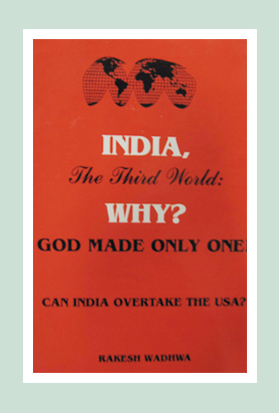
What the readers are saying…