Don, you are wrong about taxes
In response to my December 27, 2004 article advocating reduction in taxes, Don Michaels sent a letter, published in THT, making a case for an increase. Let us analyze each of his arguments.
Don’s first contention is that even if taxes are reduced businessmen will not reduce prices. Don is right that when taxes go down, the prices may not immediately go down, but, in general goods are available at a cheaper rate to consumers in a lower taxed nation than in a high one. Isn’t zero or very low taxes the reason that countries like Singapore and Hong Kong boast of the world’s highest per capita trading volumes as well as living standards which are the envy of those of us in the 3rd world?
Further, high prices due to high taxation reduce demand and thus lower economic activity in the country. If Don, you can afford to buy a Toyota RAV 4 for Rs.20 lakhs, you may not, perhaps, be willing to buy it when taxes result in it being priced at Rs.40 lakhs.
Does Don really believe that if duty rates are brought to zero from say 100% prices will stay the same? How can they? Competition amongst sellers ensures that the consumers get their reductions fast.
Second point made by Don is that, “governments use taxes to build infrastructures; without them nations cannot progress”. I do agree with the later part of the sentence. Nepal does need infrastructure, desperately so. However, if anyone thinks that government taxes result automatically in building infrastructure, that person is dreaming.
A committed socialist like Rajiv Gandhi stated that not more than 15% of what government collects is spent on what the collection is for. 85% or more just disappears in funding the government machinery and in corruption. Why not let the private sector do the job? Why not allow foreign and domestic investment to be utilized for building of roads, airports, communication networks, and power plants?
In India when government regarded telephones as infrastructure people had to wait for years to obtain a connection. And if you did manage to get one it was just that one model made by a government factory and had to be black. When a member of India’s Parliament complained about his instrument not working to the Minister, he was told that only the ‘lucky’ few got telephones as India was poor and there were no funds for ‘luxuries’. Now India’s private companies are not only supplying phone connections by the millions each month, but, are also contributing thousands of crores in taxes to the government.
Don your argument regarding infrastructure doesn’t hold water. Tax money is people’s money, if it is not collected by government it would be available for whatever people desire including infrastructure. To allocate resources is the work of capital markets not government bureaucrats and politicians.
Thirdly, Don says, “As for ‘taking’ money from the rich, who is it that creates the wealth of a nation? Is it a CEO in his plush office or the worker on a construction site, factory, mine or farm?” The implication here clearly is that the worker builds wealth, the businessmen contributes nothing.
This contention displays such ignorance of the wealth generating process that all other arguments of Don pale in comparison. How can anyone even think that a worker without capital, or managerial resources, can produce wealth? Far from it.
If workers could produce wealth on their own then Nepal would be as rich as the US. Does Thapa, a porter, in a remote mountain village at Lukla work harder, or, Smith, an elevator operator, in New York’s Waldorf Astoria Hotel? Thapa in Lukla barely survives, Smith in New York with 1% of the effort owns a car, an apartment, and flies for a holiday to Mexico each year. If Thapa in the Himalayas expended the same effort as does Smith, Thapa would surely starve.
Don, productivity and wealth are the result of capital and capital is destroyed by taxes. Businessmen are required, for they bring in this much needed capital; without them, there would be no site on which to construct, no factory, no mine, and no farm except for subsistence hand to mouth agriculture.
The Himalyan Times
Bush, Kerry, and Taxes
Ajay Bajracharya, marketing team leader of an NGO, ‘Smallholder Irrigation Market Initiative’ in Jawalakhel, is disappointed. He, like so many others in Nepal, was hoping that Kerry would become the President of the US. Ajay was opposed to Bush’s reduction of taxes for the wealthiest 2% of the taxpayers in the US.
Ajay felt that Bush favoured the rich. It didn’t matter to him that Kerry is married to a billionaire heiress to the ‘Heinz ketchup’ fortune. Kerry’s promise to increase taxes for those earning over US$2,00,000 a year was enough for Ajay. For him taking money from the rich shows that you are for the poor and the downtrodden. If it could only be that simple!
Many people feel the same and populist governments round the world, with a few notable exceptions, make policies to ‘squeeze’ the rich. India, during Indira Gandhi’s regime, had the dubious distinction of having the highest tax rates in the world. The income tax on the wealthiest was over 90%. This burden when combined with wealth, gift, and death taxes exceeded 100% of the taxpayers income in several instances.
If, as Ajay believes, this is automatically good for the poor, then Mrs. Gandhi would have succeeded in wiping off poverty from the face of India. Exactly the reverse happened. Tax collections did not increase, foreign exchange reserves remained chronically short, and India’s economy stopped growing. Unemployment and poverty became synonymous with India.
What happened? The rich refused to be sitting ducks. They rebelled against their enforced martyrdom at the hands of Mrs. Gandhi’s egalitarian philosophy. They evaded taxes, sent their capital to Swiss banks, or simply stopped working.
Now, lets turn to those countries which either had low taxes to start with or reduced them. They become fabulously rich. 11 of the world’s 16 wealthiest jurisdictions are tax havens. The top five are Bermuda, Luxembourg, Switzerland, Liechtenstein, and the US.
What about the ‘evil’ corporations, should they be made to part with at least 50% of their profits? The case of Ireland is instructive. 20 years ago Ireland was Europe’s shame. Its economy was in shambles; double digit unemployment had become the norm. It was Ireland’s onerous tax policy which was, to a significant extent, responsible for this sorry state of affairs. The corporate tax rate was 50%.
This burden on companies was reduced in the 80’s but in 1991 it was still considerable at 43%. At this point, the Irish leaders showed vision and guts. TAXES, all around were cut.
Over the next 10 years, taxes on companies were slashed drastically. Today the income tax on companies is 12.5%, one of Europe’s lowest. If we buy into Ajay’s argument then these cuts should have made the rich richer and the poor poorer.
Nothing of that sort transpired. The Irish economy went from being ‘the sick man of Europe’ to become a ‘European tiger’. Unemployment dropped by 50%, and investment both foreign and domestic zoomed. The economy in the 90’s showed the highest rate of growth – 7.7% each year – amongst all the developed countries.
The people of Ireland (hope Ajay is reading this) were the biggest winners. The Irish, who were Europe’s poor, now enjoy the second highest standard of living in that continent.
Did the government lose revenue due to these cuts? No. At a 50% rate, corporate taxes raised revenue equal to 1% of GDP. With the rates at 12.5%, the government gets 4% of GDP from the corporate income tax. The ‘evil’ corporations are now bearing a fourfold higher burden as a result of taxes being reduced to a fourth of what they were.
There might be valid reasons for Ajay to support Kerry but increase in taxes should not be one of them. Run away from politicians who promise increased taxes for that’s the way to poverty. Support those who will limit the burden of government not enhance it.
It is for sake of Nepal’s poor that we should cut taxes. The rich will always manage, it is for the disadvantaged that lowering of taxes may mean the difference between living and dying.
The Himalyan Times
Drugs: How Regulations Kill
The year 2004 has been a bad one for the big drug companies of this world. It has been a particularly trying year for Merck, one of the world’s biggest drug manufacturers. Merck share price dropped from its peak of $95 in November 2001 to US$27 in November, 2004. This means that the company is worth US$60 billion vs US$200 billion it was worth just three years ago.
The reason for Merck’s pain is its blockbuster arthritis drug Vioxx. Merck has had to pull it off the market. Worse, Merck faces liability potentially running into tens of billions of dollars which it would have to pay to the users of Vioxx.
In a study conducted by Merck, it appeared that users of Vioxx faced a slight increase in risk of getting a heart attack. Merck decided to make the study public and, in keeping with its high ethical standards, also recalled Vioxx. Stores have sent the medicine back to the company and so have consumers. They are entitled to a full refund.
There is do doubt that Merck is seriously wounded. Swarms of lawyers in the US smelling blood have sprung into action. They have begun the process of collecting names of all Vioxx users. Cases will be filed on their behalf against Merck. It is possible that every user will be entitled to damages whether or not he has been harmed.
Those who have suffered heart attacks will probably be awarded damages in tens of millions of dollars. If someone has died while taking Vioxx, it is conceivable that Merck may be liable for a 100 million dollars in damages. It is now certain that Merck will end up paying billions of dollars to settle claims against it.
Persons investing in Merck have seen the value of their holdings vaporize. Its shareholders have lost a substantial portion of their wealth. If you bought Merck shares at its peak, you would have witnessed your holdings decline by over 70% in value.
This example illustrates why drug companies in the US have to charge high prices. The risk involved in developing a new drug is just too great. The approval process is time consuming, tortuous, full of pitfalls, and costs a fortune. In the US, the Food and Drug Administration (FDA) which has to approve all drugs takes upto ten years to do so. The company seeking approval may need to spend a billion dollars before it is ready to market its new molecule.
And even this rigorous approval process does not protect a company from liability. It still remains fully liable to users for any untoward effects which may come to light years later. The fact that Vioxx was approved by FDA does not protect Merck from liability in the least bit.
Vioxx has shown to not only Merck shareholders but also to investors in other drug companies as to how severe the liabilities can be. The share prices of other drug companies like Pfizer, Roche, and Bristol Myers have also fallen. In recent years a mere whiff of legal trouble is enough to cause share prices to plunge.
When we complain of mega profits and high prices drug companies charge, we have to take into account the enormous risks they face. Drug prices in the US and worldwide can come down only if the FDA is disbanded and legal liability is limited to actual damages.
For a user of Vioxx to be awarded a million dollars in damages without having to prove actual harm is not reasonable. If he has suffered a heart attack or died, yes a million dollar or even several million dollars may be reasonable compensation.
Reform liability and compensation norms, eliminate regulations to extent possible and we will see cheaper drugs. Will we be sacrificing safety? As we have seen with Vioxx, government approvals by no means guarantee safety, they in fact enhance the danger by providing an illusion of safety when we all know that you should take drugs only if you must. There is hardly any drug which does not have any side-effects.
There are dangers stemming from regulation and limitless liabilities. FDA is going to be even more careful in approving new drugs. New life saving drugs may not be available to the world for decades.
“I think this is really blown out of proportion,” said Dr. Carl Lavie, medical director of preventive cardiology at Ochsner Clinic Foundation, in New Orleans. “I don’t think it’s easy at all to get a new drug approved, and if you start being extremely conservative you stand the risk of taking good medicines from people.
Fewer companies can now afford to develop new drugs. Companies will not market drugs which harm a few even if they substantially help a 100 times more people, since the potential liability for damages far exceeds potential profits. No one is looking at how many have benefited from Vioxx, every lawyer is concentrating on those harmed. Regulations cost far more lives than they save.
It appears that Merck will have to pay damages even if Vioxx users reside outside the US. Are you a user? If you can prove usage you too may become a millionaire. Good luck.
The Boss
Where is the Gas?
It is December 7, 2004 as I write this. America remembers it as ‘a day of infamy’. On this day, 63 years ago the Japanese attacked Pearl Harbour.
For me this is a day of infamy in Nepal. Petroleum products have yet again vanished. Throughout the day, queues of vehicles at gas stations lengthened. It is criminal at this day and age for Nepal’s policy makers to repeatedly subject its citizens to this torture.
It is ironic that even as prices at gas stations worldwide decline as a consequence of a drop of US$10 per barrel in price of oil, Nepali consumers cannot fill up their vehicle tanks. How many times does history have to repeat itself before something is done?
That ‘something’ is getting rid of Nepal Oil Corporation (NOC). And I do mean getting rid of it in double quick time. Government has had privatization plans on the anvil for far too long. It is time for action.
NOC must be sold in a fair and transparent manner. But that alone is not enough. Care must be taken to see that it no longer enjoys any monopoly privileges.
Open up the entire oil sector – imports, distribution, and sales – to competition. Allow any company from anywhere in the world to set up base in Nepal.
It is this competition that will end the shortages, bring quality products, enhance the service at gas stations and bring gas prices in Nepal at par with the international market after adjusting for local taxes.
A major benefit of allowing unfettered competition in Nepal would be to end adulteration of petroleum products. This practice wreaks havoc on the vehicles. When companies have to protect their reputation in the open market they see to it that their gas stations sell only quality products. It is only when you have a government protected monopoly that you couldn’t care less about your customers who don’t have a choice.
Why does the economy of this country have to be repeatedly wracked by government mismanagement? Why is no action taken?
Whereas other countries learn fast, Nepal shows a proclivity to take an unduly long time to absorb the lesson of past failures. It should have been clear to all that NOC can’t meet the expectations of the people. The citizens of this country deserve better than over and over becoming a prey of this government organization.
The US, which is the world’s largest consumer of gasoline, too has faced a situation similar to what Nepal faces today. However, that was during the time of one of America’s least economically savy President, Jimmy Carter. He believed in the ‘Whitehouse’ micro-managing everything from the distribution and pricing of oil to rescue of hostages in Iraq. He was a failure and lost the election to Ronald Reagan. Shortly after Reagan took office in January of 1981, he reversed Carter’s actions.
Reagan did this by removing price controls on oil and ending the practice of allocating oil by government fiat. The results confounded Carter and his supporters. They had said that eliminating the price ceiling on oil would result in an unacceptable increase in prices people would have to pay at the pumps.
Did this happen? The results were the reverse of what Carter expected. Deregulation freed the market, ended shortages, queues at gas stations vanished overnight, and best of all the price of oil dropped.
Though prices in the US go up and down in response to international fluctuations, no President since Reagan has ever instituted government ownership or control over oil flows. And the American people have never had to queue up at pumps again.
Private companies in America are adept at fulfilling the needs of their customers. Gas stations are sparkling clean, display prices prominently and many have department stores on premises. And customers have a choice. If you don’t like the service of one you can go to another. Each oil company – Texaco, Chevron, Exxon and many more – have their own or franchised gas stations.
Should the Nepali consumer not be pampered with similar levels of service and have the same choice as his American counterpart?
The Himalyan Times
Copy China, Not India
The world has woken upto what is happening in China. In the last two years, every international business magazine has done at least one cover story on China. ‘Fortune’ not only put China on the cover in its special October 11, 2004 issue, but devoted the entire magazine to it. ‘Times’ cover had Chinese gymnasts on it in its August 16, 2004 issue. ‘The Economist’ has featured China on its cover in each of the last three months; China’s growing pains were in the August 21-27 issue, September 25 – October 1 featured Chinese leaders, and the November 20–26 reported on China’s growth spreading inland.
Why all this attention? China, in the last century, was largely ignored by the world. The only time the world leaders took note of this country was when it invaded Tibet. Today, any country which ignores China does so at its own peril.
The reason is that China’s 1.3 billion people are beginning to matter. China has become one of the world’s largest market for most goods, it is also one of the world’s principal exporters. China’s demand for oil is insatiable. In 2003, it surpassed Japan to become the world’s largest buyer of oil after the US.
What accounts for its economic clout? The answer lies in the phenomenal growth of the Chinese economy since the 1970’s. In the last three decades China has been growing at 10% per year: This double digit growth has propelled it to the status of an economic superpower.
At a growth rate of 10% an economy doubles itself every seven years. That means in 14 years, the economy quadruples, and in 28 years the economy’s size grows to 16 times of what it initially was. Give the country another 7 years of 10% growth, it will double again becoming 32 times of what it was at the beginning of period from which we are counting.
This is why China which did not count for much in the 1960’s is starting to matter. The evidence of this growth is everywhere. Each major city in China has thousand’s of skyscrapers. Shanghai’s growth puts New York to shame. Shenzhen is growing faster (over 10%) than the growth rate of Singapore and Hong Kong combined. Little heard Chongqing is the world’s largest city with its 31 million people. It is estimated that $200 billion of private capital will be invested in this city alone in the next 10 years.
China has become the world’s trading hub, its exports and imports are growing at a pace at which it is expected to cross the one trillion dollar mark by 2005. Its trade with the US and Japan already exceeds $250 billion.
China has left India far behind. Indians in the 1960’s enjoyed a per capita income which was higher than that of the Chinese. Not any longer. Each Chinese is today, on average, thrice as rich as each Indian.
The difference would have been even greater had India not started to reform its economy and liberalize in the 90’s. It was a case of too little too late for India. If India has to match China, it needs to do far more.
Double-digit growth rates require investment. Huge amounts of it. China understands this, India is just beginning to do so. China gets $50 billion in foreign investment, India aspires to get 10% of that. India will have to do better, much better, it will have to liberalize more, tax less, reform its labour laws, end its reservation policy for small industries, and bring down its inspector and regulatory raj. In other words India would have to become more like China.
Where is Nepal in all this? Unfortunately, it copied India. It needs to stop doing that. Nepal should align itself with the business friendly policies of China and it too will be transformed as China has been. 35 years of even low double digit growth will propel Nepal’s per capita income from its present US$250 to US$8,000 i.e. each Nepali will then earn, Rs.50,000 a month. Wouldn’t that be transformation for real? If this was to happen, Nepal too would attract the world’s attention as China is.
The Himalyan Times
 Rakesh Wadhwa. Ever since, I was a school boy, I knew India was on the wrong path. Socialism was just not what we needed to get ahead. Government controlled our travel; government controlled our ability to buy and sell; and government controlled our freedom to move our money. My life has focused on the inherent rights people have. When I was in college, I never understood, what the governments meant by their "socialistic attitude". If people are free to buy, sell and move their capital themselves without any restrictions by state, then the welfare of people is inevitable & hence the countries they live in will become wealthy. The government has no right whatsoever, to point a finger at me or my business. I am not a revolutionary. I just want to light up my cigarette and not get nagged about it. I believe in non-interfering attitude to attain more.
 The Bastiat Award is a journalism award, given annually by the International Policy Network, London. Bastiat Prize entries are judged on intellectual content, the persuasiveness of the language used and the type of publication in which they appear. Rakesh Wadhwa won the 3rd prize (a cash award of $1,000 and a candlestick), in 2006.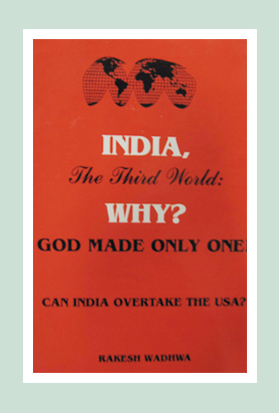

What the readers are saying…