Should Beauty be Penalised?
Sapna Malla Pradhan, Nepal’s foremost women’s right activist is a person I respect. We see eye to eye on a number of issues. Both of us would like to legalize the right of sex workers to pursue their profession. However, there are some issues on which we disagree.
Pradhan is for protecting workers by law, and for men and women once hired to be allowed to stay in their position until retirement. I want the government out of the hiring and firing process, and for employees and employers to decide between themselves what their relationship will be.
Let’s take Hong Kong. Prior to the 80’s, their were no labour laws ‘protecting’ the island state’s worker. Hong Kong absorbed immigrants from mainland China by the millions. Between 1945 and 1987, its population grew from 7,00,000 to 5.6 million – a compounded annual increase of 5.08%. This population explosion was unparalleled in the world’s history.
This increase in manpower was absorbed into the work force easily. Instead of poverty and destitution one might expect, Hong Kong grew at such a pace that its people became richer than those in UK, or Canada. It prospered even as its population zoomed. Its workers, including its women, were fully employed.
Even though Hong Kong, with its 7,000 people for each of its square kilometers, is one of the world’s most crowded places, its per capita income is almost US$ 25,000, Britain’s barely nudges past $22,500. Canada’s people are also behind earning $23,500 annually.
Let’s contrast this with Europe which, with its stringent labour laws, wanted cradle to grave security for its people. Because it was so difficult to fire workers, businessmen in Europe hired only when it became absolutely necessary. Unlike Hong Kong businesses, which hired as soon as they could productively employ someone, the European industrialists waited until it become absolutely clear that additional workers would be required forever. The result was chronic unemployment of 12% or more.
America, which though not as free as Hong Kong, allowed hire and fire subject to some ‘safeguards’. The US unemployment at around 5%, was significantly lower than that of Europe’s, though even it could not match Hong Kong.
If in Nepal we truly want to protect workers and enhance their well being then do not let the law take sides. Let voluntary contracts rule. Adopt business friendly policies and it is competition amongst employers which will continuously raise productivity and the wages of the Nepalese workers.
Why should government force hotels, airlines, and casinos to keep old ladies, when survey after survey has shown that customers prefer smart, young, and beautiful girls to serve them. Is it necessary that RNAC and IA retain aged and overweight airhostesses? Are we reducing unemployment, or are we merely blocking the positions which should go to the young? What would be wrong in explaining to new hirees, that their jobs are for five years and not more?
Don’t we hire men based on their intelligence? Would we want a dumb pilot to fly us, or have a moron perform brain surgery on us? To some God has given brains, to others beauty, and if we let market forces value these traits, what’s wrong?
I want to enquire of Sapna, “doesn’t society and the law accept that, in some fields, beauty and youth are legitimate grounds for hiring?” In movies does a youthful Rani Mukherjee dance, or, does the honour go to elderly ladies? Should the government force filmmakers to hire me in the place of Aishwarya Rai, in the name of equity and fair play?
And should Aishwarya once hired by a movie producer continue to be given work upto the age of 60? Obviously, this doesn’t make sense. It doesn’t make sense to put old and worn out faces on films, TV, or on the ramp for modeling. So, is it sensible to have grandmothers walk up and down the aisles of our national airlines serving us coffee?
It would be best for government to keep out of what should be done by voluntary consent. And as long as we continue to value beauty, the market, which merely aggregates our wishes, will continue to reward it. This, Sapnaji, is ok.
The Himalyan Times
The Communists of India and China
What is happening in Kolkata is enough to make Marx and Lenin turn in their graves. The Indian communists of West Bengal have given up their ideology and are going out of their way to attract capital – Indian and foreign.
Kolkata boasts of India’s largest Pizza Hut outlet, as well as highest selling Sony World franchisee. As if these symbols of capitalism were not enough of a reminder of a changed world, Manabendra Mukherjee, minister of IT, in the state’s communist government can look at Westside and Pantaloon malls on Camac Street from his office.
Bengal, a bastion of India’s communist rulers for 29 years, is witnessing a sea change. The communists remain in power but their philosophy could not be more different. They have embraced pro-market reforms with a vengeance – as if to make up for all their failed policies in double quick time.
Bengal’s government encouraged Pepsi to set up its potato processing plant in the state. Currently the company is doubling its 80 crore investment. The state has now become India’s second largest grower of potatoes. Dabur too has set up a fruit processing plant. Moreover, four companies from France have shown interest in investing in food processing. The communist Chief Minister, Buddhadeb Bhattacharya’s, avowed intention is to obtain investment and he doesn’t care whether it is Indian or foreign.
Though Bengal was always India’s top rice producer, it has now become No.1 in producing vegetables and pineapples as well. This has happened because, unlike in the erstwhile Soviet Russia, farms in Bengal are privately owned and whatever the tillers produce they keep.
No wonder Bengal has stunned India with its growth rates, and turnaround in industrial and agricultural development. In the last decade its economy grew by over 7% a year, while even Karnataka – the state which has Bangalore as its pride – could only manage a 6.4% yearly increase in its domestic product. Gujarat at 6.1%, and Haryana at 5.8% were way behind.
This growth has been led by Rs.27,000 crore of private industrial investment flowing into the state in the last 13 years. This investment was higher than in Maharastra, and second only to that in Gujarat.
The communists now woo private capital as if their lives depended on it. The investment in iron and steel projects is in hundreds of crores. Kolkata exports, from minister Mukherjee’s favourite IT complex, software and BPO services valued at Rs.1,400 crores. What is happening in India’s Bengal is no different than what is taking place in Lenin’s Russia and Mao’s China.
China, especially, exhibits capitalism. Its pro-market and pro-investment policies have gone far ahead of India’s in liberating businesses from red tape and controls. Where as India grew by 6.9% in 2004-05, the figure for China was 9.5%. If we account for what has happened since 1980, China is even further ahead. Its average annual growth of 9.5% exceeded India’s 5.7% by a whopping 3.8% every year.
This extraordinary growth in China has been due to its ability to convince investors to regard it as the ultimate opportunity for profits. While in 2001-03, China garnered in excess of 10% of the global foreign investment, India could not even get to the 1% mark.
China has become the world leader in exporting textiles. The success of its private entrepreneurs sends a chill down the spines of world’s competing businessmen. In 2004 alone China exported US$ 97 billion worth of textiles. India could only manage to send abroad textiles valued at US$ 14 billion.
Textiles are not the only success story. China’s manufacturers, across the board, are bedeviling the world with their newfound aggressiveness in closing deals. They are hungry for domination in the world markets and are leaving their competitors in the dust.
It is ironic the way China has jettisoned the teachings of Marx, Lenin, and Mao. Even more ironic, though, is how, in other countries including Nepal, communists still cling to their failed ideology. Let the Nepalese communist parties send their cadres to Bengal, China and Russia. Let them understand how these places, where communism originated, function. On their return, they just might influence their leaders into embracing capitalism, markets, reforms, and hence prosperity.
The Himalyan Times
 Rakesh Wadhwa. Ever since, I was a school boy, I knew India was on the wrong path. Socialism was just not what we needed to get ahead. Government controlled our travel; government controlled our ability to buy and sell; and government controlled our freedom to move our money. My life has focused on the inherent rights people have. When I was in college, I never understood, what the governments meant by their "socialistic attitude". If people are free to buy, sell and move their capital themselves without any restrictions by state, then the welfare of people is inevitable & hence the countries they live in will become wealthy. The government has no right whatsoever, to point a finger at me or my business. I am not a revolutionary. I just want to light up my cigarette and not get nagged about it. I believe in non-interfering attitude to attain more.
 The Bastiat Award is a journalism award, given annually by the International Policy Network, London. Bastiat Prize entries are judged on intellectual content, the persuasiveness of the language used and the type of publication in which they appear. Rakesh Wadhwa won the 3rd prize (a cash award of $1,000 and a candlestick), in 2006.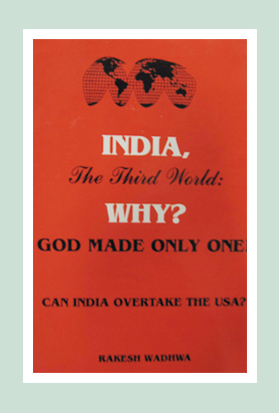
What the readers are saying…