
Some of the Best Casinos Across the Globe
Prior to the worldwide economic downturn, the global casino industry was surging ahead, seemingly unstoppable. Growth records were set between 2004 and 2008, with gross gaming revenues jumping 24% during these four years to US$358.0 billion.
Laissez-Faire Leadership: An Oxymoron?
Also known as delegative leadership, laissez-faire leadership is a ‘hands off’ form of leadership, in which the leader believes in freedom of choice for his team. The leader provides minimal direction to the team and delegates most responsibilities to
Online Gaming: Time to Give it its Due!
In the first part of this article, which you can read here, we discussed the hurdles that online gaming and its legal status have witnessed worldwide. While the size of the widely popular gambling form is difficult to measure, there are a few ways in which the necessary change can be brought about. In this section, we will talk about those factors that can usher in some positive developments in this regard.
Are the Ministries Gambling with Nepal’s Future?
Nepal’s Tourism Ministry, which had backed allowing Nepalese citizens to enter local casinos sometime back, has taken a summersault and back tracked completely. So much so that the ministry now seeks to put a ban on the entry of Nepalis into casinos, as stated in a draft released by the Ministry of Culture, Tourism and Civil Aviation (MoCTCA).
What Lies Between Nepal and Economic Growth?
Nepal is among the poorest nations in the world. It ranks 157 out of 187 countries on the Human Development Index, with approximately 25% of its population living below the poverty line. According a World Bank report, the country’s
Online Gaming: The Omnipresent Phenomenon
It’s ubiquitous and yet it is an elephant in the room. Online gaming is a popular practice throughout the world, despite the national or state regulations that have plagued it for a while.
However, this element of uncertainty surrounding the legalities related to this flourishing sector isn’t a healthy sign for the industry as a whole. Not only does this make it difficult to judge the impact of this sector, it also impedes planning and strategizing for the future.
 Rakesh Wadhwa. Ever since, I was a school boy, I knew India was on the wrong path. Socialism was just not what we needed to get ahead. Government controlled our travel; government controlled our ability to buy and sell; and government controlled our freedom to move our money. My life has focused on the inherent rights people have. When I was in college, I never understood, what the governments meant by their "socialistic attitude". If people are free to buy, sell and move their capital themselves without any restrictions by state, then the welfare of people is inevitable & hence the countries they live in will become wealthy. The government has no right whatsoever, to point a finger at me or my business. I am not a revolutionary. I just want to light up my cigarette and not get nagged about it. I believe in non-interfering attitude to attain more.
 The Bastiat Award is a journalism award, given annually by the International Policy Network, London. Bastiat Prize entries are judged on intellectual content, the persuasiveness of the language used and the type of publication in which they appear. Rakesh Wadhwa won the 3rd prize (a cash award of $1,000 and a candlestick), in 2006.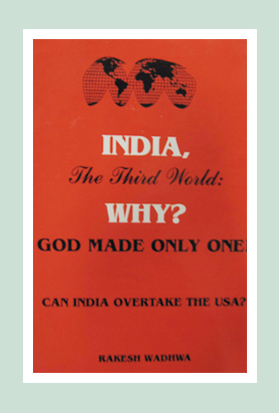

What the readers are saying…