What Power does the Free Market Hold?
“Our society is what we make it. We can shape our institutions,” says Milton Freidman in his book, Free to Choose.
Freidman Explains the Workings of the Free Market
Capitalism is about the flow of money, wealth creation, mobilization of resources and economic drive via innovation. Friedman says that, undeniably, money drives the market and helps expand human freedom. And to this end, we do need government as a facilitator. The role of the government is only that of a catalyst; never a master!

There have been others who promoted this same thought, before Freidman. For instance, Ayn Rand was an advocate of free markets; and she wrote about the virtue of selfishness. The father of economics, Adam Smith, also promoted self-interest, not charity.
A capitalist economic system is about people having the liberty to choose what they want. In such a system, the goal of the state is to protect a person’s property rights, and his or her ability to create wealth and make money. In such an economy, innovators flourish.
Yes, using money, we do create personal wealth, by exchange of goods and services. Capitalism is ultimately about the generation of wealth for the entire society via innovation and the power of the human mind.
The innovators and the competent do become rich, but they become rich only by serving society. Steve Jobs made billions but only because everyone who bought his products, including his iPhones, considered his products to be of a higher value, than the price. For instance, you will buy an iPhone for Rs 40,000, if and only if, the value you obtain from it exceeds the Rs 40,000 you pay for it; otherwise, you will not part with your money.
By this exchange, unless both parties (the buyer and the seller) benefit, the trade does not happen. That is why trade is beneficial. It makes all the parties involved in voluntary trade better off than they were before the trade took place. By its very nature, trade will not happen if either party stands to lose.
The Power of the Market: Milton Friedman
In his book, Freidman takes a more traditional example to describe a capitalistic economy. He talks about how the wood from the northwest forests in America is shipped to Indonesia to make pencils. The finished product then comes back to America, where people exchange money for it. All this activity happens in a voluntary basis with no critical figure guiding the show. This is the invisible hand of Adam Smith at work, providing us with all that we need and can pay for.
Let us take a more modern example; coming back to the iPhones, which are “Designed in California, Assembled in China.” We all know iPhones are not manufactured in America, but the stamp and brains behind it is “All American.” So, how is this supply chain managed? Not by the orders of the central officers, and yet, there is no disarray.
Adam Smith explains – He says that in free market cooperation, the voluntary coordination between the buyers and sellers mobilizes economy. We shape society via our own interests, creating wealth for the economy as a whole. The price system regulates the market, by transmitting information, price discovery, and income distribution.
“Physical and human characteristics limit the alternatives available to us. But none prevents us, if we will, from building a society that relies primarily on voluntary cooperation to organize both economic and other activity…,”concludes Milton Freidman, in a chapter called The Power of the Markets, in his book, Free to Choose.
 Rakesh Wadhwa. Ever since, I was a school boy, I knew India was on the wrong path. Socialism was just not what we needed to get ahead. Government controlled our travel; government controlled our ability to buy and sell; and government controlled our freedom to move our money. My life has focused on the inherent rights people have. When I was in college, I never understood, what the governments meant by their "socialistic attitude". If people are free to buy, sell and move their capital themselves without any restrictions by state, then the welfare of people is inevitable & hence the countries they live in will become wealthy. The government has no right whatsoever, to point a finger at me or my business. I am not a revolutionary. I just want to light up my cigarette and not get nagged about it. I believe in non-interfering attitude to attain more.
 The Bastiat Award is a journalism award, given annually by the International Policy Network, London. Bastiat Prize entries are judged on intellectual content, the persuasiveness of the language used and the type of publication in which they appear. Rakesh Wadhwa won the 3rd prize (a cash award of $1,000 and a candlestick), in 2006.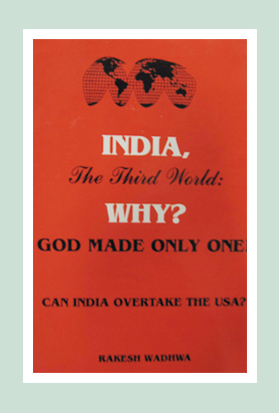
What the readers are saying…