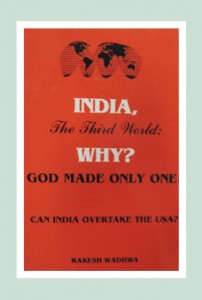
INDIA, The Third World: WHY?
GOD MADE ONLY ONE!
CAN INDIA OVERTAKE THE USA?
India’s potential is held back by bureaucracy, red tape and outdated socialist thinking. Yet the country has the resources and ability to become a great, prosperous nation and even overtake the USA and generate long-term wealth for all. Achieving this requires abandoning Nehru’s socialism in favour of free-market capitalism. By removing strict government controls and adopting a bold, futuristic vision, the nation can shed outdated ideologies and restore its former glory as the “Golden Bird.” The book calls for India to abandon tired ideology and pursue economic reform boldly and decisively.

The Deal Maker
The book follows Sudesh, an honest policeman’s son who dreams of reforming India. After his father’s death exposes the failures of the system, Sudesh joins a multinational company and learns about libertarianism, free markets, business and investment. This novel critiques India’s economic landscape, advocating for democracy and individual freedom. Through his journey, it explores India’s political and economic realities and champions democracy, freedom and reform. Sudesh ultimately takes on the responsibility of becoming a deal maker who can break the shackles holding India back and restore its prosperity.
Going Abroad
This is a practical guide for Indians considering travel, work, study, business or permanent settlement overseas. It explains why people migrate (for better income, education, freedom, security and business opportunities) and how to choose a destination. The book then outlines passports, visas, immigration routes and residency requirements, with country-by-country guidance on the US, Canada, UK, Germany, Australia, New Zealand, the Middle East, Japan and Singapore. Its central message is that informed planning can turn emigration into a realistic route to greater opportunity and a better life.
The Joy of Gambling
This book draws on history and international experience to presents a case for replacing India’s restrictive gaming laws with legalisation, privatisation and regulation. Legalisation, it says, can protect consumer choice, generate investment, jobs and tax revenue, boost tourism and weaken organised crime. Finally, Internet gambling makes prohibition futile as technology and cross-border access defeat bans. Legalisation can capture benefits, such as boosting tourism, creating jobs, defunding organised crime and modernising India’s approach to personal liberty, while addressing harms like problem gambling.
 Rakesh Wadhwa. Ever since, I was a school boy, I knew India was on the wrong path. Socialism was just not what we needed to get ahead. Government controlled our travel; government controlled our ability to buy and sell; and government controlled our freedom to move our money. My life has focused on the inherent rights people have. When I was in college, I never understood, what the governments meant by their "socialistic attitude". If people are free to buy, sell and move their capital themselves without any restrictions by state, then the welfare of people is inevitable & hence the countries they live in will become wealthy. The government has no right whatsoever, to point a finger at me or my business. I am not a revolutionary. I just want to light up my cigarette and not get nagged about it. I believe in non-interfering attitude to attain more.
 The Bastiat Award is a journalism award, given annually by the International Policy Network, London. Bastiat Prize entries are judged on intellectual content, the persuasiveness of the language used and the type of publication in which they appear. Rakesh Wadhwa won the 3rd prize (a cash award of $1,000 and a candlestick), in 2006.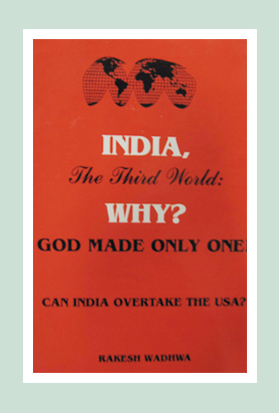
What the readers are saying…