
Chip Subsidies Are Slow. Private Money Moves Faster.
Making semiconductors is expensive. Building a single new chip factory can take years and cost billions of dollars. On the other hand, the global chip shortage of 2020-22 showed how risky it is to rely on imported chips. In

Maritime Supply Chain Adaptations in the Red Sea
Global shipping routes have faced one disruption after another in recent years. First, the Red Sea crisis made container ships seek an alternative route to the Suez Canal.

From Gas Pumps to Gold: How Markets Restore Balance
When oil prices soar or gold reaches a new high, the reaction is immediate. Consumers worry about rising costs, investors prepare for more volatility and politicians look around for someone to blame.

BRICS+ and the “Rial-Rupiah-Real” Pivot
The BRICS (now BRICS+) is now increasingly focusing on its de-dollarisation agenda. This is part of the bloc’s plans to boost local currencies, such as the Iranian Rial, Indonesian Rupiah and Brazilian Real,

Why Gold Prices May Keep Falling if the US-Iran War Continues
Although 2026 began on a positive note for the financial markets, things suddenly changed with the news of coordinated airstrikes on Iran on February 28, 2026. Under such circumstances, one would have expected the

Wish to Build an Innovative Company? Fire Your Innovation Officer
If you want your company to invent the “next big thing,” your first instinct might be to hire a Chief Innovation Officer (CINO). It looks great on a press release.

Argentina’s Shift to Free Market Policies Is Starting to Pay Off
From a $20 billion bailout deal with the IMF in April 2025 to the same agency projecting GDP growth for the year at 5.5% in August, Argentina has certainly come a long way.

Economic Nationalism Will Be Detrimental to Global Economic Growth
After a long and tedious history, Economic Nationalism (a focusing on domestic interests and following protectionist policies) had been shelved my most countries.
Ease of Doing Business Can Propel India’s Trajectory to Becoming the Third Largest Economy
India has long maintained a track record of being among the fastest-growing economies worldwide. The latest

SWIFT: Time to Break Free from Centralized Oversight of the West?
The Society for Worldwide Interbank Financial Telecommunications (SWIFT) is the most widely used messaging network today to facilitate financial transactions between banks and other financial institutions.
 Rakesh Wadhwa. Ever since, I was a school boy, I knew India was on the wrong path. Socialism was just not what we needed to get ahead. Government controlled our travel; government controlled our ability to buy and sell; and government controlled our freedom to move our money. My life has focused on the inherent rights people have. When I was in college, I never understood, what the governments meant by their "socialistic attitude". If people are free to buy, sell and move their capital themselves without any restrictions by state, then the welfare of people is inevitable & hence the countries they live in will become wealthy. The government has no right whatsoever, to point a finger at me or my business. I am not a revolutionary. I just want to light up my cigarette and not get nagged about it. I believe in non-interfering attitude to attain more.
 The Bastiat Award is a journalism award, given annually by the International Policy Network, London. Bastiat Prize entries are judged on intellectual content, the persuasiveness of the language used and the type of publication in which they appear. Rakesh Wadhwa won the 3rd prize (a cash award of $1,000 and a candlestick), in 2006.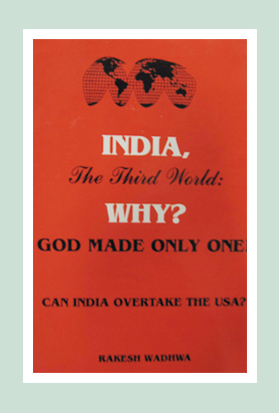
What the readers are saying…