BRICS+ and the “Rial-Rupiah-Real” Pivot
The BRICS (now BRICS+) is now increasingly focusing on its de-dollarisation agenda. This is part of the bloc’s plans to boost local currencies, such as the Iranian Rial, Indonesian Rupiah and Brazilian Real, apart from supporting the Chinese Yuan, Russian Ruble and Indian Rupee. With India holding the BRICS presidency in 2026, de-dollarisation is likely to move from political rhetoric into reality.
For decades, the US dollar has been the basis of global commerce. If a Brazilian farmer wanted to sell soybeans to an Indian processor, they would have to swap reals for dollars, route the transaction through a correspondent bank in New York via the SWIFT network, and then swap those dollars for rupees. Here, each step is a point of friction, marked by fees and geopolitical vulnerability.
Then came the BRICS Local Currency Settlement (LCS) framework. It is a fully unified, bloc-wide payment system that is being actively rolled out. This is likely to play a key role in the “Rial-Rupiah-Real” pivot.
The Rise of Alternative Rails
The pivot to local currencies will be built on UPI-style integrations. The Reserve Bank of India (RBI) has formally proposed linking Central Bank Digital Currencies (CBDCs) across BRIC+ members to ensure interoperability between these digital currencies, like India’s e-Rupee and Brazil’s Drex.
The Bloc has already connected India’s UPI with systems like UAE’s AANI and Russia’s MIR to create what can be seen as a multipolar payment rail. It is called BRICS Pay. This is a decentralised alternative to SWIFT and it offers real-time settlement without depending on the Western-led messaging systems. BRICS Pay is already growing rapidly. In fact, intra-BRICS trade grew to more than $600 billion in 2025.
Democratising Currency for SMEs
There is a hidden cost of using the dollar as a middleman. Let’s call this the “dollar tax.” This tax includes transaction fees, clearing delays and liquidity risk – the dollar could suddenly strengthen against local currencies.
The true impact of the pivot to local currencies will be felt by small and medium enterprises (SMEs). These businesses have historically been the biggest victims of the dollar-denominated system. For a large conglomerate, a 2% currency conversion fee may feel like a rounding error. But for a small business, it can be the difference between being profitable and becoming insolvent.
For countries like India and the UAE, which saw bilateral trade rise to $100.05 billion in FY2024-25, switching to a local currency-based settlement system will hugely reduce transaction times and exchange rate risks.
BRICS+ is not just democratising currency by enabling direct local-to-local trade but also levelling the playing field. Now, a Nigerian tech startup can hire Indian developers or a Brazilian boutique can source materials from the Middle East without needing to go through a high-priced conversion desk from a Western intermediary bank.
But critics argue that this transition to local currencies will lead to the fragmentation of the global market. They believe it would divide the world into multiple financial islands, where capital cannot flow freely, which would reduce global liquidity. However, from the perspective of the Global South, which accounts for 40% of the global GDP, this isn’t fragmentation; it’s liberation.
In fact, by reducing the “tax” of dollar-denominated banking, the free market would actually expand. New corridors of trade, that were previously too expensive or too risky to navigate, would open up.
The 2026 Outlook
As we move through the second quarter of 2026, the success of the “Rial-Rupiah-Real” pivot will be measured by volume. If these local currency rails can maintain stability, we will witness the birth of a post-dollar trade era. The global market may be splitting, but for millions of entrepreneurs in emerging economies, it is finally starting to work in their favour. The dollar remains a dominant force, but it no longer has a monopoly on the rails of global commerce.
Beyond state-backed digital currencies and local settlement systems, decentralised assets like Bitcoin introduce a fundamentally different paradigm. Over time, Bitcoin could evolve into the world’s first truly transparent and absolutely neutral currency, operating beyond the control of any single nation or bloc.
 Rakesh Wadhwa. Ever since, I was a school boy, I knew India was on the wrong path. Socialism was just not what we needed to get ahead. Government controlled our travel; government controlled our ability to buy and sell; and government controlled our freedom to move our money. My life has focused on the inherent rights people have. When I was in college, I never understood, what the governments meant by their "socialistic attitude". If people are free to buy, sell and move their capital themselves without any restrictions by state, then the welfare of people is inevitable & hence the countries they live in will become wealthy. The government has no right whatsoever, to point a finger at me or my business. I am not a revolutionary. I just want to light up my cigarette and not get nagged about it. I believe in non-interfering attitude to attain more.
 The Bastiat Award is a journalism award, given annually by the International Policy Network, London. Bastiat Prize entries are judged on intellectual content, the persuasiveness of the language used and the type of publication in which they appear. Rakesh Wadhwa won the 3rd prize (a cash award of $1,000 and a candlestick), in 2006.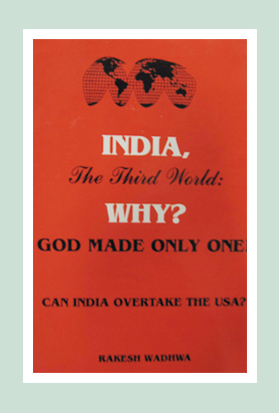
What the readers are saying…