Why Gold Prices May Keep Falling if the US-Iran War Continues
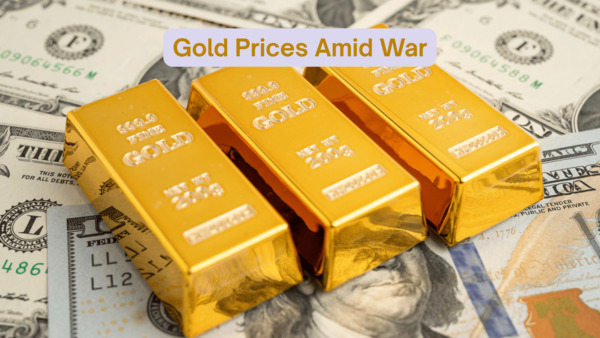
Although 2026 began on a positive note for the financial markets, things suddenly changed with the news of coordinated airstrikes on Iran on February 28, 2026. Under such circumstances, one would have expected the demand for gold, the traditional “safe haven”, to skyrocket. But the story of gold prices since the beginning of March has been anything but predictable. Instead of soaring, we saw a “golden paradox,” where gold prices appeared to prefer the basement to the penthouse.
A Wild Ride for Gold
Gold started 2026 on a high, hitting an all-time record of $5,595 per ounce on January 29, 2026. This was a continuation of the bull run of 2025, fuelled by the persisting geopolitical tensions.
When the US-Iran conflict started, gold prices moved as expected – there was a spike. By March 2, the precious metal was once again rising towards a new high, trading near $5,419. But this uptrend was short-lived. By late March, gold suffered its steepest monthly decline since the 2008 financial crisis, falling to the $4,100-$4,400 range, representing a sharp decline of 20%-25% from its record high in January. As of April 14, 2026, the yellow metal stabilised slightly near $4,780, but the bearish pressure remained palpable.
Why Did Gold Fall During a War?
Falling gold prices sounds counterintuitive, given that geopolitical tensions usually drive the price up. Here are the three main reasons why gold lost its shine:
1. Dollar Dominance
When global uncertainty rises, investors run to safety. In the US-Iran conflict, the US dollar became the go-to safe haven. Since gold is priced in US dollars, a stronger greenback makes gold more expensive for international buyers, naturally dampening demand.
2. Inflation-Interest Rate Trap
Earlier this year, the Federal Reserve was looking to cut its benchmark interest rates. However, the war caused energy prices to rise sharply. This led to speculations of the Federal Reserve adopting a “higher for longer” stance for interest rates. In a higher interest rate environment, the demand for the non-yielding yellow metal typically falls. Investors would rather hold a bond that pays 5% than a gold bar that offers neither interest nor dividends.
3. Margin Call Chaos
In March 2026, institutional investors resorted to what experts call “forced selling.” When volatility rises in the stock and oil markets, large investors often lose money on their other trades. To cover those losses (and the associated margin calls), they sell their most liquid assets, which is often gold. So, gold falls not because it is no longer a safe haven but because it’s the only thing people can sell to raise cash quickly.
What Analysts Predict
Despite the recent price declines, analysts are split on whether gold is trading at a discount now and will rise as the year progresses or is on its way out as a safe haven.
Analysts at Goldman Sachs expect gold to return to about $5,400 by the year-end, believing that the long-term bull case remains intact due to continued central bank buying. Meanwhile, the Swiss private bank, Union Bancaire Privée (UBP), forecasts gold to reach $6,000 by end-2026, stating that its clients are slowly rebuilding their gold portfolios after the initial war-induced slump.
With inflation still high, the Federal Reserve held interest rates steady at its March meeting. Speculations are skewed towards an interest rate hike towards the end of the year. High interest rates weigh on gold demand since gold doesn’t pay interest.
The Bottom Line
If the tensions between the US and Iran continue, the “golden paradox” could persist. While banks like UBP remain optimistic about a $6,000 target, the reality of a soaring US dollar and rising yields could weigh on gold demand. For now, gold isn’t behaving like a safe haven, but if the geopolitical instability worsens, the demand for gold could reemerge, reversing this trend.
So, could gold hit $5,400 by December? Perhaps. But if the US dollar remains king, we might be looking at a floor of $3,800.
 Rakesh Wadhwa. Ever since, I was a school boy, I knew India was on the wrong path. Socialism was just not what we needed to get ahead. Government controlled our travel; government controlled our ability to buy and sell; and government controlled our freedom to move our money. My life has focused on the inherent rights people have. When I was in college, I never understood, what the governments meant by their "socialistic attitude". If people are free to buy, sell and move their capital themselves without any restrictions by state, then the welfare of people is inevitable & hence the countries they live in will become wealthy. The government has no right whatsoever, to point a finger at me or my business. I am not a revolutionary. I just want to light up my cigarette and not get nagged about it. I believe in non-interfering attitude to attain more.
 The Bastiat Award is a journalism award, given annually by the International Policy Network, London. Bastiat Prize entries are judged on intellectual content, the persuasiveness of the language used and the type of publication in which they appear. Rakesh Wadhwa won the 3rd prize (a cash award of $1,000 and a candlestick), in 2006.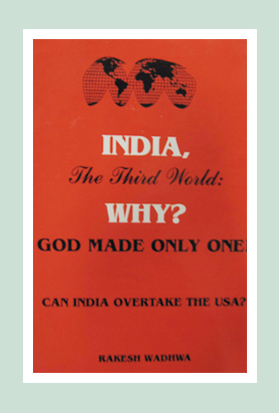
What the readers are saying…