From Conflict to Commerce: The Case for Free Markets Today
The global economy has had to contend with one black swan event after another in the 2020s. From a pandemic that brought the world to a standstill to persisting trade wars and escalating geopolitical tensions that disrupted multiple supply chains, the infrastructure that keeps the modern world moving is under immense strain. State-led interventions only worsened the situation, creating artificial bottlenecks. This once again highlights an important truth: when there’s conflict between nations, it’s only the resilient mechanisms of the free market that can save commerce from total collapse.
Blocked Maritime Veins
The cost of conflict is painfully apparent in the energy sector. The closure of the Strait of Hormuz in March 2026, in response to military escalations between the US and Iran, resulted in blocking one of the world’s most critical maritime veins. This narrow strait is the route taken by 25% of the world’s seaborne oil. The economic impact of its closure was immediate and global. Deprived of normal shipping access, Brent crude oil prices had spiked 51% by March 29, reaching a peak of $126 per barrel, the largest monthly increase in history.
This was not just a crisis for fuel. The blockade triggered a complex energy shock affecting Liquefied Natural Gas (LNG), fertilisers and industrial plastics. According to The Hague Centre for Strategic Studies, the sudden halt exposed deep structural vulnerabilities across Europe and Asia, forcing businesses worldwide to struggle with soaring shipping insurance premiums and disrupted manufacturing lines.
The Return of Aggressive Tariffs
While physical blockades choke the seas, political protectionism is strangling borders. In June 2026, the Trump administration renewed its aggressive trade offensive, proposing additional Section 301 tariffs of up to 12.5% on imports from 60 countries, including major economic partners like China, India and Brazil.
This sweeping policy, designed to rebuild emergency tariffs, after a Supreme Court ruling struck down previous executive measures, threatens to paralyse companies that spent years diversifying their operations. This “tariff stacking” forces businesses to raise costs for ordinary consumers, while treating trusted trading allies like economic adversaries.
The Free Market as a Shock Absorber
In an environment of state-sponsored friction, how do we prevent global economic paralysis? The answer lies in the adaptive power of the free market.
When governments shut down traditional routes, the free enterprise system acts as a dynamic shock absorber. High prices act as a warning sign, driving private actors to innovate. For instance, data indicates that the global energy market is already correcting the Hormuz shock. High prices have spurred fresh oil production in non-OPEC countries like the US, Kazakhstan and Venezuela. Fitch Ratings expects this excess production to lead to an oversupply of oil by September 2026, potentially bringing crude oil prices down to $70 per barrel. At the same time, logistics firms have rerouted supply chains through land-based pipelines to bypass the Persian Gulf.
When tariffs or regional blockades make a specific country’s goods too expensive, private firms immediately exercise their freedom to pivot. This can be seen in the way 65% of supply chain companies responded to recent tariff volatility by changing their sourcing patterns.
Rather than shutting down, businesses shifted production to non-tariff-targeted or closer regions. For example, as automotive tariffs shifted in early 2026, electronics assembly and machinery parts supply chains quickly re-routed toward ASEAN nations and Mexico, bypassing the geopolitical crossfire.
Commerce as a Bridge, Not a Weapon
Free markets democratise economic resilience. While politicians draw rigid geopolitical lines, independent businesses turn to decentralised technology and flexible contracts to build alternative trade corridors. They automatically re-allocate capital to safer jurisdictions, re-engineer product components and find workarounds that state planners could never anticipate.
Geopolitical conflicts and retaliatory tariffs operate on the logic of coercion and isolation. On the other hand, free markets operate on the logic of cooperation and mutual benefit. While states use trade as a weapon, the global marketplace uses commerce as a bridge. To survive the turbulent landscape of 2026, the world does not need more economic fortresses; it needs the flexibility of open markets to turn the tides of conflict back toward the path of shared prosperity.
 Rakesh Wadhwa. Ever since, I was a school boy, I knew India was on the wrong path. Socialism was just not what we needed to get ahead. Government controlled our travel; government controlled our ability to buy and sell; and government controlled our freedom to move our money. My life has focused on the inherent rights people have. When I was in college, I never understood, what the governments meant by their "socialistic attitude". If people are free to buy, sell and move their capital themselves without any restrictions by state, then the welfare of people is inevitable & hence the countries they live in will become wealthy. The government has no right whatsoever, to point a finger at me or my business. I am not a revolutionary. I just want to light up my cigarette and not get nagged about it. I believe in non-interfering attitude to attain more.
 The Bastiat Award is a journalism award, given annually by the International Policy Network, London. Bastiat Prize entries are judged on intellectual content, the persuasiveness of the language used and the type of publication in which they appear. Rakesh Wadhwa won the 3rd prize (a cash award of $1,000 and a candlestick), in 2006.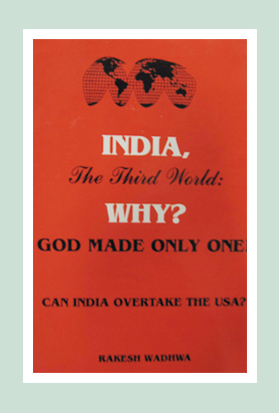
What the readers are saying…