Fragmented Freedom: The Rise of Resource Nationalism

Governments across the world are rewriting the rules of global trade. There was a time, in the not-so-distant past, when raw materials moved easily across borders. Today, that open system is breaking down because countries want more control over their own resources. This resource nationalism is causing supply shortages, driving up prices of essential goods, sparking trade wars and forcing companies to look for local solutions.
The New Playbook of Protectionism
Resource nationalism is a government taking over control of and trying to protect its country’s natural resources. This idea isn’t new. It started during the 1920s-1930s and peaked again in the 1960s and 1970s. Today, it focuses mostly on the minerals needed for modern technology.
In 2025 and 2026, many nations turned to total export bans, strict trade limits and laws that force companies to process materials locally. While advanced economies are now seeking to secure tech supplies, developing nations are looking to capture the highest profit.
The scale of this shift is huge. The Verisk Maplecroft Resource Nationalism Index shows that 47 developing nations have become much riskier for trade over the past five years. Now, more than 33% of the world’s copper comes from these high-risk regions.
Today, many governments are actively choosing protectionism over open markets. On January 1, 2026, Vietnam amended its mining laws, banning raw rare earth exports. Meanwhile, the Democratic Republic of the Congo restricted its cobalt exports, cutting trade quotas to less than half of the recent global levels for 2026 and 2027. In addition, China has tightened export controls on strategic technological minerals.
Market Shocks and Economic Fortresses
These restrictions are leading to global market shocks. By stopping the flow of raw minerals, governments are essentially driving up the price of microchips, green tech and everyday electronics.
As a result, importing nations are scrambling to protect themselves. They are moving away from open trade to building state-funded safety nets. For instance, in February 2026, the US launched “Project Vault,” a $12 billion plan to stockpile critical minerals and shield the American economy from global supply shocks.
Ultimately, resource nationalism destroys economic freedom. It forces businesses to rely on messy political alliances instead of simple supply and demand mechanics. While a few countries gain quick political advantage, consumers pay the bill through higher prices and constant uncertainty.
Economic Pragmatism Over Politics
History shows that the free market can fix this political gridlock. When governments squeeze supply, prices go up. These high prices act as a clear signal, instantly telling nations to search for new mineral mines, build better recycling plants and invent substitute materials. The free market ignores political fights and relies on simple economics. In doing so, it naturally repairs the supply chains that resource nationalism is tearing apart.
 Rakesh Wadhwa. Ever since, I was a school boy, I knew India was on the wrong path. Socialism was just not what we needed to get ahead. Government controlled our travel; government controlled our ability to buy and sell; and government controlled our freedom to move our money. My life has focused on the inherent rights people have. When I was in college, I never understood, what the governments meant by their "socialistic attitude". If people are free to buy, sell and move their capital themselves without any restrictions by state, then the welfare of people is inevitable & hence the countries they live in will become wealthy. The government has no right whatsoever, to point a finger at me or my business. I am not a revolutionary. I just want to light up my cigarette and not get nagged about it. I believe in non-interfering attitude to attain more.
 The Bastiat Award is a journalism award, given annually by the International Policy Network, London. Bastiat Prize entries are judged on intellectual content, the persuasiveness of the language used and the type of publication in which they appear. Rakesh Wadhwa won the 3rd prize (a cash award of $1,000 and a candlestick), in 2006.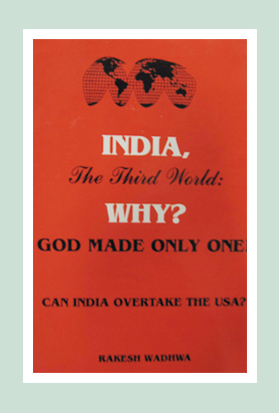
What the readers are saying…