The 1970s Oil Crisis: A Case Study in Market Distortion
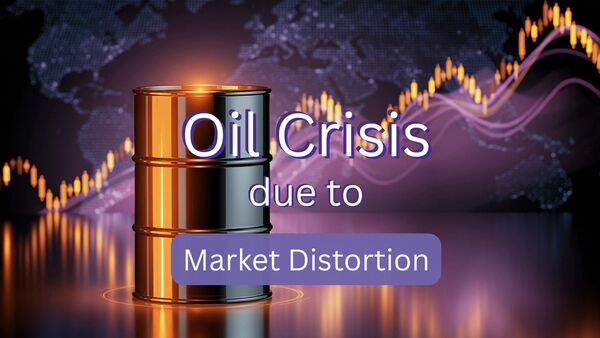
The 1970s oil crisis was perhaps one of the most chaotic chapters in modern history, but it taught us with a crucial lesson in economics. It completely changed how we think about energy, global trade and the limits of government power. What started out as a geopolitical chess move quickly spiralled into a decade-long economic crisis, leaving the Western world with a severe oil shortage.
The initial shock came from foreign embargos on oil. However, the real tragedy was how long the problem dragged on, thanks largely thanks to government interventions that went against the basic rules of the free market.
What Caused the Oil Crisis?
It all started with the outbreak of the Arab-Israeli War in October 1973. When the US decided to resupply the Israeli military, the Organisation of Arab Petroleum Exporting Countries (OAPEC) retaliated by using oil as a diplomatic weapon. The organisation launched an embargo against the US and its Western allies, cutting off direct oil exports and slashing overall production across the Middle East.
Unfortunately, this was also a time when the global energy market was very vulnerable. For decades, the US had enjoyed excess domestic oil production capacity that could step in to stabilise global supply shocks. By 1973, that domestic supply had peaked, leaving the West heavily dependent on oil imports.
The Ripple Effect
The shockwaves spread rapidly through the global economy. Crude oil prices skyrocketed almost four-fold, from $2.90 per barrel before the embargo to $11.65 by January 1974. Oil is the basic commodity that powers most industries, from transport to manufacturing. So, the price hike sparked a huge wave of inflation. Industrialised nations fell into stagflation, with soaring prices and stagnating growth. The crisis highlighted the fragility of global supply chains and led to severe recession in Europe and Japan. Plus, it permanently shifted global financial power toward oil-producing nations.
How Policy Controls Caused the Lines
In an effort to calm the panicked public, governments rushed to intervene, but they only ended up pouring oil on the fire. US President Richard Nixon implemented strict price controls and a rationing system to keep oil prices artificially low for everyday consumers.
Legendary economist Milton Friedman was among the loudest voices warning that this intervention completely cut the wires of the market’s primary communication system: the price signal. Friedman noted that economists knew exactly how to create a shortage: simply pass a law saying a retailer cannot sell a product above a certain price, and a shortage will instantly appear.
Because gas stations were legally forbidden from raising prices to reflect how scarce oil actually was, people had no financial incentive to conserve fuel. Demand stayed sky-high while supply vanished. This artificial imbalance, rather than the embargo itself, created the infamous, miles-long lines at American gas stations.
“We economists don’t know much, but we do know how to create a shortage. If you want to create a shortage of tomatoes, for example, just pass a law that retailers can’t sell tomatoes for more than two cents a pound. Instantly you’ll have a tomato shortage. It’s the same with oil or gas.” — Milton Friedman
The Carter Sequel and the Reagan Cure
The mistake continued into the late 1970s. When the Iranian Revolution triggered a second oil shock in 1979, the administration of President Jimmy Carter maintained a complex web of price deregulation. This took oil prices to a new high of $15.85 per barrel, leading to a resurgence of massive, panicked lines at gas stations, fistfights at the pumps, and a crippling sense of economic malaise.
The gridlock only broke when a fundamentally different economic philosophy took the reins. On January 28, 1981, just days after taking office, President Ronald Reagan signed Executive Order 12287, completely and immediately dismantling all remaining federal price and allocation controls on crude oil and petrol.
Critics at the time warned that deregulation would cause gas prices to instantly double. Instead, the exact opposite happened. The sudden liberalisation allowed the free market to function. Prices adjusted to reflect true market value, which immediately incentivised domestic drilling, unlocked hidden supply and forced distributors to become efficient. Almost overnight, the lines vanished, shortages evaporated, and within a few years, a global oil glut sent fuel prices tumbling.
The Case for a Free Market Approach
Looking back, a free-market approach would have led to a much smoother, less chaotic outcome. If governments had simply let oil prices float based on real supply and demand, prices at pumps would have risen immediately. While that would have hurt at first, that sharp price increase would have naturally led people to conserve fuel, eliminating the need for hours-long lines.
More importantly, high prices would have sent a loud and clear distress signal to investors worldwide. It would have fast-tracked funding into non-OPEC oil exploration and alternative energy tech years before it finally happened. By treating a supply problem as a political crisis to be regulated, policymakers proved a painful truth: state-mandated price caps can do far more damage than the market shocks they are trying to fix.
 Rakesh Wadhwa. Ever since, I was a school boy, I knew India was on the wrong path. Socialism was just not what we needed to get ahead. Government controlled our travel; government controlled our ability to buy and sell; and government controlled our freedom to move our money. My life has focused on the inherent rights people have. When I was in college, I never understood, what the governments meant by their "socialistic attitude". If people are free to buy, sell and move their capital themselves without any restrictions by state, then the welfare of people is inevitable & hence the countries they live in will become wealthy. The government has no right whatsoever, to point a finger at me or my business. I am not a revolutionary. I just want to light up my cigarette and not get nagged about it. I believe in non-interfering attitude to attain more.
 The Bastiat Award is a journalism award, given annually by the International Policy Network, London. Bastiat Prize entries are judged on intellectual content, the persuasiveness of the language used and the type of publication in which they appear. Rakesh Wadhwa won the 3rd prize (a cash award of $1,000 and a candlestick), in 2006.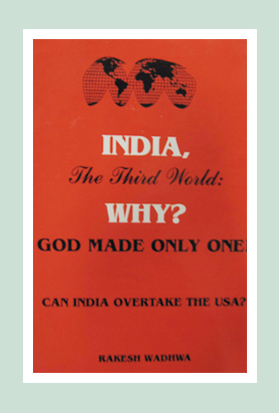
What the readers are saying…