Is Protectionism Wearing a Disguise of Freedom?
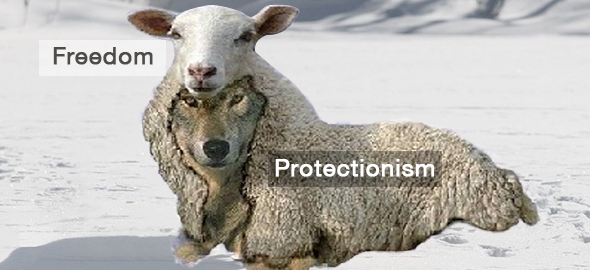
Two years is all it is taking for the Federal Communications Commission (FCC) to do a complete flip and end the short-term ceasefire achieved over the contentious issue of “Net Neutrality”. What is being proposed under the guise of a “free” internet are stricter regulations.
Net Neutrality and Free Markets
Just like a free-market economy thrives in the absence of overbearing regulations, the internet can too if we free it off the discriminatory approach that governments the world over seem to adopt in their desire to control it. Net neutrality has become the holy grail where several internet companies and broadband providers seem to be at loggerheads and each side advocates an open internet in theory but shows little intent on the ground to help achieve this.
What Happened in 2015?
A detailed 400-page document was chalked out by the FCC to outline the guiding principles of Net Neutrality. Internet providers were classified as Title II telecommunications service under the 1934 Communications Act, thereby exposing them to stricter FCC regulations. Some of these measures towards achieving a free, fair and open internet included:
- No Blocking: Broadband service providers were prevented from blocking services, except under emergency situations, such as the Denial-of-Service attack. This was permitted, since it was perceived as a technically justifiable reason to manage traffic, rather than for any commercial reasons.
- No Throttling: New rules were enforced that prevented internet service providers to slow down the speed of any website, application or internet service.
- No Paid Prioritization: It was decided to end discriminatory practices such as putting service providers like Netflix in “fast lanes” in a paid arrangement.
Lifting of Regulations is Being Met with Protests
There could well be a rollback of the protectionist measures being previously undertaken. This would be great news for bigger internet players like Google, which were being curtailed to give way to smaller companies.
However, thousands of companies (yes, all smaller ones!) are protesting the lifting of protectionist measures. Their argument is that the bigger players have created barriers to entry, preventing smaller companies from being able to compete or even survive.
The most important question is: What have these smaller companies really achieved while protectionist measures were in place over the last two years? Have the protectionist measures really given the smaller companies a platform to take off or has protection made them more relaxed and, therefore, complacent? Meanwhile, the bigger companies have become fiercer and fought harder to maintain (and increase) their lead.
How can there be any freedom when a company (irrespective of size) is not permitted to take a course of action that it deems as commercially viable? This seems as ridiculous as thinking Samsung is being unfair to Nokia just because it is paying for running TV ads to increase its lead in the market!
No doubt the internet needs some guidelines in place to prevent unfair business practices. However, one cannot demand “freedom” by curtailing the freedom of others.
 Rakesh Wadhwa. Ever since, I was a school boy, I knew India was on the wrong path. Socialism was just not what we needed to get ahead. Government controlled our travel; government controlled our ability to buy and sell; and government controlled our freedom to move our money. My life has focused on the inherent rights people have. When I was in college, I never understood, what the governments meant by their "socialistic attitude". If people are free to buy, sell and move their capital themselves without any restrictions by state, then the welfare of people is inevitable & hence the countries they live in will become wealthy. The government has no right whatsoever, to point a finger at me or my business. I am not a revolutionary. I just want to light up my cigarette and not get nagged about it. I believe in non-interfering attitude to attain more.
 The Bastiat Award is a journalism award, given annually by the International Policy Network, London. Bastiat Prize entries are judged on intellectual content, the persuasiveness of the language used and the type of publication in which they appear. Rakesh Wadhwa won the 3rd prize (a cash award of $1,000 and a candlestick), in 2006.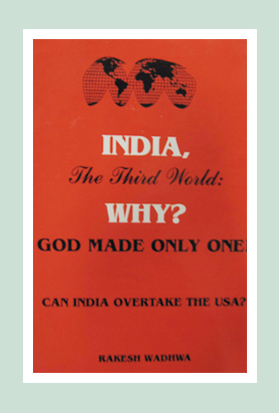
What the readers are saying…