Indian Casino Industry: Can it compete with Nepal?
Nepal has emerged as one of “THE” casino hot-spots during the last decade. In fact, this South Asian country is home to the region’s oldest casino industry. The first casino in Asia was established as far back as 1968 in Nepal. ‘Casino Nepal’ was owned by King Mahendra’s younger brother. During that time, the casino was only accessible to foreigners. This is because the government was afraid that the Nepalese citizens could lose all their earnings if they were allowed to indulge in the casino.
While Nepal has moved on to become a secular republic, having a federal government, it is still not very “welcoming” to the whole idea of casinos. The casinos continue to be off-limits for locals. A Nepali caught gambling illegally or even participating in a legal casino can be fined heftily in case of a first offence. In case of a second or third offence, the guilty could have to serve a prison term of as much a whole year.
However, more than four decades after Casino Nepal steered the casino industry in the nation, several changes have shaken up the spirit of the gambling business in-and-around the region. The country’s capital, Kathmandu, has eight casinos that are open 24-hours. Today, the casino industry is among the top revenue generators in the Nepalese economy.
This brings us to the question; can the Indian casino industry compete with Nepal?
The Indian Wave Rises
At present, casinos are considered legal only in the states of Sikkim and Goa. However, the union territory of Daman is all set to get a piece of the action soon. Sikkim is host to one casino, while Goa has 12- of which five are floating and seven are land-based (in five-star hotels). All the casinos offer standard games, such as Baccarat, Blackjack, Roulette, Poker and Pontoon. The chips need not necessarily be bought with Indian Rupee. Most of these casinos are extremely high-end, and accept common western currencies like the US Dollar, Euro and UK Pound.
A recent industry report stated that- while the casino industry in regions like Philippines, Singapore and Macau are expanding at an annual rate of 30 to 40 percent, the revenue from casinos in Goa is growing at a much impressive rate of 50 percent per annum. Clearly, the Indian casino industry has made its mark in the terrain. Although it might have started out late, it seems to be making up for its tardiness nonetheless.
 Rakesh Wadhwa. Ever since, I was a school boy, I knew India was on the wrong path. Socialism was just not what we needed to get ahead. Government controlled our travel; government controlled our ability to buy and sell; and government controlled our freedom to move our money. My life has focused on the inherent rights people have. When I was in college, I never understood, what the governments meant by their "socialistic attitude". If people are free to buy, sell and move their capital themselves without any restrictions by state, then the welfare of people is inevitable & hence the countries they live in will become wealthy. The government has no right whatsoever, to point a finger at me or my business. I am not a revolutionary. I just want to light up my cigarette and not get nagged about it. I believe in non-interfering attitude to attain more.
 The Bastiat Award is a journalism award, given annually by the International Policy Network, London. Bastiat Prize entries are judged on intellectual content, the persuasiveness of the language used and the type of publication in which they appear. Rakesh Wadhwa won the 3rd prize (a cash award of $1,000 and a candlestick), in 2006.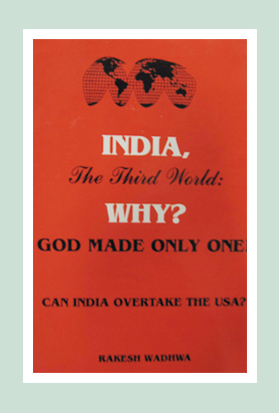
1 Comment
Owye
February 14, 2012showing us all drfiefent sides to it. Youre a great blogger. Please keep it up. I cant wait to read whats next.