The Geopolitics of Friend-Shoring: Free Markets in a Divided World

The global economy is changing fast. For decades, companies sought the lowest-cost producer. This was the core idea of the free market. Now, a new priority is taking over: geopolitical reliability. This shift is called “friend-shoring,” or moving supply chains to politically friendly countries.
Governments and companies are equally wary of rivals and wish to reduce their dependence on them. So, they move manufacturing to nations that are political allies that share similar values or trade agreements. The preference, therefore, has shifted to the “safest” producer rather than the cheapest one.
This trend is bringing about inefficiencies, as cost is no longer the single most important driver. National security and political trust now shape economic decisions.
The Rise of Connector Countries
Friend-shoring is boosting investment in “connector countries.” These are nations that act as intermediaries, since they are perceived as reliable trade partners. They receive investment from US, European, and even Chinese companies. Chinese companies, in turn, invest to bypass US tariffs, assembling their goods in a connector country. Then they export the final product to the US. This makes the supply chain more complex but politically safer.
Mexico and Vietnam are two prime examples of connector countries. They are seeing a sharp increase in foreign direct investment (FDI) due to friend-shoring. In the first nine months of 2025, Mexico’s FDI crossed $40.9 billion, higher than the total FDI for all of 2024. In fact, new investment in the first nine months of 2025 was over 200% higher than in the same period in 2024.
Similarly, Vietnam is a key beneficiary in Southeast Asia. FDI in the country rose 8.9% year-on-year to reach $23.6 billion in the first eleven months of 2025.
Major corporations are also making concrete friend-shoring moves. For instance, Apple has been moving some iPhone production from China to India. Semiconductor manufacturers are also relocating production to allied nations to reduce dependence on regions with volatile relations.
Companies are not just looking for lower wages. They are looking for stable governments and strong legal frameworks to reduce the risk of sudden trade disruptions.
The Cost of Security
Yes, friend-shoring provides security and resilience. But this security comes with an economic cost.
Decisions based on political alignment often lead to higher production costs. These higher costs are usually passed on to the consumer. According to the IMF, friend-shoring could result in a “more fragmented global trade network,” along with up to a 2% loss to the world’s GDP.
The friend-shoring trend will affect some sectors more than others. The semiconductor industry is perhaps the most visible battleground for friend-shoring. Chips are the essential components for everything from military hardware and AI to consumer electronics and cars. But the global supply chain for advanced chips is highly concentrated, with Taiwan-based TSMC and South Korea’s Samsung dominating cutting-edge manufacturing. Geopolitical tensions in the APAC region create immense risk for global technology supply.
Due to this, governments are pouring billions into creating secure, allied supply chains. For instance, the US CHIPS and Science Act offers $52.7 billion in federal subsidies to boost domestic and allied manufacturing. The goal is to reduce reliance on potentially vulnerable or adversarial production hubs and ensure allies have guaranteed access to advanced computing power. But we already know that subsidies have a detrimental impact on the economy.
Another sector seeing a rise in friend-shoring is electric vehicles (EVs) and batteries. The industry is critically dependent on the supply of critical minerals and processing capacity. China currently holds a dominant position in the EV battery supply chain, especially in the processing of critical minerals like lithium, cobalt, and graphite, and the manufacturing of anode and cathode materials. Dependence on China for these inputs creates a national security vulnerability for the West.
Due to this, policies are being designed to build a secure, Western-aligned battery supply chain from mining to final assembly. The US Inflation Reduction Act (IRA) provides consumer tax credits for EVs only if a certain percentage of the battery components and critical minerals are sourced from the US or countries with which America has a Free Trade Agreement (FTA).
The Outcome: Rise of Geoeconomic Blocs
The single, interconnected global free market is breaking down. It is being replaced by geoeconomic blocs, which are groups of countries that prioritise trading and investing with each other. This is leading to the global economy becoming increasingly fragmented. Trade and investment flows are being redirected along geopolitical lines. Such fragmentation stifles global productivity and knowledge diffusion. It disproportionately hurts developing economies that are outside these major blocs. They lose opportunities for investment and growth.
The new global economic map is one of rivalry and resilience and economic ties are now a tool of statecraft.
 Rakesh Wadhwa. Ever since, I was a school boy, I knew India was on the wrong path. Socialism was just not what we needed to get ahead. Government controlled our travel; government controlled our ability to buy and sell; and government controlled our freedom to move our money. My life has focused on the inherent rights people have. When I was in college, I never understood, what the governments meant by their "socialistic attitude". If people are free to buy, sell and move their capital themselves without any restrictions by state, then the welfare of people is inevitable & hence the countries they live in will become wealthy. The government has no right whatsoever, to point a finger at me or my business. I am not a revolutionary. I just want to light up my cigarette and not get nagged about it. I believe in non-interfering attitude to attain more.
 The Bastiat Award is a journalism award, given annually by the International Policy Network, London. Bastiat Prize entries are judged on intellectual content, the persuasiveness of the language used and the type of publication in which they appear. Rakesh Wadhwa won the 3rd prize (a cash award of $1,000 and a candlestick), in 2006.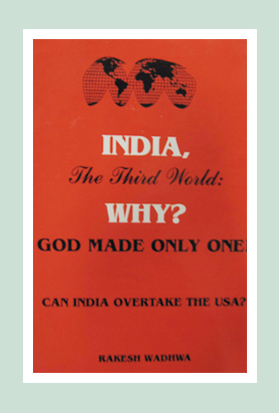
What the readers are saying…