
Gambling – A Boon or A Curse?
Gambling in India seems to have a negative connotation. The very mention of the word conjures up images of people losing their life’s earnings (and even their wife… courtesy The Mahabharata). Gambling is perceived as an addiction that could lead to misery. Is that what gambling is all about?
Asian Casino Industry: A Good Bet?
Despite most countries across the globe struggling to emerge from depression and financial crisis, the Asian casino industry has something to cheer about and celebrate. The gambling industry is severely impacted by any slump in the economy. The reason is that gambling revenues are totally driven by consumer spending behaviours, which in turn is dependent heavily on disposable income. While the casino industry has been hit by the economic downturn, the projections for Asia are far from dismal.
Free the People, Control the Government: A Lesson from Hong Kong
It is often believed that countries that are small are easy to govern. It is also believed that high population impedes economic development. There is one nation that shattered these popular beliefs… Hong Kong!
Sweden Holds Lessons for Indian Economy
It was not long ago when a small country in northern Europe – Sweden – exemplified a perfect example of Keynesian economics. The country stuck to the context of welfare state and had no plans to move towards free market economy. However, the country woke up just in time to realise the importance of free markets.
Gambler’s Paradise: Top Casinos You Can Bet Your Money On
The thrill of legal gambling is known only to a select few. Moreover, a lot depends on the atmosphere of the casino, as it takes gamblers to an exalted state of mind. I will tell you about the top three casinos of the world that you definitely cannot afford to give a miss in this lifetime.
Divestment Is Essential To Good Governance
Published in 1776, Adam Smith’s The Wealth of Nations defines the basic premise of business – profit. Smith argues that a voluntary exchange between two parties will take place if and only if both believe that they stand to benefit. In this context, how fair is a system that limits individuals from exercising their choices? Can a system that limits individuals from expanding their businesses, in the name of public good, be considered fair to the society itself? Consider this: It is the government that lays down the rules for business, or in other words, acts as a regulator and constructs the framework within which businesses must operate. How can, then, the government run its own businesses without being unfair to individuals who raise capital through markets?
When Government Inaction Cripples Economic Activity
It is a known fact that demand and supply decide the direction of a free market economy. However, it is the government that creates an atmosphere where market forces can operate without any fear for their investment.
Swindlers Target Asian Casinos
Asian casinos are the new target of cheats who leave no stone unturned to take the gambling world by surprise. Casinos in Asia generate billions of dollars each year and are, thus, an obvious target of cheats. Moreover, in a clear trend, the gaming industry in the Western world is stagnating, while in Asia casinos are generating impressive growth.
How Vegas Got Blackjacked At its Own Game
You may not believe it, but it’s actually true! Macau has long overtaken Vegas as the premier gambling destination of the world. And the lead it enjoys over its American sister is not thin. According to Macau’s Gaming Inspection and Coordination Bureau, the gaming revenues generated by Macau casinos were a staggering $33.5 billion in 2011; that’s Vegas’ revenues rolled five times over! Gambling was always associated with Nevada. Macau wasn’t even in the scene till the turn of this millennium. How did Macau do it then?
The $1.5 Trillion That Could Have Been Ours
From being an economic powerhouse of the Middle Ages to a third world country in the 21st century, India has surely come a long way… BACK, that is. And it is not without reason that corruption is regarded as the harbinger of poverty in the country. Sample this: In 2006, a Swiss Banking Association Report said that “India has more black money than the rest of the world combined.” Unofficial reports estimate the total sum to be more that a whopping $1,456 billion in black money in Swiss banks. The question to ask is why Indian money goes to the Swiss and not the other way round.

 Rakesh Wadhwa. Ever since, I was a school boy, I knew India was on the wrong path. Socialism was just not what we needed to get ahead. Government controlled our travel; government controlled our ability to buy and sell; and government controlled our freedom to move our money. My life has focused on the inherent rights people have. When I was in college, I never understood, what the governments meant by their "socialistic attitude". If people are free to buy, sell and move their capital themselves without any restrictions by state, then the welfare of people is inevitable & hence the countries they live in will become wealthy. The government has no right whatsoever, to point a finger at me or my business. I am not a revolutionary. I just want to light up my cigarette and not get nagged about it. I believe in non-interfering attitude to attain more.
 The Bastiat Award is a journalism award, given annually by the International Policy Network, London. Bastiat Prize entries are judged on intellectual content, the persuasiveness of the language used and the type of publication in which they appear. Rakesh Wadhwa won the 3rd prize (a cash award of $1,000 and a candlestick), in 2006.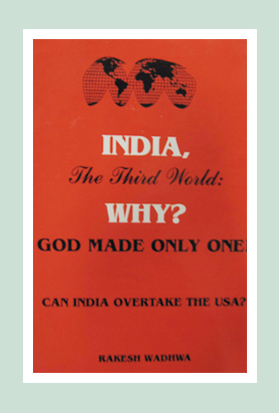

What the readers are saying…