
Digital Sovereignty: Fragmentation of the Tech Free Market
When the internet was first launched, it held promises of a borderless world. You could buy a product from a Japanese company as easily as from your neighbouring market. You could store files in a cloud hosted in Dublin

The Geopolitics of Friend-Shoring: Free Markets in a Divided World
The global economy is changing fast. For decades, companies sought the lowest-cost producer. This was the core idea of the free market. Now

Monopolies Arise in the Absence of Free Markets
Many of the monopolies today are state-owned entities, which are highly susceptible to political interference. Politicians may use them as tools to achieve personal or political goals, such as rewarding loyal supporters with management positions or contracts,

Argentina’s Shift to Free Market Policies Is Starting to Pay Off
From a $20 billion bailout deal with the IMF in April 2025 to the same agency projecting GDP growth for the year at 5.5% in August, Argentina has certainly come a long way.

Voluntary Tax: It’s Merely a Sugarcoated Pill
The US tax code states that it is based on “a system of voluntary compliance.” However, this is a complete misnomer. Taxation in the US, like most other countries, is instead based on the phrase used by highwaymen during robberies:

30% of Lithium Producers are in the Red: Who is to Blame?
The world’s efforts at energy transition depend on lithium. With EVs grabbing the spotlight, the global demand for this metal has been rapidly growing. And yet, the global lithium market is expected to remain oversupplied till 2028. As

Outsourcing is Not the Root of America’s Economic Woes
When was the last time you wore a jacket that you stitched yourself? Many of you, like me, would say “Never.” You probably didn’t manufacture the car you drive or build the home you live in. We all outsource to make our lives comfortable and
Fiat Money: Is It a Failed Experiment?
News of scams and cyberfraud are rampant now, and their proliferation can send chills down the spine. As many as 85% people were targets of digital scam attempts, according to the 2024 Secure Living survey across 7 countries. While such news grabs the spotlight,

Can Government Intervention Help Economies Fight the COVID-19 Crisis? (Part 2)
Read the first article of this series here.
Businesses have always felt stifled by government regulations. A little more in some countries and a little
Is India Beginning to Recognise the Power of the Invisible Hand?
The Indian Economic Survey was released in January as a prelude to the Union Budget for 2020. In the report, Chief Economic Advisor (CEA) Krishnamurthy Subramanian has suggested several solutions to boost the Indian economy. This comes in highly challenging
 Rakesh Wadhwa. Ever since, I was a school boy, I knew India was on the wrong path. Socialism was just not what we needed to get ahead. Government controlled our travel; government controlled our ability to buy and sell; and government controlled our freedom to move our money. My life has focused on the inherent rights people have. When I was in college, I never understood, what the governments meant by their "socialistic attitude". If people are free to buy, sell and move their capital themselves without any restrictions by state, then the welfare of people is inevitable & hence the countries they live in will become wealthy. The government has no right whatsoever, to point a finger at me or my business. I am not a revolutionary. I just want to light up my cigarette and not get nagged about it. I believe in non-interfering attitude to attain more.
 The Bastiat Award is a journalism award, given annually by the International Policy Network, London. Bastiat Prize entries are judged on intellectual content, the persuasiveness of the language used and the type of publication in which they appear. Rakesh Wadhwa won the 3rd prize (a cash award of $1,000 and a candlestick), in 2006.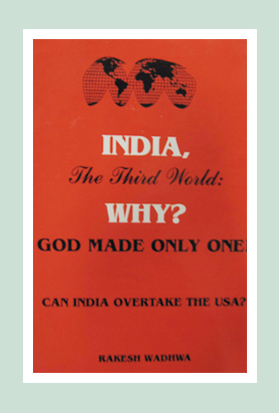
What the readers are saying…