Divestment Is Essential To Good Governance
Published in 1776, Adam Smith’s The Wealth of Nations defines the basic premise of business – profit. Smith argues that a voluntary exchange between two parties will take place if and only if both believe that they stand to benefit. In this context, how fair is a system that limits individuals from exercising their choices? Can a system that limits individuals from expanding their businesses, in the name of public good, be considered fair to the society itself? Consider this: It is the government that lays down the rules for business, or in other words, acts as a regulator and constructs the framework within which businesses must operate. How can, then, the government run its own businesses without being unfair to individuals who raise capital through markets?
When Government Inaction Cripples Economic Activity
It is a known fact that demand and supply decide the direction of a free market economy. However, it is the government that creates an atmosphere where market forces can operate without any fear for their investment.
Was Laissez Faire Responsible for the Economic Crisis?
It is not from the benevolence of the butcher, the brewer or the baker, that we expect our dinner, but from their regard to their own self interest. We address ourselves, not to their humanity but to their self-love, and never talk to them of our
3 Most Common Myths About Capitalism
If we take a look at the economic history worldwide, private businesses have been instrumental in improving the standard of living. Business houses have created job opportunities, invented products, made profits, helped impoverished people and
Myths About Free Markets Debunked!
The AT&T deregulation in the 1980s offered competitive phone rates to the market. The US airlines deregulation in 1979 facilitated lower airfares and more choices to consumers. Despite these historic successes of a free market system, those
Can Free Markets Battle Corruption?
When Alexander the Great visited the philosopher Diogenes and asked whether he could do anything for him, Diogenes is said to have replied: ‘Yes, stand a little less between me and the sun.’ It is what every citizen is entitled to ask of his government.
Government Regulations Hamper Growth of Small Businesses
Being an ardent supporter of the free market, I had always known that government interventions curb entrepreneurs’ innovativeness, thus leading to fewer opportunities for all. Data from the World Bank Group Entrepreneurship Survey (2008) proves it. World Bank economists
Will Free Markets Ruin Society?
I am a staunch believer in free markets. But that isn’t reason enough for you to be convinced. Let’s instead consider a recent study in this field. Let us consider what some experts have to say regarding whether free markets will ruin society:
Smoking, Drinking, Gambling and the Government
There are plenty of people in this world who are involved in smoking, drinking or gambling or maybe all of them together. What chance does the government have of stopping activities which in spite of their harmful effects are being followed by an overwhelming
Control versus Freedom: Comparing India and Hong Kong
Hong Kong spreads over 1,104.4 sq km and is home to 7.097 million people. Its GDP was $224.1 billion in 2010 at a GDP real growth rate of 6.8%.
Hong Kong is one of the leading capitalist economies of the world. It has been ranked as the freest economy for 17 consecutive years in the Wall Street Journal and Heritage Foundation’s Index of Economic Freedom. Hong Kong has proved that resources are used most efficiently if market forces decide its allocation. Hong Kong is one of the richest economies in the world.
 Rakesh Wadhwa. Ever since, I was a school boy, I knew India was on the wrong path. Socialism was just not what we needed to get ahead. Government controlled our travel; government controlled our ability to buy and sell; and government controlled our freedom to move our money. My life has focused on the inherent rights people have. When I was in college, I never understood, what the governments meant by their "socialistic attitude". If people are free to buy, sell and move their capital themselves without any restrictions by state, then the welfare of people is inevitable & hence the countries they live in will become wealthy. The government has no right whatsoever, to point a finger at me or my business. I am not a revolutionary. I just want to light up my cigarette and not get nagged about it. I believe in non-interfering attitude to attain more.
 The Bastiat Award is a journalism award, given annually by the International Policy Network, London. Bastiat Prize entries are judged on intellectual content, the persuasiveness of the language used and the type of publication in which they appear. Rakesh Wadhwa won the 3rd prize (a cash award of $1,000 and a candlestick), in 2006.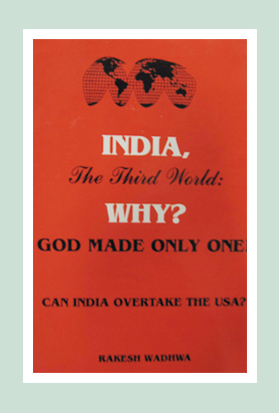
What the readers are saying…