
Where Does the Future of the Casino Industry Lie?
“Online gambling is ‘fool’s gold.’ Whether it is full casino gaming, poker only, or anything in between – this is a societal train wreck waiting to happen.” This is what Sheldon Adelson, Chairman and CEO of the largest gaming company in the world, Las Vegas Sands, had to say to Forbes Magazine in June 2013.

Dr. BR Ambedkar: A Free Market Economist at Heart
“Ambedkar is my Father in Economics. He is true celebrated champion of the underprivileged. He deserves more than what he has achieved today. However he was highly controversial figure in his home country, though it was not the reality.
Prof. B.R. Shenoy: India’s Free Market Visionary
The birth of a nation represents sheer potential. Potential in terms of an unwritten future, that could go in any direction. The blank pages of history wait to be filled… with overlying goals, structure and the freedom to decide how to achieve the goals. When India became independent, it was faced with three economic models.
Online Gaming: Time to Give it its Due!
In the first part of this article, which you can read here, we discussed the hurdles that online gaming and its legal status have witnessed worldwide. While the size of the widely popular gambling form is difficult to measure, there are a few ways in which the necessary change can be brought about. In this section, we will talk about those factors that can usher in some positive developments in this regard.
Online Gaming: The Omnipresent Phenomenon
It’s ubiquitous and yet it is an elephant in the room. Online gaming is a popular practice throughout the world, despite the national or state regulations that have plagued it for a while.
However, this element of uncertainty surrounding the legalities related to this flourishing sector isn’t a healthy sign for the industry as a whole. Not only does this make it difficult to judge the impact of this sector, it also impedes planning and strategizing for the future.
Free the People, Control the Government: A Lesson from Hong Kong
It is often believed that countries that are small are easy to govern. It is also believed that high population impedes economic development. There is one nation that shattered these popular beliefs… Hong Kong!
Was Laissez Faire Responsible for the Economic Crisis?
It is not from the benevolence of the butcher, the brewer or the baker, that we expect our dinner, but from their regard to their own self interest. We address ourselves, not to their humanity but to their self-love, and never talk to them of our
3 Most Common Myths About Capitalism
If we take a look at the economic history worldwide, private businesses have been instrumental in improving the standard of living. Business houses have created job opportunities, invented products, made profits, helped impoverished people and
Myths About Free Markets Debunked!
The AT&T deregulation in the 1980s offered competitive phone rates to the market. The US airlines deregulation in 1979 facilitated lower airfares and more choices to consumers. Despite these historic successes of a free market system, those
Can Free Markets Battle Corruption?
When Alexander the Great visited the philosopher Diogenes and asked whether he could do anything for him, Diogenes is said to have replied: ‘Yes, stand a little less between me and the sun.’ It is what every citizen is entitled to ask of his government.
 Rakesh Wadhwa. Ever since, I was a school boy, I knew India was on the wrong path. Socialism was just not what we needed to get ahead. Government controlled our travel; government controlled our ability to buy and sell; and government controlled our freedom to move our money. My life has focused on the inherent rights people have. When I was in college, I never understood, what the governments meant by their "socialistic attitude". If people are free to buy, sell and move their capital themselves without any restrictions by state, then the welfare of people is inevitable & hence the countries they live in will become wealthy. The government has no right whatsoever, to point a finger at me or my business. I am not a revolutionary. I just want to light up my cigarette and not get nagged about it. I believe in non-interfering attitude to attain more.
 The Bastiat Award is a journalism award, given annually by the International Policy Network, London. Bastiat Prize entries are judged on intellectual content, the persuasiveness of the language used and the type of publication in which they appear. Rakesh Wadhwa won the 3rd prize (a cash award of $1,000 and a candlestick), in 2006.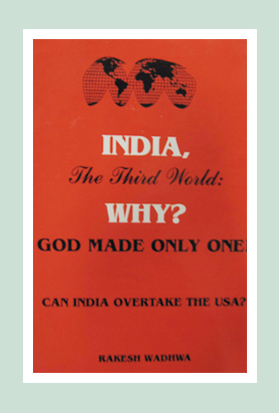
What the readers are saying…