Government Regulations Hamper Growth of Small Businesses
Being an ardent supporter of the free market, I had always known that government interventions curb entrepreneurs’ innovativeness, thus leading to fewer opportunities for all. Data from the World Bank Group Entrepreneurship Survey (2008) proves it. World Bank economists
Airlines and Regulations
The world including Nepal has realized the disservice caused to all of us by the state running businesses. Worldwide privatization of government assets has taken place on a grand scale.
However, most people still maintain that regulation by state is essential. Poor service by private organizations is the reason why many of us want government oversight.
In an article on domestic private airlines in the 19-25 November issue of Nepali Times by ‘Artha Beed’, the service – or rather the lack of it – was given by him as a reason for wanting the government to step in. He said that free markets need government regulators to be successful.
Not so. Let us find out what went wrong. When private airlines first took off, the staff was enthusiastic and well groomed, service was warm, and flights were on time. Let us agree with Artha that service and courtesy has since vanished.
Let us, however, compare the situation now with what was prevailing at the time when RNAC was the only airline. Perhaps Artha is too young to remember. People used to queue up overnight to get tickets, service was non-existent, and the staff attitude said, ‘put up with us or walk to your destination’. However, bad the situation now is, it is infinitely better than at the time of RNAC’s monopoly.
Apart from the impossibility of government regulators forcing the airline’s staff to smile (Artha’s desire), regulations boost costs, empower corrupt bureaucracies, and achieve little.
Does it mean that Artha will remain permanently frustrated? Is there no way to make private airlines come upto his expectations? Fortunately, there are ways to improve efficiency and service without the heavy hand of the government.
Ending RNAC’s monopoly was good. What wasn’t good was prohibiting foreign airlines from flying on domestic routes. If you want world class service, then you must let world class companies compete in your markets.
This is not only true of airline business but of all businesses. India was no better. Under the anti-foreign-investment raj of Indira Gandhi, protected businesses produced shoddy goods and customers got lousy service. Now, foreign investment where permitted is changing that.
India which produced the ugly ‘ambassador’, even for which there was a waiting period, now offers its consumers an unlimited array of world-class cars. Its autos and their components are exported to many countries. Would this have happened under the protective regime of the Neheru-Indira era? Never.
Nepal does not need more government regulations but opening up of its market including the domestic airline market to free and unfettered competition. Then it will be companies which best serve the interests of the Nepali consumer which will thrive.
A word of caution here is necessary. Open and free competition does not mean that private businesses, be they airline or any other, will always meet all of the customers expectations. It only means that customers will have a choice and most will be satisfied most of the time. All customers cannot always be satisfied. Airlines, for example, can only provide the level of service which the public is prepared to pay for.
While travelling within the US, I find that airlines do not serve much more than a packet of peanuts and a soft drink. This is because the US airlines have found that people travel on basis of cheap fares. The preference of people is not for fancy service and gourmet food but low ticket prices. Customers want rock bottom fares and that is what they get. They can always pick up-food of their choice at the airport’s fast-food restaurants and are unwilling to pay extra for food and service inside the aircraft.
It is possible that even after the domestic airline market is opened to foreign competition Artha still does not get gourmet food served to him on his half hour flight to Pokhara. This would only be if most travelers value cheaper flights which do not factor in the cost of Artha’s choice of food and drinks.
But again if Artha has resources he should have options. He could buy a plane, hire his own pilot and airhostess, and have food of his choice served to him. Good luck Mr. Beed.
The Himalyan Times
Drugs: How Regulations Kill
The year 2004 has been a bad one for the big drug companies of this world. It has been a particularly trying year for Merck, one of the world’s biggest drug manufacturers. Merck share price dropped from its peak of $95 in November 2001 to US$27 in November, 2004. This means that the company is worth US$60 billion vs US$200 billion it was worth just three years ago.
The reason for Merck’s pain is its blockbuster arthritis drug Vioxx. Merck has had to pull it off the market. Worse, Merck faces liability potentially running into tens of billions of dollars which it would have to pay to the users of Vioxx.
In a study conducted by Merck, it appeared that users of Vioxx faced a slight increase in risk of getting a heart attack. Merck decided to make the study public and, in keeping with its high ethical standards, also recalled Vioxx. Stores have sent the medicine back to the company and so have consumers. They are entitled to a full refund.
There is do doubt that Merck is seriously wounded. Swarms of lawyers in the US smelling blood have sprung into action. They have begun the process of collecting names of all Vioxx users. Cases will be filed on their behalf against Merck. It is possible that every user will be entitled to damages whether or not he has been harmed.
Those who have suffered heart attacks will probably be awarded damages in tens of millions of dollars. If someone has died while taking Vioxx, it is conceivable that Merck may be liable for a 100 million dollars in damages. It is now certain that Merck will end up paying billions of dollars to settle claims against it.
Persons investing in Merck have seen the value of their holdings vaporize. Its shareholders have lost a substantial portion of their wealth. If you bought Merck shares at its peak, you would have witnessed your holdings decline by over 70% in value.
This example illustrates why drug companies in the US have to charge high prices. The risk involved in developing a new drug is just too great. The approval process is time consuming, tortuous, full of pitfalls, and costs a fortune. In the US, the Food and Drug Administration (FDA) which has to approve all drugs takes upto ten years to do so. The company seeking approval may need to spend a billion dollars before it is ready to market its new molecule.
And even this rigorous approval process does not protect a company from liability. It still remains fully liable to users for any untoward effects which may come to light years later. The fact that Vioxx was approved by FDA does not protect Merck from liability in the least bit.
Vioxx has shown to not only Merck shareholders but also to investors in other drug companies as to how severe the liabilities can be. The share prices of other drug companies like Pfizer, Roche, and Bristol Myers have also fallen. In recent years a mere whiff of legal trouble is enough to cause share prices to plunge.
When we complain of mega profits and high prices drug companies charge, we have to take into account the enormous risks they face. Drug prices in the US and worldwide can come down only if the FDA is disbanded and legal liability is limited to actual damages.
For a user of Vioxx to be awarded a million dollars in damages without having to prove actual harm is not reasonable. If he has suffered a heart attack or died, yes a million dollar or even several million dollars may be reasonable compensation.
Reform liability and compensation norms, eliminate regulations to extent possible and we will see cheaper drugs. Will we be sacrificing safety? As we have seen with Vioxx, government approvals by no means guarantee safety, they in fact enhance the danger by providing an illusion of safety when we all know that you should take drugs only if you must. There is hardly any drug which does not have any side-effects.
There are dangers stemming from regulation and limitless liabilities. FDA is going to be even more careful in approving new drugs. New life saving drugs may not be available to the world for decades.
“I think this is really blown out of proportion,” said Dr. Carl Lavie, medical director of preventive cardiology at Ochsner Clinic Foundation, in New Orleans. “I don’t think it’s easy at all to get a new drug approved, and if you start being extremely conservative you stand the risk of taking good medicines from people.
Fewer companies can now afford to develop new drugs. Companies will not market drugs which harm a few even if they substantially help a 100 times more people, since the potential liability for damages far exceeds potential profits. No one is looking at how many have benefited from Vioxx, every lawyer is concentrating on those harmed. Regulations cost far more lives than they save.
It appears that Merck will have to pay damages even if Vioxx users reside outside the US. Are you a user? If you can prove usage you too may become a millionaire. Good luck.
The Boss
Plan or Prosper
Most people believe that governments must plan. Communist and socialist regimes made planning the centerpiece of their development agenda. India had its five year plans, copied on the basis of central planning by its ally the Soviet Union. Nepal too has its planning commission.
Government it seemed – and still seems to most – is required to plan everything. Government has to plan the savings rate. Government has to plan the growth in population, and family size. Government has to channel investments according to its plan. Government has to plan the food grain output. Government has to plan, plan, and plan – for four decades after independence the government of India planned the production of cement, iron, scooters, cars, fertilizers, electricity, wheat…
Nothing in India could be produced without a license. The government decided that it alone must allocate scarce resources in a planned manner for its people’s benefit.
Government also intervened directly to mandate that no private investment would be permitted in TV, airlines, railways, telephones, power stations … and that government would exclusively run and plan the production of these goods and services.
The private sector and markets were subjugated. Indira Gandhi referred sarcastically to those who advocated free markets as ‘marketwallahs’. In interest of planning India’s progress she nationalized the insurance companies and banks.
How successful were these plans? Indian industry was chained and crippled by its planners. Shortages became endemic. People could – at least some people could – satisfy their urgent requirements by buying in the black market. Smugglers satisfied the requirement of goods demanded from abroad.
Government planned the use of foreign exchange. “Perish the thought of private importing”, the people were told, “we hardly have enough dollars to buy petrol”.
Government of India planned. The economy stagnated. The sub 2% growth rate achieved during that period was dubbed, “the Hindu rate”. There was a problem with Hindus, thought the people of India. Inspite of such extensive government planning, if we still can’t progress, the reason must lie in our nature and our religion that advocates a belief that life is pre-destined and beyond our control.
All this changed in the early 1990’s. Industrial licensing was abolished in one fell swoop by the Narasimha Rao government. What could not be achieved by bureaucrats in over four decades of planning was accomplished by businessmen in a few years when planning became their job.
Shortages of steel, cement, telephones, scooters, and cars vanished. Today, not only do these industries fund their own expansion, they pay huge taxes as well. Foreign exchange reserves have grown from zero to $110 billion and the problem now is how to effectively use all the dollars coming in.
Similar failures of planning became even more apparent in the former Soviet Bloc. Planning by the state doomed the ‘evil’ Russian Empire. It collapsed overnight. The Berlin wall came down and East Germany disappeared in its rubble.
What is required is not planning by the state, but a complete separation between government and the economy. The role of the government must be minimized, that of the market maximized.
It is not the job of bureaucrats to allocate resources, it is for the consumer guided market to do so. Bureaucrats have no incentive to take correct decisions. If they allocate too few resources for the manufacture of cement, so what, they can always shift the blame to greedy hoarders. If government buys wheat at a price leading to overflowing granaries that serve as food stores for rats, so what, the loss gets to be borne by the taxpayers.
If private companies make mistakes – and they often do – it is they who lose out, not the taxpayer. Businessmen, therefore, have all the incentive to rectify mistakes fast or risk bankruptcy. If they produce too little they leave room for a competitor to come in and bridge the gap. If they produce too much, they run into a loss. They will thus continually struggle to get things right. There is no taxpayer and no currency printing presses supporting their mistakes.
Government, if it is serious about economic progress must shut down its planning office, and leave planning and implementation where it belongs – in the hands of businessmen.
The Himalyan Times
 Rakesh Wadhwa. Ever since, I was a school boy, I knew India was on the wrong path. Socialism was just not what we needed to get ahead. Government controlled our travel; government controlled our ability to buy and sell; and government controlled our freedom to move our money. My life has focused on the inherent rights people have. When I was in college, I never understood, what the governments meant by their "socialistic attitude". If people are free to buy, sell and move their capital themselves without any restrictions by state, then the welfare of people is inevitable & hence the countries they live in will become wealthy. The government has no right whatsoever, to point a finger at me or my business. I am not a revolutionary. I just want to light up my cigarette and not get nagged about it. I believe in non-interfering attitude to attain more.
 The Bastiat Award is a journalism award, given annually by the International Policy Network, London. Bastiat Prize entries are judged on intellectual content, the persuasiveness of the language used and the type of publication in which they appear. Rakesh Wadhwa won the 3rd prize (a cash award of $1,000 and a candlestick), in 2006.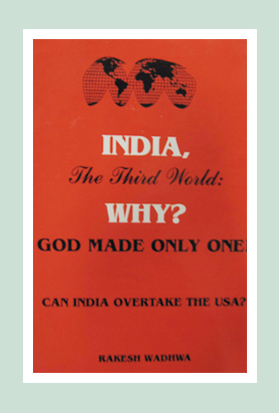

What the readers are saying…