Digital Sovereignty: Fragmentation of the Tech Free Market

When the internet was first launched, it held promises of a borderless world. You could buy a product from a Japanese company as easily as from your neighbouring market. You could store files in a cloud hosted in Dublin and stream a Hollywood movie right to your home TV. Fantastic, right? But, as time passed, this frictionless “digital highway” became vulnerable to a major ideological shift – that of digital sovereignty.
What does this mean? Digital sovereignty is basically a push by countries to control their own digital data and technology infrastructure. Data privacy became a buzzword and somewhere government felt they needed to enforce laws for it. This is what is reshaping the free market for tech today, by exchanging global efficiency for local control.
The Rise of Digital Borders
So, why did this sudden urge to put fences around the cloud arise? Firstly, governments realised that data isn’t just an abstract concept but crucial for economic power. Plus, the rapid growth of artificial intelligence (AI) turned raw computing power into a strategic asset.
This alerted regulatory bodies that data protection needed to be strengthened. As of early 2026, 144 countries have enacted national data privacy laws, which covers over 6.64 billion people or 82% of the global population. From the EU’s pioneering frameworks to India’s Digital Personal Data Protection (DPDP) Act, countries worldwide are demanding that data collected about their citizens stays physically within their borders.
The Rise of Splinternet and the AI Race
Digital boundaries led to the fragmentation of the internet, which became “splintered” into smaller, isolated networks controlled by governments, corporations, or ideologies. Although splinternet stems from national interests, censorship and geopolitical tension, it has led to localised, filtered and often incompatible digital spaces, or “cyber-balkanisation.”
The next concern was the proliferation of AI. To prevent over-reliance on tech giants in the US and China, countries began to focus on building their own independent systems. According to Deloitte, nations and regional blocs are expected to invest over $100 billion in building sovereign AI compute capabilities in 2026. This localised push is creating massive physical booms in the emerging markets. For instance, strict data localisation mandates in India are driving an unprecedented infrastructure wave, with the country’s data centre capacity expected to cross 8 GW by 2030.
The Cost of Going Local
While digital sovereignty gives citizens better localised privacy protections and nations more agency, it does not come for free. The tech free market thrives on massive scale and shared resources, but when you fragment that market, multiple things happen.
Stifled Innovation
Over-regulation and strict data localisation laws can break the global nature of the internet, creating digital silos that restrict cross-border collaboration and the exchange of ideas. Plus, smaller tech disruptors are getting squeezed out because they simply cannot afford to build localised data infrastructure in every region they want to serve. The Information Technology and Innovation Foundation (ITIF) notes that pursuing stringent digital sovereignty could cost Europe $4.2 trillion over 10 years. These costs don’t just come from building new servers, but from the lost productivity of not being able to use seamless global networks.
Inflated Costs
Forcing companies to replicate data centres and build localised teams creates huge redundancies. In addition, extra compliance costs are ultimately passed on to consumers. Moreover, localising data can weigh on economic growth. According to the OECD’s report on the economic implications of data regulation, a worst-case scenario of full digital fragmentation, where all economies fully restrict their cross-border data flows, could reduce the global GDP by 4.5% and cut global exports by 8.5%.
Fractured User Experience
Features available to a user in one country might be restricted in another simply due to complex regional data routing rules. To deal with these compliance walls, tech companies are forced to adopt “zero data egress” architectures, which are systems engineered specifically to ensure data never leaves its designated sovereign zone. The consequence is that apps or AI assistants could be missing essential features in some regions, simply because the advanced processing needed happens on a server in another country.
The Bottom Line
Digital sovereignty is no longer a futuristic concept; it is the current reality that businesses are grappling with. This means the tech free market is no longer an arena of frictionless trade, but a complex grid of national interests. For users, this means more secure data but a potentially more fragmented digital experience. For the tech industry, the challenge of the decade is learning how to build global products within very local borders.
 Rakesh Wadhwa. Ever since, I was a school boy, I knew India was on the wrong path. Socialism was just not what we needed to get ahead. Government controlled our travel; government controlled our ability to buy and sell; and government controlled our freedom to move our money. My life has focused on the inherent rights people have. When I was in college, I never understood, what the governments meant by their "socialistic attitude". If people are free to buy, sell and move their capital themselves without any restrictions by state, then the welfare of people is inevitable & hence the countries they live in will become wealthy. The government has no right whatsoever, to point a finger at me or my business. I am not a revolutionary. I just want to light up my cigarette and not get nagged about it. I believe in non-interfering attitude to attain more.
 The Bastiat Award is a journalism award, given annually by the International Policy Network, London. Bastiat Prize entries are judged on intellectual content, the persuasiveness of the language used and the type of publication in which they appear. Rakesh Wadhwa won the 3rd prize (a cash award of $1,000 and a candlestick), in 2006.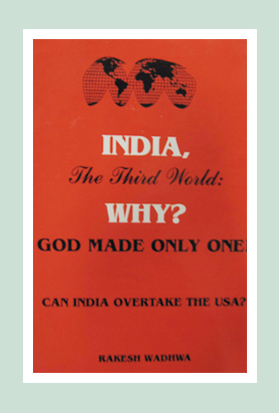
What the readers are saying…