Free the Banks
Whenever I make a presentation on how economic freedom would make Nepal prosper, I am confronted with the objection that Nepal is landlocked, different and what applies to other countries is not applicable here. Nepal is different and landlocked, but, to say that economic freedom would fail here, when, it has never failed to eliminate poverty elsewhere, is a travesty.
Switzerland provides the best example of how a landlocked nation has used its geographical position to great advantage. The Swiss said to the surrounding countries of Europe and then to the world, ‘if you have money, bring it to us. We will keep it safe and if you want the matter kept confidential, we shall honour your desire.’
This single measure of anonymous banking accounts is one of the foremost reasons for the Swiss being among the richest people on this planet. They, on average, earn 34,000 dollars annually.
The Swiss do not consider tax-evasion a crime and a foreigner is not penalized for bringing in money from foreign lands on which tax has not been paid.
Would it be possible for Nepal to become an international financial service centre? Yes, according to a report prepared by Collins and Associates of Boston, USA. However, despite several years of effort by Joseph Collins, the government did not allow it to happen. Collins finally gave up.
Besides confidential banking, Switzerland has a banking system which is one of world’s freest and hence, not surprisingly, one of the most competitive as well.
Banks in Switzerland, offer a wide range of financial services which banks in Nepal, subject to pervasive state control, cannot. Standard Chartered Bank in Nepal does not even offer foreign currency credit cards to its customers fearing that it might run foul of the government controls.
If you want to establish a bank in Switzerland, it does require government approval, but, once you get the permission to begin operations, you are accorded the same treatment as a local bank. There is no restriction on 100% foreign ownership of a bank. Nepal does not allow 100% foreign ownership of banks. A foreign bank can only come in as a partner in a joint venture.
“Free” Switzerland has over 400 banks out of which over 150 have either total or majority control exercised by foreigners. Consider the employment generated, at high wages, and the wealth landing in Switzerland thanks to the marketing efforts of these banks. Any wonder then, that Switzerland retains its reputation as one of the safest havens of capital.
Indians are estimated to have more billions secreted away in Swiss and other foreign bank accounts than the entire foreign currency reserves of the government of India. Under the existing laws, Nepal would never see any of this money.
In Nepal, the government directly controls the five regional development banks and also two of the major commercial banks: Nepal Bank Limited and Rastriya Banijya Bank. The state thus controls 60% of bank lending in the country.
Indira Gandhi during her heyday nationalized most of India’s leading banks and all but destroyed its financial sector. The price for these actions was paid by the Indian taxpayers who bore the losses.
The people of Nepal bear the burden of billions of rupees of losses incurred by the government banks. The true cost cannot be measured as we have no way of knowing the extent of bad loans made in India or in Nepal by government banks under pressure from their political masters.
The good news is that, if the government has the will, the banking system can be restructured in a few months. Sell off the government banks, free the currency markets, abolish irrelevant and harmful controls on banking, permit foreign banks to come in with a minimum of red tape, and allow confidential accounts in the currency of the depositor’s choice. Do this and Nepal would one day become an international finance and banking centre.
The Himalyan Times
 Rakesh Wadhwa. Ever since, I was a school boy, I knew India was on the wrong path. Socialism was just not what we needed to get ahead. Government controlled our travel; government controlled our ability to buy and sell; and government controlled our freedom to move our money. My life has focused on the inherent rights people have. When I was in college, I never understood, what the governments meant by their "socialistic attitude". If people are free to buy, sell and move their capital themselves without any restrictions by state, then the welfare of people is inevitable & hence the countries they live in will become wealthy. The government has no right whatsoever, to point a finger at me or my business. I am not a revolutionary. I just want to light up my cigarette and not get nagged about it. I believe in non-interfering attitude to attain more.
 The Bastiat Award is a journalism award, given annually by the International Policy Network, London. Bastiat Prize entries are judged on intellectual content, the persuasiveness of the language used and the type of publication in which they appear. Rakesh Wadhwa won the 3rd prize (a cash award of $1,000 and a candlestick), in 2006.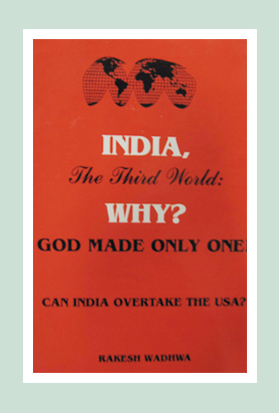
What the readers are saying…