Is it Time to Give Up Our Freedom?

 When we see a majestic lion sitting idly inside a cage in the zoo, we can’t help but feel sorry. Afterall, every living creature deserves to be free. Yes, life will be harsh in the wild, with a myriad of threats to its very survival. But is that enough reason to lock it up in a cage? If we can feel so distressed about animals being caged up, why have we so timidly accepted our own liberty being taken away?
Yes, I’m talking about the lockdown. Governments around the world have imposed stringent restrictions on their citizens. And, shockingly, most people have surrendered without giving a second thought to values like freedom of choice or even the freedom to earn a living and support your family.
The Value of Freedom

The term “freedom” stirs up strong emotions in people. Many have sacrificed their lives fighting for the freedom we enjoy today. But this term goes far beyond gaining independence from being ruled by another nation. It encompasses the freedom to decide what’s right for us and even the freedom to take risks. If you decide to climb Mount Everest, should a government be allowed to stop you? Should the government step in and ban skydiving? And, where does this coercion end? According to official figures, 1.5 lakh people lost their lives in 2018 to road accidents. Should the government ban cars and buses?
There’s great value governments can add by spreading awareness. In fact, during the pandemic, the Indian government did a terrific job of spreading awareness, through speeches, messages playing every time you call someone and TV and radio ads. Even before the pandemic hit us, every citizen knew the dreaded virus was on its way to India. We understood the importance of keeping our hands clean and wearing masks.
Spread awareness and let people decide. That’s all governments needed to. After that, whoever wishes to remain indoors should be free to do so and whoever wishes to step out and go about their business should not be stopped.
Giving Up a Basic Human Right
The lockdown put an end to liberty, which is a vital component of human dignity. Coercive laws are terrifying, simply because the government’s main goal should be the welfare of its citizens. And, there is no welfare without individual freedom. The ultimate responsibility of the government is to increase the options available to its citizens and give them the freedom to choose. To me, this is not a utopian state, but a basic human right. I believe that humans have the intelligence to judge what’s best for them, given their circumstances. And, when given this responsibility, they become better decision makers.

Look at what history has taught us. Liberal democracies have progressed much faster. Governments that exercise control over their citizens have run their countries down.
So, it’s for you to decide now. Do you value freedom? Or would you rather succumb your liberty to state-sponsored visions of how you should live your life?
I am philosophically against coercion, but there is also an economic impact of the lockdown. And, on what basis did we choose the lockdown and its impact on human lives. Finally, what the government can do to boost economic growth
 Rakesh Wadhwa. Ever since, I was a school boy, I knew India was on the wrong path. Socialism was just not what we needed to get ahead. Government controlled our travel; government controlled our ability to buy and sell; and government controlled our freedom to move our money. My life has focused on the inherent rights people have. When I was in college, I never understood, what the governments meant by their "socialistic attitude". If people are free to buy, sell and move their capital themselves without any restrictions by state, then the welfare of people is inevitable & hence the countries they live in will become wealthy. The government has no right whatsoever, to point a finger at me or my business. I am not a revolutionary. I just want to light up my cigarette and not get nagged about it. I believe in non-interfering attitude to attain more.
 The Bastiat Award is a journalism award, given annually by the International Policy Network, London. Bastiat Prize entries are judged on intellectual content, the persuasiveness of the language used and the type of publication in which they appear. Rakesh Wadhwa won the 3rd prize (a cash award of $1,000 and a candlestick), in 2006.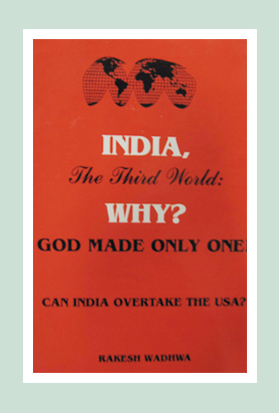
What the readers are saying…