







>13% – Russia’s tax on income
13% – Russia’s tax on income
America is a haven for capitalists while Russia is a workers paradise. US glorifies profits, Russia vilifies it. This was the conventional wisdom. It has been turned on its head. Bush fought a bruising battle in the US Congress to marginally reduce taxes. Vladimir Putin, the Russian President, did it with ease.
Jan 1, 2001 was the beginning of a new era in Russia. Russians woke up to a flat 13 percent income tax. It was a watershed event. That’s right; it is Russia that we are talking about, not Hong Kong or Singapore. The USSR was founded on the principle that all businessmen were evil and profits were passe – a bourgeois concept.
Now, businessmen can retain 87 percent of what they earn in the land of Lenin! This is something which I would not have dreamed of 10 years ago. Truth is stranger than fiction.
What is surprising is that Russia had just three tax rates of 12, 20 and 30 percent prior to this reduction. The rates were high but comparable with what most countries charge, and, yet, Putin chopped them.
What has been the result of this relatively low tax rate? It has been an unprecedented success for Russia. It has contributed to Russia’s stability which was so lacking in the aftermath of the collapse of communism. The benefits to the Russian economy grow by the day.
Capital flight has stopped and foreign investors have started returning to Russia. This, inspite of the huge losses incurred by the dollar investors resulting from a complete collapse of the ruble in the 1990’s.
Hoover Institution scholar Alvin Rabushka observed in a February 21, 2002 analysis for www.russiaeconomy.org, “the 13 percent flat tax has exceeded the expectations of the government in terms of revenue. For the vast majority of taxpayers, its implementation is simple, and no forms need to be filed.” Adjusting for currency fluctuations, Rabushka adds, “real ruble revenues increased about 28 percent.”
This novel experiment is paying huge dividends for the Russian government by inculcating the habit of paying taxes in people who were used to a culture of evasion. This changed attitude was to be expected; after all, evasion too comes at a cost – black money is difficult to reinvest in business and peace of mind is lost. People, therefore, do pay up when rates are not extortionate.
Russian tax revenue which barely equaled nine percent of its Gross Domestic Product (GDP) has grown to 16 percent. Russia also grew by 5% in 2001. A win-win situation for all concerned. Taxpayers are smiling, Putin has become a hero of the ‘Union of World’s Taxpayers’, and Russia’s government is busy collecting a windfall.
The US meanwhile has six tax rates from 10 to a high of 38.6 percent. Its 46,900-page Tax Code provides elephant size loopholes to the wealthy while the middle classes pay up. Russians file a simple one page form.
It is estimated that tax accountants will gobble up over 150 billion dollars for the paperwork which accompanies the tax payment in the US. This burden is one of the reasons why the US economy will not average even half the growth rate accomplished by Putin’s Russia.
It is ironic that Russia has a 13 percent flat tax while the bastion of world’s capitalism cannot even bring in a flat 17 percent tax. This is what Steve Forbes, a republican contender for the US presidency, had wanted but could not achieve.
Clearly, Russia has more to do if it wants to prosper. Rule of law, freedom of speech and, especially, far stronger property rights are surely needed. The 13 percent income tax is however a very powerful step in the right direction.
Nepal, to make an impact, must abolish the income tax. To do so would signal to the world’s business community, ‘invest here; Russia may have larger markets but in Nepal you need no tax experts and pay no income tax.’
With the abolition of the income tax, foreign and domestic investment would boom and trade would virtually explode. Any loss in revenue would be more than made up by higher VAT realizations by the government.
The Boss
>Freedom and education
>
And yet as good as my school was, I remained uncomfortable with certain aspects of it. I studied science, maths and english by choice. Why was I forced to learn Hindi, Sanskrit and painting?
The government dictated to the school that I learn to write in Hindi, I have never done that again after I left school. I regarded Sanskrit as a waste of time; I have never written, spoken or heard it since I left school. Inspite of a great drawing teacher, I never passed that exam or had any inclination to be an artist.
My school’s attempt to make me a linguist and an artist failed. I wondered if there was a better option. A school where you could study and do as you liked. A school where you were not forced by control minded governments and school authorities to learn and do things you had no interest in.
Count Leo Tolstoy spoke about it in 1862.
“What is meant by non-interference of the school in learning? — It means granting students the full freedom to avail themselves of teaching that answers their needs, and that they want, only to the extent that they need and want it; and it means not forcing them to learn what they do not need or want.”
“I doubt, whether the kind of school I am discussing, will become common for another century. It is not likely that schools based on students’ freedom of choice will be established even a hundred years from now.”
Tolstoy was right. It was only a 106 years later, in 1968 that such a school was founded in Framingham, in Massachusetts, USA.
The school starts from Aristotle’s premise stated over 2000 years ago, “human beings are naturally curious”. It allows its students to do what they like. If you have no interest in science and would rather fish the whole day, you are allowed to do just that. In fact you may fish for a whole year if you like.
Before you write-off that experiment as unworkable, please understand that the school’s existence after 35 years of its founding is a testimonial to its success. It does not get or ask for any financial or other support from the government and competes exceptionally well with ‘free’ schools run by the government.
The students, teachers and parents are all fiercely loyal to the school and swear by it. The school has been written about extensively and is admired by freedom loving people worldwide. Those who pass out are admitted to the best US universities with ease.
It is beyond the scope of this article to explain how the school works. Suffice it to say that it is among the most disciplined in the country. Everyone’s rights are respected.
Yes, you may fish the whole day, but if you decide to attend classes you must honour your commitment. If, for example, you fix time with the maths teacher to help you understand a theorem, you must attend and fulfill your promise.
The experience has been that when students want to learn, they do so in double quick time. There are boys and girls completely uninterested in maths until they are 12 years old and then suddenly get the urge to learn. When that happens, they learn in one year what students in other schools learn in 12 years of schooling.
This country would do well not to straightjacket education under the deadening weight of rules and regulations of a know-it-all bureaucracy. The need of the hour is to let private investment, including foreign, come into education unhindered. Who knows, perhaps then ‘Sudbury’ might be persuaded to open a school in Nepal.
>Freedom and education
>
And yet as good as my school was, I remained uncomfortable with certain aspects of it. I studied science, maths and english by choice. Why was I forced to learn Hindi, Sanskrit and painting?
The government dictated to the school that I learn to write in Hindi, I have never done that again after I left school. I regarded Sanskrit as a waste of time; I have never written, spoken or heard it since I left school. Inspite of a great drawing teacher, I never passed that exam or had any inclination to be an artist.
My school’s attempt to make me a linguist and an artist failed. I wondered if there was a better option. A school where you could study and do as you liked. A school where you were not forced by control minded governments and school authorities to learn and do things you had no interest in.
Count Leo Tolstoy spoke about it in 1862.
“What is meant by non-interference of the school in learning? — It means granting students the full freedom to avail themselves of teaching that answers their needs, and that they want, only to the extent that they need and want it; and it means not forcing them to learn what they do not need or want.”
“I doubt, whether the kind of school I am discussing, will become common for another century. It is not likely that schools based on students’ freedom of choice will be established even a hundred years from now.”
Tolstoy was right. It was only a 106 years later, in 1968 that such a school was founded in Framingham, in Massachusetts, USA.
The school starts from Aristotle’s premise stated over 2000 years ago, “human beings are naturally curious”. It allows its students to do what they like. If you have no interest in science and would rather fish the whole day, you are allowed to do just that. In fact you may fish for a whole year if you like.
Before you write-off that experiment as unworkable, please understand that the school’s existence after 35 years of its founding is a testimonial to its success. It does not get or ask for any financial or other support from the government and competes exceptionally well with ‘free’ schools run by the government.
The students, teachers and parents are all fiercely loyal to the school and swear by it. The school has been written about extensively and is admired by freedom loving people worldwide. Those who pass out are admitted to the best US universities with ease.
It is beyond the scope of this article to explain how the school works. Suffice it to say that it is among the most disciplined in the country. Everyone’s rights are respected.
Yes, you may fish the whole day, but if you decide to attend classes you must honour your commitment. If, for example, you fix time with the maths teacher to help you understand a theorem, you must attend and fulfill your promise.
The experience has been that when students want to learn, they do so in double quick time. There are boys and girls completely uninterested in maths until they are 12 years old and then suddenly get the urge to learn. When that happens, they learn in one year what students in other schools learn in 12 years of schooling.
This country would do well not to straightjacket education under the deadening weight of rules and regulations of a know-it-all bureaucracy. The need of the hour is to let private investment, including foreign, come into education unhindered. Who knows, perhaps then ‘Sudbury’ might be persuaded to open a school in Nepal.
Freedom and education
I went to St Columbus’s school in New Delhi in the 1970’s, and enjoyed it. The Irish missionaries who taught there were dedicated and made learning fun.
And yet as good as my school was, I remained uncomfortable with certain aspects of it. I studied science, maths and english by choice. Why was I forced to learn Hindi, Sanskrit and painting?
The government dictated to the school that I learn to write in Hindi, I have never done that again after I left school. I regarded Sanskrit as a waste of time; I have never written, spoken or heard it since I left school. Inspite of a great drawing teacher, I never passed that exam or had any inclination to be an artist.
My school’s attempt to make me a linguist and an artist failed. I wondered if there was a better option. A school where you could study and do as you liked. A school where you were not forced by control minded governments and school authorities to learn and do things you had no interest in.
Count Leo Tolstoy spoke about it in 1862.
“What is meant by non-interference of the school in learning? — It means granting students the full freedom to avail themselves of teaching that answers their needs, and that they want, only to the extent that they need and want it; and it means not forcing them to learn what they do not need or want.”
“I doubt, whether the kind of school I am discussing, will become common for another century. It is not likely that schools based on students’ freedom of choice will be established even a hundred years from now.”
Tolstoy was right. It was only a 106 years later, in 1968 that such a school was founded in Framingham, in Massachusetts, USA.
The by-laws of “The Sudbury Valley School’ say, “the purpose for which this corporation is formed is to establish and maintain a school for the education of members of the community that is founded upon the principle that learning is best fostered by self-motivation, self-regulation, and self-criticism.”
The school starts from Aristotle’s premise stated over 2000 years ago, “human beings are naturally curious”. It allows its students to do what they like. If you have no interest in science and would rather fish the whole day, you are allowed to do just that. In fact you may fish for a whole year if you like.
Before you write-off that experiment as unworkable, please understand that the school’s existence after 35 years of its founding is a testimonial to its success. It does not get or ask for any financial or other support from the government and competes exceptionally well with ‘free’ schools run by the government.
The students, teachers and parents are all fiercely loyal to the school and swear by it. The school has been written about extensively and is admired by freedom loving people worldwide. Those who pass out are admitted to the best US universities with ease.
It is beyond the scope of this article to explain how the school works. Suffice it to say that it is among the most disciplined in the country. Everyone’s rights are respected.
Yes, you may fish the whole day, but if you decide to attend classes you must honour your commitment. If, for example, you fix time with the maths teacher to help you understand a theorem, you must attend and fulfill your promise.
The experience has been that when students want to learn, they do so in double quick time. There are boys and girls completely uninterested in maths until they are 12 years old and then suddenly get the urge to learn. When that happens, they learn in one year what students in other schools learn in 12 years of schooling.
This country would do well not to straightjacket education under the deadening weight of rules and regulations of a know-it-all bureaucracy. The need of the hour is to let private investment, including foreign, come into education unhindered. Who knows, perhaps then ‘Sudbury’ might be persuaded to open a school in Nepal.
The Himalyan Times
SAARC not required
Governments worldwide have treaties for removal of trade restrictions. The European Union (EU) and North America free trade Agreement (NAFTA) are examples.
We too are following the example of these and other regional blocs. We have the South Asian Association for Regional Cooperation (SAARC). Further, each of the seven countries comprising SAARC has its own bilateral agreements with other countries.
Do we need the government to ‘manage’ free trade? Must we have treaties before we open our borders to imports? Would unilateral free trade harm us?
Let us look at countries which are open to trade without bothering about reciprocity. Whenever countries have eliminated tariffs and cut regulations hindering trade they have gained irrespective of what other countries did.
Hong Kong and Singapore practiced unilateral free trade much before these treaties came into fashion. They still do.
Singapore has an average tariff rate of less than one percent. 96% of all imports are duty free. There are no import quotas. License requirements exist for only a handful of items.
Hong Kong is duty-free and levies no duties except on tobacco, alcohol and fuel. The average rate of tax on imports is below even Singapore’s and close to zero. There are no licensing requirements or other barriers.
These two dots on the map prove that you do not need treaties to benefits from free trade. If free trade was good only if your trading partners practiced it, then, Hong Kong and Singapore would both have perished under the onslaught of free imports flooding their territories.
Far from perishing both have thrived. Yes, their imports are huge, Singapore’s imports in 2004 were $164 billion, Hong Kong’s was showered with goods from all over the world with imports of $ 300 billion in the same year.
These duty free imports allowed the puny ‘Davids’ to become trading ‘Goliaths’. Singapore in 2004, exported goods and services valued at US $ 180 billion, Hong Kong was one of the world’s dominant trader with its exports at US $ 311 billion.
If your imports are duty free, you automatically become a low cost producer of everything. It does not take an Einstein to figure out that with this advantage you will become a big exporter as well.
Imports and exports go hand in hand. India, after trade liberalization in the 90’s has seen its trade multiply. This happened even though India is still highly regulated and duties on imports are amongst the highest in today’s world. When India was almost closed to imports, its currency reserves fell to zero and it had to pawn its gold reserves to fund its ‘essential’ imports of oil etc. Now, its foreign currency reserves are US $ 140 billion.
The United States average tariff in 2004 was 1.8%. Though the US is not as free as Singapore or Hong Kong, as it does maintain restrictions on imports of textiles, beers and wines, cotton, chocolates and other items, the US by global standards has a low level of ‘protection’ from imports.
The US imports in 2004 were the highest in the world at US $1.63 trillion, its exports too were the highest at US $1.06 trillion. Imports exceeded exports by US $570 billion. This ‘deficit’ was higher than any other country’s. No one minds, as countries are happy to send goods to the US for its paper – the US dollar.
Did the US suffer because of its imports? No. Its people enjoy the world’s highest standard of living with access to cheap goods from all over the world.
Anytime trade restrictions are removed we gain. Therefore, treaties if they bring down trade barriers help in improving our standard of living. If SAARC was to bring free trade to this region well and good.
However, as India and Pakistan are unlikely to come together, it is doubtful whether any free trade agreement can be worked out amongst the SAARC nations. Fortunately, Nepal does not have to wait for this to happen.
All Nepal has to do is to unilaterally remove restrictions and custom duties on imports and it will become a trading giant. Cheap imports would allow Nepalese to become competitive exporters and with the markets provided by India and China, Nepal needs to look no further.
The Himalyan Times
>SAARC not required
>
We too are following the example of these and other regional blocs. We have the South Asian Association for Regional Cooperation (SAARC). Further, each of the seven countries comprising SAARC has its own bilateral agreements with other countries.
Do we need the government to ‘manage’ free trade? Must we have treaties before we open our borders to imports? Would unilateral free trade harm us?
Let us look at countries which are open to trade without bothering about reciprocity. Whenever countries have eliminated tariffs and cut regulations hindering trade they have gained irrespective of what other countries did.
Hong Kong and Singapore practiced unilateral free trade much before these treaties came into fashion. They still do.
Singapore has an average tariff rate of less than one percent. 96% of all imports are duty free. There are no import quotas. License requirements exist for only a handful of items.
Hong Kong is duty-free and levies no duties except on tobacco, alcohol and fuel. The average rate of tax on imports is below even Singapore’s and close to zero. There are no licensing requirements or other barriers.
These two dots on the map prove that you do not need treaties to benefits from free trade. If free trade was good only if your trading partners practiced it, then, Hong Kong and Singapore would both have perished under the onslaught of free imports flooding their territories.
Far from perishing both have thrived. Yes, their imports are huge, Singapore’s imports in 2004 were $164 billion, Hong Kong’s was showered with goods from all over the world with imports of $ 300 billion in the same year.
These duty free imports allowed the puny ‘Davids’ to become trading ‘Goliaths’. Singapore in 2004, exported goods and services valued at US $ 180 billion, Hong Kong was one of the world’s dominant trader with its exports at US $ 311 billion.
If your imports are duty free, you automatically become a low cost producer of everything. It does not take an Einstein to figure out that with this advantage you will become a big exporter as well.
Imports and exports go hand in hand. India, after trade liberalization in the 90’s has seen its trade multiply. This happened even though India is still highly regulated and duties on imports are amongst the highest in today’s world. When India was almost closed to imports, its currency reserves fell to zero and it had to pawn its gold reserves to fund its ‘essential’ imports of oil etc. Now, its foreign currency reserves are US $ 140 billion.
The United States average tariff in 2004 was 1.8%. Though the US is not as free as Singapore or Hong Kong, as it does maintain restrictions on imports of textiles, beers and wines, cotton, chocolates and other items, the US by global standards has a low level of ‘protection’ from imports.
The US imports in 2004 were the highest in the world at US $1.63 trillion, its exports too were the highest at US $1.06 trillion. Imports exceeded exports by US $570 billion. This ‘deficit’ was higher than any other country’s. No one minds, as countries are happy to send goods to the US for its paper – the US dollar.
Did the US suffer because of its imports? No. Its people enjoy the world’s highest standard of living with access to cheap goods from all over the world.
Anytime trade restrictions are removed we gain. Therefore, treaties if they bring down trade barriers help in improving our standard of living. If SAARC was to bring free trade to this region well and good.
However, as India and Pakistan are unlikely to come together, it is doubtful whether any free trade agreement can be worked out amongst the SAARC nations. Fortunately, Nepal does not have to wait for this to happen.
All Nepal has to do is to unilaterally remove restrictions and custom duties on imports and it will become a trading giant. Cheap imports would allow Nepalese to become competitive exporters and with the markets provided by India and China, Nepal needs to look no further.
The Himalyan Times
>SAARC not required
>
We too are following the example of these and other regional blocs. We have the South Asian Association for Regional Cooperation (SAARC). Further, each of the seven countries comprising SAARC has its own bilateral agreements with other countries.
Do we need the government to ‘manage’ free trade? Must we have treaties before we open our borders to imports? Would unilateral free trade harm us?
Let us look at countries which are open to trade without bothering about reciprocity. Whenever countries have eliminated tariffs and cut regulations hindering trade they have gained irrespective of what other countries did.
Hong Kong and Singapore practiced unilateral free trade much before these treaties came into fashion. They still do.
Singapore has an average tariff rate of less than one percent. 96% of all imports are duty free. There are no import quotas. License requirements exist for only a handful of items.
Hong Kong is duty-free and levies no duties except on tobacco, alcohol and fuel. The average rate of tax on imports is below even Singapore’s and close to zero. There are no licensing requirements or other barriers.
These two dots on the map prove that you do not need treaties to benefits from free trade. If free trade was good only if your trading partners practiced it, then, Hong Kong and Singapore would both have perished under the onslaught of free imports flooding their territories.
Far from perishing both have thrived. Yes, their imports are huge, Singapore’s imports in 2004 were $164 billion, Hong Kong’s was showered with goods from all over the world with imports of $ 300 billion in the same year.
These duty free imports allowed the puny ‘Davids’ to become trading ‘Goliaths’. Singapore in 2004, exported goods and services valued at US $ 180 billion, Hong Kong was one of the world’s dominant trader with its exports at US $ 311 billion.
If your imports are duty free, you automatically become a low cost producer of everything. It does not take an Einstein to figure out that with this advantage you will become a big exporter as well.
Imports and exports go hand in hand. India, after trade liberalization in the 90’s has seen its trade multiply. This happened even though India is still highly regulated and duties on imports are amongst the highest in today’s world. When India was almost closed to imports, its currency reserves fell to zero and it had to pawn its gold reserves to fund its ‘essential’ imports of oil etc. Now, its foreign currency reserves are US $ 140 billion.
The United States average tariff in 2004 was 1.8%. Though the US is not as free as Singapore or Hong Kong, as it does maintain restrictions on imports of textiles, beers and wines, cotton, chocolates and other items, the US by global standards has a low level of ‘protection’ from imports.
The US imports in 2004 were the highest in the world at US $1.63 trillion, its exports too were the highest at US $1.06 trillion. Imports exceeded exports by US $570 billion. This ‘deficit’ was higher than any other country’s. No one minds, as countries are happy to send goods to the US for its paper – the US dollar.
Did the US suffer because of its imports? No. Its people enjoy the world’s highest standard of living with access to cheap goods from all over the world.
Anytime trade restrictions are removed we gain. Therefore, treaties if they bring down trade barriers help in improving our standard of living. If SAARC was to bring free trade to this region well and good.
However, as India and Pakistan are unlikely to come together, it is doubtful whether any free trade agreement can be worked out amongst the SAARC nations. Fortunately, Nepal does not have to wait for this to happen.
All Nepal has to do is to unilaterally remove restrictions and custom duties on imports and it will become a trading giant. Cheap imports would allow Nepalese to become competitive exporters and with the markets provided by India and China, Nepal needs to look no further.
The Himalyan Times
>Trade will make us rich
>
If I were to pick up one indicator of the wealth of a nation, that would be its exports and imports. Consider India: its share of world trade which was 2.5% at the time of its Independence, had plummeted to 0.45% by the late 80s.
It was a pathetic performance. India, with 16% of the world’s population, would have had to increase its imports and exports by 32 times to just reach the world’s ‘average’. India remained poor – its people had to survive on less than a dollar a day.
Compare this with a ‘dot’ on the globe: Singapore. With a population of just 4.2 million, its imports and exports are double that of India’s. This translates to each Singaporean trading, on average, 500 times more than an Indian. No wonder an average Singaporean lives comfortably, enjoying an annual income of over US$ 25,000.
Some say that the comparison with Singapore is not apt. Let us compare China with India. ‘Anti-capitalist’ China’s trade with the world has burgeoned to a trillion dollars, five times that of India’s while China’s population exceeds India’s by just 28%. Chinese now enjoy an annual income which is more than twice that of the Indians while just three decades ago the Chinese were poorer.
Contrast Nepal with Switzerland. Both countries are landlocked, but, the similarity ends there. Again trade provides an indication of why Nepal lags behind. Nepal’s imports and exports don’t add upto even three billion dollars. Switzerland’s figure is 326 billion dollars.
On a per person basis, the comparison is even more stark. Each person in Switzerland trades 400 times more than a Nepali. Switzerland’s per capita annual income at US$ 35,000 is one of the world’s highest.
Trade is not the only reason for Switzerland’s wealth. Their banking laws which guarantee anonymity to the depositor also have a lot to do with the Swiss being rich. However, trade plays a significant role.
Why are Singaporeans and the Swiss such good traders, achieving a prodigious percentage of the world’s trade, while the Indians and Nepalese are bit players and do not count? High taxes and stifling controls pursued by Nepal and India compared to the free market, low tax policies (average import duty is below one percent) of Singapore and Switzerland is the reason.
India, upto 1990, was ‘protected’ by the world’s highest tariff rates, import bans on all consumer products, and an inefficient and corrupt bureaucracy bent upon controlling trade.
The results of this ‘protection’ were obvious. Indians who would buy from a Scot and sell to Jew and still make a profit had no opportunity to do so in the world markets.
Post 1990, India began to see sense, but only after its policies had brought the economy to a shuddering halt. It had no foreign currency left and had to pawn its gold reserves. India liberalized and very soon its trade took off and dollar reserves started accumulating.
Within 15 years India achieved what it could not do in the earlier five decades. Its share of world trade has increased to 0.8% and foreign exchange reserves have crossed the 140 billion dollar mark starting from almost nothing.
If this was achieved with only a modest reduction of controls and import duties, consider what can be attained by the abolition of all controls and taxes on trade.
The good news for Nepal is that it can rewrite its laws tomorrow. There is nothing stopping this country from emulating Singapore and eliminating its trade barriers.
The government has to do just this and then watch the people of this country take to trade as a child takes to candy. Nepal will have shopping malls no less full of merchandise than Singapore. Goods will be cheaper too as both labour and real estate are priced lower.
Further Nepal will get as many tourists as it can handle. Why should people from India, Bangladesh and Pakistan go to Singapore, Hong Kong or Dubai when they can come to Nepal with its warm, hospitable people, majestic mountains, and, yes, cheaper perfumes too.
The Himalyan Times
>Trade will make us rich
>
If I were to pick up one indicator of the wealth of a nation, that would be its exports and imports. Consider India: its share of world trade which was 2.5% at the time of its Independence, had plummeted to 0.45% by the late 80s.
It was a pathetic performance. India, with 16% of the world’s population, would have had to increase its imports and exports by 32 times to just reach the world’s ‘average’. India remained poor – its people had to survive on less than a dollar a day.
Compare this with a ‘dot’ on the globe: Singapore. With a population of just 4.2 million, its imports and exports are double that of India’s. This translates to each Singaporean trading, on average, 500 times more than an Indian. No wonder an average Singaporean lives comfortably, enjoying an annual income of over US$ 25,000.
Some say that the comparison with Singapore is not apt. Let us compare China with India. ‘Anti-capitalist’ China’s trade with the world has burgeoned to a trillion dollars, five times that of India’s while China’s population exceeds India’s by just 28%. Chinese now enjoy an annual income which is more than twice that of the Indians while just three decades ago the Chinese were poorer.
Contrast Nepal with Switzerland. Both countries are landlocked, but, the similarity ends there. Again trade provides an indication of why Nepal lags behind. Nepal’s imports and exports don’t add upto even three billion dollars. Switzerland’s figure is 326 billion dollars.
On a per person basis, the comparison is even more stark. Each person in Switzerland trades 400 times more than a Nepali. Switzerland’s per capita annual income at US$ 35,000 is one of the world’s highest.
Trade is not the only reason for Switzerland’s wealth. Their banking laws which guarantee anonymity to the depositor also have a lot to do with the Swiss being rich. However, trade plays a significant role.
Why are Singaporeans and the Swiss such good traders, achieving a prodigious percentage of the world’s trade, while the Indians and Nepalese are bit players and do not count? High taxes and stifling controls pursued by Nepal and India compared to the free market, low tax policies (average import duty is below one percent) of Singapore and Switzerland is the reason.
India, upto 1990, was ‘protected’ by the world’s highest tariff rates, import bans on all consumer products, and an inefficient and corrupt bureaucracy bent upon controlling trade.
The results of this ‘protection’ were obvious. Indians who would buy from a Scot and sell to Jew and still make a profit had no opportunity to do so in the world markets.
Post 1990, India began to see sense, but only after its policies had brought the economy to a shuddering halt. It had no foreign currency left and had to pawn its gold reserves. India liberalized and very soon its trade took off and dollar reserves started accumulating.
Within 15 years India achieved what it could not do in the earlier five decades. Its share of world trade has increased to 0.8% and foreign exchange reserves have crossed the 140 billion dollar mark starting from almost nothing.
If this was achieved with only a modest reduction of controls and import duties, consider what can be attained by the abolition of all controls and taxes on trade.
The good news for Nepal is that it can rewrite its laws tomorrow. There is nothing stopping this country from emulating Singapore and eliminating its trade barriers.
The government has to do just this and then watch the people of this country take to trade as a child takes to candy. Nepal will have shopping malls no less full of merchandise than Singapore. Goods will be cheaper too as both labour and real estate are priced lower.
Further Nepal will get as many tourists as it can handle. Why should people from India, Bangladesh and Pakistan go to Singapore, Hong Kong or Dubai when they can come to Nepal with its warm, hospitable people, majestic mountains, and, yes, cheaper perfumes too.
The Himalyan Times
 Rakesh Wadhwa. Ever since, I was a school boy, I knew India was on the wrong path. Socialism was just not what we needed to get ahead. Government controlled our travel; government controlled our ability to buy and sell; and government controlled our freedom to move our money. My life has focused on the inherent rights people have. When I was in college, I never understood, what the governments meant by their "socialistic attitude". If people are free to buy, sell and move their capital themselves without any restrictions by state, then the welfare of people is inevitable & hence the countries they live in will become wealthy.
 The Bastiat Award is a journalism award, given annually by the International Policy Network, London. Bastiat Prize entries are judged on intellectual content, the persuasiveness of the language used and the type of publication in which they appear. Rakesh Wadhwa won the 3rd prize (a cash award of $1,000 and a candlestick), in 2006.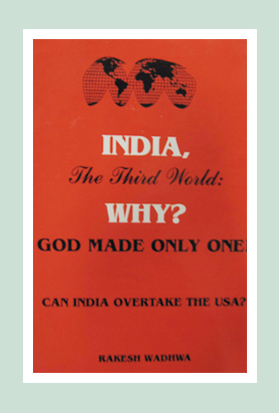
What the readers are saying…