Sweat Shops
Amongst the anti-capitalist images generated by Marxists, is the image of a sweat shop full of children working hard on shoes for a big corporation like Nike. Their argument against the sweat-shop is plain; it is torture of children for the sake of large-scale profits.
Arguments like this one form part of the pro-welfare argument. Poor people need welfare and protection to help them rise up and have a level playing ground. The question to ask is: “Are the government welfare schemes going to work or shall the tax payee money end up in the hands of government officials and middlemen”?
What people need are not government hand-outs but opportunities to grow to their fullest potential.
In the case of the sweat shops, how does closing them help the children? They need the money and lacking options they may well starve or be forced into other more exploitative professions – i.e. girls into prostitution.
Instead of condemning sweat shops, the answer lies in rapid growth of India’s per capital income – so that all parents could send their children to schools instead. This is how sweat shops ended in the western world and how they will end in India.
 Rakesh Wadhwa. Ever since, I was a school boy, I knew India was on the wrong path. Socialism was just not what we needed to get ahead. Government controlled our travel; government controlled our ability to buy and sell; and government controlled our freedom to move our money. My life has focused on the inherent rights people have. When I was in college, I never understood, what the governments meant by their "socialistic attitude". If people are free to buy, sell and move their capital themselves without any restrictions by state, then the welfare of people is inevitable & hence the countries they live in will become wealthy. The government has no right whatsoever, to point a finger at me or my business. I am not a revolutionary. I just want to light up my cigarette and not get nagged about it. I believe in non-interfering attitude to attain more.
 The Bastiat Award is a journalism award, given annually by the International Policy Network, London. Bastiat Prize entries are judged on intellectual content, the persuasiveness of the language used and the type of publication in which they appear. Rakesh Wadhwa won the 3rd prize (a cash award of $1,000 and a candlestick), in 2006.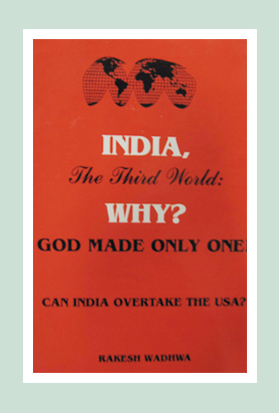
1 Comment
Arhy
February 13, 2012We are snpeding our way into oblivion-we will never get out of debt.The so called ‘leaders’ of our country are nothing but liars and criminals. God help America.