The Core Conflict: Fiat Opacity vs. Bitcoin Transparency of Value
 What type of currency would you prefer for your everyday transactions? Government-issued money (fiat currency), like the US dollar and euro, or bitcoin, a decentralised digital currency not controlled by any central authority. The debate ultimately boils down to who controls and audits the flow of value. Rapid technological shifts, especially in decentralised systems, are fundamentally redefining the arguments.
I had previously commented on the privacy vs. transparency debate, pointing to the irony that governments that demand transparency and full disclosure from the private sector are opaque in their operations. The fiat currency vs. bitcoin debate brings us back to the same dichotomy.
The Core Conflict: Opacity vs. Transparency
The traditional debate often frames privacy as the right to conceal information and transparency as the obligation to disclose it. However, modern digital systems introduce a new layer of complexity: opacity. Centralised legacy institutions operate with an opacity that breeds distrust. They collect vast amounts of private user data but are rarely transparent about how that data is used, modelled, or secured.
The divergence between fiat and bitcoin systems is the starkest example of the privacy/transparency debate in modern finance. The conflict centres on a fundamental shift in where trust is placed and what is made visible.
Traditional fiat currencies operate through a centralised banking and governmental structure. This model exhibits a critical imbalance. The rules governing money supply, interest rates and bailouts are determined by a small, centralised group (central banks). These decisions are prone to systemic opacity. The inner workings of central banks and capital flows remain largely invisible to the average citizen.
All major fiat transactions (bank transfers, credit cards, payment apps) are centrally logged, monitored, and permanently tied to a verified personal identity (KYC/AML rules). For the state and its institutions, the financial life of every participant is completely transparent, traceable, and subject to audit or seizure. For the public, only physical cash offers true transactional privacy in the fiat system.
Bitcoin inverts this model, prioritising a transparent, auditable system over the privacy of transactional data. The rules of the system—the total supply, the issuance schedule, the security protocols and the transaction validation process—are codified in open-source software. This makes it entirely transparent and auditable by anyone. This transparency of the code and the mathematical rules remove the need to blindly trust institutions like legacy banks, central banks or governments.
Every transaction is recorded on a public, immutable ledger (the blockchain) that anyone can view. This is the highest level of transactional transparency. However, these transactions are tied only to cryptographic addresses (public keys), not to a user’s name, ID, or physical location. This provides a high degree of “pseudonymity.” The financial activity is transparent, but the identity of the actor remains private.
The New Privacy Paradigm: Pseudonymity on a Public Ledger
The digital debate is shifting from a fight for data secrecy to a fight for control and context within a world where data leakage is inevitable.
| Feature | Traditional Privacy | Decentralized Transparency |
| Data Protection Goal | Keep information hidden and inaccessible. | Assert control over identity and context on a public, immutable record. |
| Mechanism | Access Control (passwords, firewalls). | Pseudonymity (using unlinked public keys) and Cryptography (zero-knowledge proofs). |
| The New Tension | Privacy vs. Disclosure | Control/Anonymity vs. Institutional Surveillance |
This new paradigm argues that true privacy in the digital age is not the ability to hide everything, but the ability to decide who can link public, transparent data to one’s private, real-world identity. Decentralised systems aim to provide structural, technological guarantees (via cryptography) that allow individuals to participate in transparent economic systems without surrendering their identity to a central party.
The Path Forward: Building Trust Through Auditable Design
To navigate this complex intersection, we must move beyond mere policy compliance and prioritise verifiable trust mechanisms.
Shifting from “Privacy by Policy” to “Privacy by Design”
Privacy cannot be an afterthought or a line item in a terms and conditions agreement. It must be baked into the architecture of systems, ensuring that transparency obligations can be met without undermining individual privacy rights. This includes minimising data collection, anonymisation at the source, and decentralising data stores.
Contextual Integrity
The concept of contextual integrity needs renewed focus. The argument is that the appropriateness of sharing data depends entirely on the context and the governing norms. A transparent public ledger for economic transactions is acceptable if the context allows pseudonymity, while a transparent corporate review of private health data is not.
Auditable Transparency
The most crucial link between privacy and transparency is accountability. Systems must be built to allow for independent auditing (transparency) of how data is handled, while simultaneously protecting the individual identities within that data set (privacy). This is the promise of open-source and decentralised technology. The rules are transparently auditable, leading to greater systemic trust, even if the data itself is immutable.
The Digital Gold Standard: Decoupling Economic Visibility from Personal Surveillance
In his keynote address at the Bitcoin policy summit in September 2025, BTC in DC, tech visionary Jeff Booth warned of increased surveillance and a corresponding loss of individual privacy. He believes this is what happens when centralised powers attempt to maintain control in a deflationary, technology-driven world. In this context, transparency of a decentralised, open-source protocol becomes the mechanism for trust, while the opacity of centralised systems enables control.
The bitcoin-fiat debate highlights that economic transparency needn’t be synonymous with personal surveillance. The fiat model requires you to sacrifice personal privacy (by linking your ID to all digital wealth) in exchange for the (opaque) security of the central system. Bitcoin proposes that a robust, secure, and verifiably transparent economic system can be built on public rules. It allows individuals to participate without surrendering their digital identity to a centralised third party. This shift presents a powerful case that true digital liberty is found at the intersection of system transparency and individual pseudonymity.
 Rakesh Wadhwa. Ever since, I was a school boy, I knew India was on the wrong path. Socialism was just not what we needed to get ahead. Government controlled our travel; government controlled our ability to buy and sell; and government controlled our freedom to move our money. My life has focused on the inherent rights people have. When I was in college, I never understood, what the governments meant by their "socialistic attitude". If people are free to buy, sell and move their capital themselves without any restrictions by state, then the welfare of people is inevitable & hence the countries they live in will become wealthy. The government has no right whatsoever, to point a finger at me or my business. I am not a revolutionary. I just want to light up my cigarette and not get nagged about it. I believe in non-interfering attitude to attain more.
 The Bastiat Award is a journalism award, given annually by the International Policy Network, London. Bastiat Prize entries are judged on intellectual content, the persuasiveness of the language used and the type of publication in which they appear. Rakesh Wadhwa won the 3rd prize (a cash award of $1,000 and a candlestick), in 2006.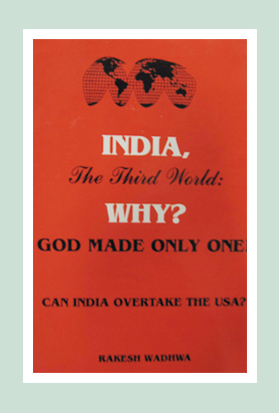
What the readers are saying…