The Military Industrial Complex
The US deployment of troops in Afghanistan has raised much ironic press against Nobel Peace Prize winner, Barack Obama. It has also brought back speculation with regards to the US defense budget, specifically money allocated to private production of defense equipment and the supply of this equipment to other ‘enemy countries’.
Many journalists and documentary makers have begun quoting Dwight Eisenhower’s farewell speech where with much foreboding he spoke of the Military Industrial complex and its many cancer like outcomes.
Interestingly India for the last decade has been speculating on opening up the private sector, in the defense sector. The government founded a Group of Ministers committee that submitted a report titled: “Reforming National Security System”. Based on the recommendations of the report, the defense sector was opened up 100% up to private investment and was given a 26% FDI cap.
This reform was part of an ongoing dialogue, obsessed with increasing India’s strength and research capability in terms of armaments. The country’s armed forces have been subject to poor, imported, and expensive armament technology for some time. India’s research divisions under organizations like the DRDO have seen negligible progress. Bearing these factors in mind, it seems natural that the government might want to look into private investment in defense by awarding Raksha Udyog Ratnas to reliable firms. But, is the RUR enough? And, isn’t the armament industry in America sufficient admonition against private investment?
Desiring government control is all nice and idealistic but when the money starts pouring in, it would be naïve to expect the government not to try and profit from private defense technology production. Maybe they’ll fling a few wars around the world? People will die.
If you were to glance at the decrepit state of the country’s defense technology now, you might neglect the warnings. The question in itself is not a closed one. Perhaps private investment in defense needs a lot more thought.
 Rakesh Wadhwa. Ever since, I was a school boy, I knew India was on the wrong path. Socialism was just not what we needed to get ahead. Government controlled our travel; government controlled our ability to buy and sell; and government controlled our freedom to move our money. My life has focused on the inherent rights people have. When I was in college, I never understood, what the governments meant by their "socialistic attitude". If people are free to buy, sell and move their capital themselves without any restrictions by state, then the welfare of people is inevitable & hence the countries they live in will become wealthy. The government has no right whatsoever, to point a finger at me or my business. I am not a revolutionary. I just want to light up my cigarette and not get nagged about it. I believe in non-interfering attitude to attain more.
 The Bastiat Award is a journalism award, given annually by the International Policy Network, London. Bastiat Prize entries are judged on intellectual content, the persuasiveness of the language used and the type of publication in which they appear. Rakesh Wadhwa won the 3rd prize (a cash award of $1,000 and a candlestick), in 2006.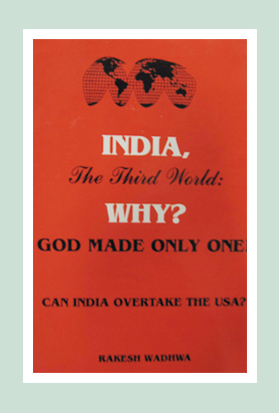
1 Comment
Zaylin
November 29, 2011It was dark when I woke. This is a ray of sunshine