The Commonwealth Games
It must have struck some of you; the way the media, in the middle of the commonwealth games, seemed to change its very acrimonious stance towards the government. The games went very quickly from being shame of the nation to being a cause for patriotic pride.
And yet for the average citizen in Delhi they were a symbol of nothing less than throttling control by the state. With the lack of infrastructure to actually accommodate the games, citizens of the city were pushed around to make that space. And in an unhealthy way, policemen and NSG guards became a common and in some case a harassing reminder of the presence of the games.
And of course now there is talk of a bid for the Olympics. One can only imagine the torture the citizen will have to endure in that case. And with respect to this one has to wonder, if games are to be directly equated with patriotism, and then one must ask, patriotism for whom? The young lady who is harassed by excessive policing, the non-government worker who travels in a stifling metro train every day? Whose patriotism is this?
 Rakesh Wadhwa. Ever since, I was a school boy, I knew India was on the wrong path. Socialism was just not what we needed to get ahead. Government controlled our travel; government controlled our ability to buy and sell; and government controlled our freedom to move our money. My life has focused on the inherent rights people have. When I was in college, I never understood, what the governments meant by their "socialistic attitude". If people are free to buy, sell and move their capital themselves without any restrictions by state, then the welfare of people is inevitable & hence the countries they live in will become wealthy. The government has no right whatsoever, to point a finger at me or my business. I am not a revolutionary. I just want to light up my cigarette and not get nagged about it. I believe in non-interfering attitude to attain more.
 The Bastiat Award is a journalism award, given annually by the International Policy Network, London. Bastiat Prize entries are judged on intellectual content, the persuasiveness of the language used and the type of publication in which they appear. Rakesh Wadhwa won the 3rd prize (a cash award of $1,000 and a candlestick), in 2006.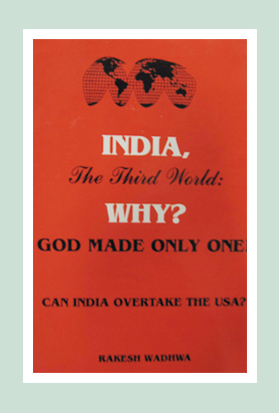
What the readers are saying…