Bitcoin: Herald for Free Markets?

Imagine a currency that does not belong to any one country, owes no allegiance to geographical or political borders and exists only in virtual form. Now imagine the impact on the economies of the world when confronted by this relative newcomer in the currency category. Today, bitcoin is the most widespread Internet currency. It is digital, decentralized and in use globally. The best part about this cryptographically-secure currency is that transactions using it does not require middlemen – in other words, there are no banks involved. So, here are no transaction fees!
So What’s a Bitcoin Anyway?
Bitcoin is essentially a program with in-built rules. The program can process user transactions anonymously and no central bank can regulate its transactions. It works a lot like online banking and can be transferred cryptically from one digital repository (e-Wallet) to another. In short, it is a system of money in which a computer algorithm governs its functioning; rather than the government.
Bitcoin transactions are protected by the ‘blockchain,’ a public ledger that records the history and proof of transactions on each computer node involved in a transaction. As a result, an individual bitcoin cannot be used in two places at the same time.
Using Bitcoins
As a virtual currency, bitcoin offers advantages such as protection against unauthorized spending and forgery. A bitcoin in itself contains no intrinsic value and is subject to market fluctuations. This is caused by the fact that bitcoin is not determined by any fixed exchange rate regime.
Anything can be purchased online using a bitcoin, from ordering a pizza to booking a holiday in Hawaii. Total privacy is assured in your transaction. The greatest advantage is that international payments become easier and cheaper, with this currency not being governed by any country. Some folks are using bitcoins as an investment.
Real Money Reports to Governments
Most governments are more than happy to regulate the exchange rate of currencies and some have banned the threat of bitcoins, but this move is close to impossible. The privacy offered by bitcoins is definitely bothering some governments, but there’s growing acceptance of this currency by even the most unlikely countries. China has recently emerged as a major bitcoin destination. In fact, bitcoin exchanges in China account for 42% of all bitcoin transactions. Pretty soon, one can expect bitcoins to be accepted in the casinos of Macau.
The US has categorized bitcoins as ‘property,’ and there are predictions of the value of this currency jumping in the event Trump becomes President. Windsor Holden, head of forecasting & consultancy at Juniper Research, said in a statement, “If Donald Trump becomes president of the U.S., there is the very real prospect of turmoil on world markets — the Economist Intelligence Unit ranks his presidency within the Top 10 global risks…However, bitcoin trading would thrive in such an environment, at least until the impact on major fiat currencies becomes clear.” Juniper Research predicts the total volume of bitcoin transactions to skyrocket from less than $27 billion in 2015 to more than $92 billion by the end of 2016.
Who are Bitcoin Users?
Initially bitcoins earned a bad reputation, due to the anonymity of transaction. Many governments believe “privacy” means we’re definitely up to no good! They believe that without regulations, we would all end up dealing in narcotics!! Here are some facts that point to the contrary:
Microsoft, Dell and Dish Network are among the biggest companies that accept bitcoins as a method of online payment. Among the other big players are multinational retail chains, airline companies and dating sites. What’s more, you can actually use bitcoins to buy a gift card from major retailers like Wal-Mart, Amazon and Target.
As you can see, a mere 17 MB of source code can literally overtake the world’s economic systems and create disruption, upheaval and serious rethinking about the fundamental tenets that governments base their economic and financial institutions upon.
 Rakesh Wadhwa. Ever since, I was a school boy, I knew India was on the wrong path. Socialism was just not what we needed to get ahead. Government controlled our travel; government controlled our ability to buy and sell; and government controlled our freedom to move our money. My life has focused on the inherent rights people have. When I was in college, I never understood, what the governments meant by their "socialistic attitude". If people are free to buy, sell and move their capital themselves without any restrictions by state, then the welfare of people is inevitable & hence the countries they live in will become wealthy. The government has no right whatsoever, to point a finger at me or my business. I am not a revolutionary. I just want to light up my cigarette and not get nagged about it. I believe in non-interfering attitude to attain more.
 The Bastiat Award is a journalism award, given annually by the International Policy Network, London. Bastiat Prize entries are judged on intellectual content, the persuasiveness of the language used and the type of publication in which they appear. Rakesh Wadhwa won the 3rd prize (a cash award of $1,000 and a candlestick), in 2006.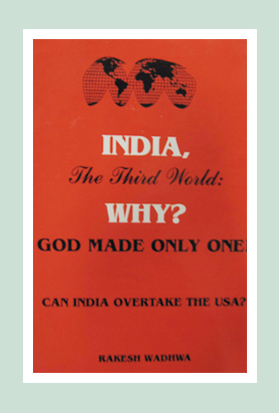
What the readers are saying…