Governments and Contradictory Objectives
My previous blog – Why Governments Fail – addressed some questions. Governments do not fail because of inept politicians or a dearth of the number of laws being passed.
There is talk of improving the public sector by removing political interference and granting autonomy i.e. run government companies as private companies. This is a contradiction. If the public sector is to function as the private sector and provide a return on investment, then why have it at all?
Why Governments Fail?
When one is in office one has no idea how damnable things can feel to the ordinary rank and profile of the public – Sir Winston Churchill
Government isn’t the solution; government is the problem – Old slogan of the Libertarian Party of the USA
Feeling good about the government is like looking on the bright side of any catastrophe. When you quit looking on the bright side, the catastrophe is still there – P.J. O’Rourke
Why do governments perform poorly? Why do government actions have consequences which are the opposite of the intended objectives? Why are government forays into business abysmal failures? Why is the government record pathetic in controlling crime and terrorism? Why when the government administers justice, the horrendous delays negate the concept of justice? Why are government budgets perpetually in deficit and countries eternally in debt? Why are governments constantly looking for increased revenues and forever increasing taxes? Why are government actions hallmarks of ineptitude and inefficiency? Why is corruption endemic?….Why?

Why India and Nepal Rank Low in Economic Freedom Index
On the face of it, economic freedom is a simple concept. However, it encompasses every aspect of an individual’s life. Economic freedom defines the standard of living and has a significant influence on the quality of life.
A Review of Mancur Olson’s Power and Prosperity
Renowned social scientist and economist Mancur Olson is best known for his treatise called The Logic of Collective Action. But, it is another work of his that also deserves attention. In Power and Prosperity, Olson deals with the oft repeated question – why does an economic divide persist between countries?
The History and Modern Forms of Baccarat
Which is the game whose dealings end up influencing the annual turnovers of major casinos across the globe? Which game is the favourite of the ‘high rollers’ or the casino’s crème de la crème? It is the game that was once a penchant for the French royalty and has been shown in most of the Bond movies. Yes, ladies and gentlemen, it is Baccarat.
How the Concept of Laissez Faire has Evolved
Laissez Faire is a term that finds its etymological roots in the French language, in which it means ‘allowed to do’. Also referred to as ‘let it be’ economics, Laissez Faire refers to a sect of political thought that does not favor political interference in private sector free markets. It was claimed to have first been first coined by Marquis D’Argenson, who was to later become Louis XV’s foreign minister during the Austrian War, in his work titled Memoires, published in 1736.
Various political groups throughout American history have made it their clarion call, right from Thomas Jefferson to recent political leaders such as Ron Paul.
Some of the Best Casinos Across the Globe – Part II
Casino gaming has a long and eventful history. The industry stops for breath once in a while, but its contribution to the inflow of tourists and foreign currency as well as tax revenues cannot be overlooked. Yes, it is continuously in the spotlight of government regulations, but an increasing number of countries are embracing the opportunities the casino industry has to offer.
More recently, Macau has become the epicenter of the global casino industry. However, visiting Las Vegas still remains the dream for most casino lovers. The EMEA (Europe, the Middle East and Africa) region also has its share of magnificent and exciting casinos.
In my previous article, which you can read here, I covered some of the best casinos in the Eastern part of the world. Here, I have described some of the most exciting casinos in Las Vegas and the EMEA region. There is also one casino from Nepal that finds a mention in this article.

Some of the Best Casinos Across the Globe
Prior to the worldwide economic downturn, the global casino industry was surging ahead, seemingly unstoppable. Growth records were set between 2004 and 2008, with gross gaming revenues jumping 24% during these four years to US$358.0 billion.
Laissez-Faire Leadership: An Oxymoron?
Also known as delegative leadership, laissez-faire leadership is a ‘hands off’ form of leadership, in which the leader believes in freedom of choice for his team. The leader provides minimal direction to the team and delegates most responsibilities to
Online Gaming: Time to Give it its Due!
In the first part of this article, which you can read here, we discussed the hurdles that online gaming and its legal status have witnessed worldwide. While the size of the widely popular gambling form is difficult to measure, there are a few ways in which the necessary change can be brought about. In this section, we will talk about those factors that can usher in some positive developments in this regard.

 Rakesh Wadhwa. Ever since, I was a school boy, I knew India was on the wrong path. Socialism was just not what we needed to get ahead. Government controlled our travel; government controlled our ability to buy and sell; and government controlled our freedom to move our money. My life has focused on the inherent rights people have. When I was in college, I never understood, what the governments meant by their "socialistic attitude". If people are free to buy, sell and move their capital themselves without any restrictions by state, then the welfare of people is inevitable & hence the countries they live in will become wealthy. The government has no right whatsoever, to point a finger at me or my business. I am not a revolutionary. I just want to light up my cigarette and not get nagged about it. I believe in non-interfering attitude to attain more.
 The Bastiat Award is a journalism award, given annually by the International Policy Network, London. Bastiat Prize entries are judged on intellectual content, the persuasiveness of the language used and the type of publication in which they appear. Rakesh Wadhwa won the 3rd prize (a cash award of $1,000 and a candlestick), in 2006.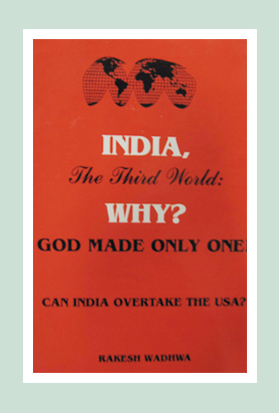


What the readers are saying…