Manila’s Crown Jewel
The successful operators of Macau-based Melco Crown Entertainment Limited look to continue their winning streak with a brand new venture, The City of Dreams, in Manila. Started in December 2014, The City of Dreams aims to attract high-roller Asians for a whole new experience. This is the second development in the famous Entertainment City, and only adds to the city’s mission of topping Las Vegas’ revenues by 2020.
According to Julius Guevara, director of a real-estate consultancy, the bay-side area of Manila shows promise. He claims that the property rates have gone up, along with the development of the city’s infrastructure. He says that the whole city is being “brought-up” and chiselled to match the existing gambling business and luxury resorts across the world.

The City of Dreams, Manila – The Economic Significance
The luxury establishment consists of three hotels, with over 380 gambling tables. According to a statement by Melco Crown, it alone represents over 5,000 jobs. The country’s gambling regulator, the Philippine Amusement and Gaming Corp, expects this new strip to contribute at least $10 billion annually. What this means is that it will outshine Vegas as well as Singapore by 2020.
The confidence behind the Gaming Corp’s expectation is not only due to the project size. The City of Dreams is the only company in Manila with a huge backing in Macau. So, Melco Crown will be able to draw in VIP customers from Macau to this new destination. However, are the VIPs enough? Considering the charts in Macau, the VIP clientele contributes to over 70% of the revenues. This is not only the case with Crown Limited, but with many other leading casinos in that country.
Macau versus Manila
Lawrence Ho, CEO of Melco Crown, expects the revenue breakdown between Macau and Manila to be a little different. He expects that the non-gaming revenue in Manila would amount to anywhere between 25% and 30%, compared to about 10% for the Macau counterpart. This means, apart from gaming, there will also be a demand for leisure activities and entertainment. Also, unlike the 70% VIP engagement in the Chinese establishment, the VIP customers might only account for 50% of the revenues at the Philippines strip.
The City of Dreams also has a tie-up with the Philippines’ SM Group, which is the largest shopping mall operator in the country. This will further help in brand development and domestic revenues.
The chances that this strip will nibble into the market share of both Singapore and Macau have also increased. Both these cities recorded a lull in gaming revenues in 2014. So, one can assume that the public is looking for a new scene. Also, the recent visa restrictions and anti-corruption crackdowns in China might fuel the need for high-rollers to look at the Manila alternative.
What does the Future Hold?
The Manila strip has been setup with a mission to offer the most luxurious hospitality and entertainment experience; and this will definitely attract diverse clients and enhance business growth. So, the 2020 target of Manila becoming Asia’s premier gaming destination is not as far-fetched as it had earlier seemed.
By the end of the decade, Manila Bay is expected to be filled with an array of massive establishments. And this growth spurt might be the biggest development progress that the hospitality sector has seen. Also, it is highly unlikely that the surge will be supported solely out of domestic demand. There is also a huge need to increase the influx of tourists. However, this might be a challenge because neighbouring countries, like Thailand and Malaysia, have been long established as tourist hotspots. A good way to attract tourists is to offer inclusive packages that cover these neighbouring countries as well.
 Rakesh Wadhwa. Ever since, I was a school boy, I knew India was on the wrong path. Socialism was just not what we needed to get ahead. Government controlled our travel; government controlled our ability to buy and sell; and government controlled our freedom to move our money. My life has focused on the inherent rights people have. When I was in college, I never understood, what the governments meant by their "socialistic attitude". If people are free to buy, sell and move their capital themselves without any restrictions by state, then the welfare of people is inevitable & hence the countries they live in will become wealthy. The government has no right whatsoever, to point a finger at me or my business. I am not a revolutionary. I just want to light up my cigarette and not get nagged about it. I believe in non-interfering attitude to attain more.
 The Bastiat Award is a journalism award, given annually by the International Policy Network, London. Bastiat Prize entries are judged on intellectual content, the persuasiveness of the language used and the type of publication in which they appear. Rakesh Wadhwa won the 3rd prize (a cash award of $1,000 and a candlestick), in 2006.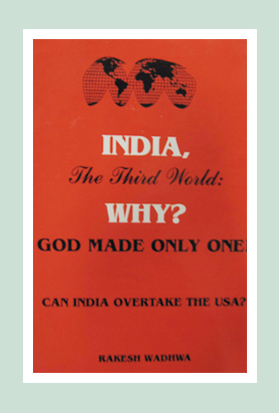
What the readers are saying…