

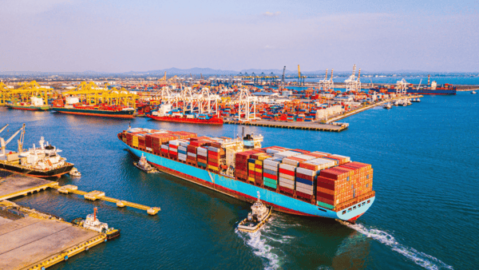







Trade will make us rich
Countries which trade are rich. Countries which don’t are poor.
If I were to pick up one indicator of the wealth of a nation, that would be its exports and imports. Consider India: its share of world trade which was 2.5% at the time of its Independence, had plummeted to 0.45% by the late 80s.
It was a pathetic performance. India, with 16% of the world’s population, would have had to increase its imports and exports by 32 times to just reach the world’s ‘average’. India remained poor – its people had to survive on less than a dollar a day.
Compare this with a ‘dot’ on the globe: Singapore. With a population of just 4.2 million, its imports and exports are double that of India’s. This translates to each Singaporean trading, on average, 500 times more than an Indian. No wonder an average Singaporean lives comfortably, enjoying an annual income of over US$ 25,000.
Some say that the comparison with Singapore is not apt. Let us compare China with India. ‘Anti-capitalist’ China’s trade with the world has burgeoned to a trillion dollars, five times that of India’s while China’s population exceeds India’s by just 28%. Chinese now enjoy an annual income which is more than twice that of the Indians while just three decades ago the Chinese were poorer.
Contrast Nepal with Switzerland. Both countries are landlocked, but, the similarity ends there. Again trade provides an indication of why Nepal lags behind. Nepal’s imports and exports don’t add upto even three billion dollars. Switzerland’s figure is 326 billion dollars.
On a per person basis, the comparison is even more stark. Each person in Switzerland trades 400 times more than a Nepali. Switzerland’s per capita annual income at US$ 35,000 is one of the world’s highest.
Trade is not the only reason for Switzerland’s wealth. Their banking laws which guarantee anonymity to the depositor also have a lot to do with the Swiss being rich. However, trade plays a significant role.
Why are Singaporeans and the Swiss such good traders, achieving a prodigious percentage of the world’s trade, while the Indians and Nepalese are bit players and do not count? High taxes and stifling controls pursued by Nepal and India compared to the free market, low tax policies (average import duty is below one percent) of Singapore and Switzerland is the reason.
India, upto 1990, was ‘protected’ by the world’s highest tariff rates, import bans on all consumer products, and an inefficient and corrupt bureaucracy bent upon controlling trade.
The results of this ‘protection’ were obvious. Indians who would buy from a Scot and sell to Jew and still make a profit had no opportunity to do so in the world markets.
Post 1990, India began to see sense, but only after its policies had brought the economy to a shuddering halt. It had no foreign currency left and had to pawn its gold reserves. India liberalized and very soon its trade took off and dollar reserves started accumulating.
Within 15 years India achieved what it could not do in the earlier five decades. Its share of world trade has increased to 0.8% and foreign exchange reserves have crossed the 140 billion dollar mark starting from almost nothing.
If this was achieved with only a modest reduction of controls and import duties, consider what can be attained by the abolition of all controls and taxes on trade.
The good news for Nepal is that it can rewrite its laws tomorrow. There is nothing stopping this country from emulating Singapore and eliminating its trade barriers.
The government has to do just this and then watch the people of this country take to trade as a child takes to candy. Nepal will have shopping malls no less full of merchandise than Singapore. Goods will be cheaper too as both labour and real estate are priced lower.
Further Nepal will get as many tourists as it can handle. Why should people from India, Bangladesh and Pakistan go to Singapore, Hong Kong or Dubai when they can come to Nepal with its warm, hospitable people, majestic mountains, and, yes, cheaper perfumes too.
The Himalyan Times
Regulate Less, Save Lives
It is a fundamental principle of economics that demand for a product increases with a reduction in its price. As regulations are ‘free’, and people who advocate them bear negligible costs, it is virtually guaranteed that demand for government regulations will continue to grow indefinitely.
However, do government regulations really cost us nothing? Is the cost always borne by big corporations and evil businessmen? Businesses may initially bear the costs, but rest assured that they will, as soon as they can, pass on these costs to you and I. How? By an increase in the price of goods that we buy. We as consumers ultimately pay for all government regulations.
Each individual regulation added onto by the government means little to us, and the cost of each may be so infinitesimal, that it is only rational for us to ignore it and concentrate our attention on more pressing matters. The problem is that when the cost of all the regulations imposed on us is added up, it is no longer a small matter.
The only country where an attempt has been made to identify the cost of regulations is the US. The cost borne by its people was estimated at $660 billion in the year 2000. The projected annual cost now for a household of four exceeds $10,000.
Clearly, this level of regulation if imposed on the people of Nepal, would immediately shatter the economy. Imagine if the US regulations, designed to protect buildings against earthquakes in Los Angeles, were made applicable in Kathmandu. All, except the wealthy few, would find themselves gazing at the stars at night instead of a roof.
Even though a rich country can better tolerate regulations, yet it is this regulatory burden – exceeding half of the US federal government’s tax receipts – which has made annual growth rates in America average an anemic two percent.
No one doubts the good intentions of our lawmakers. Regulations are often drafted with thoughts of making our buildings safer, food healthier, water hygienic, air pollution free, aircrafts less likely to have accidents, and labour happy.
The problem is that this plethora of regulations increases the cost of everything we buy and, hence, makes life difficult for the most vulnerable in our society: the poor. They just cannot afford the costly goods.
Theoretically, it is possible to eliminate aircraft crashes by zealous government oversight and regulation. However, the cost of such burdensome regulations would make air-travel so expensive that many more people would die because of the use of road transport, which is far less safe than travel by air.
In Nepal, the best way for government to make domestic air travel safer would, ironically, be by deregulation. Let the government abrogate the monopoly of domestic airlines and permit foreign airlines to compete on domestic routes. This would increase foreign investment, bring in international airlines – with a worldwide reputation to protect – and make flights safer.
Big companies often capture the government agency in charge of regulating by intensive lobbying. They then use regulations as a weapon against their smaller competitors.
In the UK, for example, large businesses wanted an onerous licensing burden to be applied to all food premises. These big companies knew that they would have an easy time complying with these regulations, but their smaller competitors would be forced to close shop.
In the same manner, asking roadside restaurants in Nepal to adhere to standards which are met by Hyatt or Holiday Inn would result in their closure. Commonsense tells us that this is not a desirable outcome.
Likewise, minimum wage laws and other labour legislation cause problems for small businesses. The big companies can pay their staff more than what is required by law and would be happy to see that the small enterprises are forced to do the same. Strict enforcement of wage & labour laws as exist today would lead to the closure of most of the small businesses with unemployment even more widespread than it is now.
We should learn from the example of the developed countries and try to rid ourselves of regulations if we are to banish poverty faster. Deregulating by creating wealth, would save lives. Rich people live longer by about 20 years – that is the difference in life expectancy between those living in the rich and those in poor countries.
The Himalyan Times
Should Beauty be Penalised?
Sapna Malla Pradhan, Nepal’s foremost women’s right activist is a person I respect. We see eye to eye on a number of issues. Both of us would like to legalize the right of sex workers to pursue their profession. However, there are some issues on which we disagree.
Pradhan is for protecting workers by law, and for men and women once hired to be allowed to stay in their position until retirement. I want the government out of the hiring and firing process, and for employees and employers to decide between themselves what their relationship will be.
Let’s take Hong Kong. Prior to the 80’s, their were no labour laws ‘protecting’ the island state’s worker. Hong Kong absorbed immigrants from mainland China by the millions. Between 1945 and 1987, its population grew from 7,00,000 to 5.6 million – a compounded annual increase of 5.08%. This population explosion was unparalleled in the world’s history.
This increase in manpower was absorbed into the work force easily. Instead of poverty and destitution one might expect, Hong Kong grew at such a pace that its people became richer than those in UK, or Canada. It prospered even as its population zoomed. Its workers, including its women, were fully employed.
Even though Hong Kong, with its 7,000 people for each of its square kilometers, is one of the world’s most crowded places, its per capita income is almost US$ 25,000, Britain’s barely nudges past $22,500. Canada’s people are also behind earning $23,500 annually.
Let’s contrast this with Europe which, with its stringent labour laws, wanted cradle to grave security for its people. Because it was so difficult to fire workers, businessmen in Europe hired only when it became absolutely necessary. Unlike Hong Kong businesses, which hired as soon as they could productively employ someone, the European industrialists waited until it become absolutely clear that additional workers would be required forever. The result was chronic unemployment of 12% or more.
America, which though not as free as Hong Kong, allowed hire and fire subject to some ‘safeguards’. The US unemployment at around 5%, was significantly lower than that of Europe’s, though even it could not match Hong Kong.
If in Nepal we truly want to protect workers and enhance their well being then do not let the law take sides. Let voluntary contracts rule. Adopt business friendly policies and it is competition amongst employers which will continuously raise productivity and the wages of the Nepalese workers.
Why should government force hotels, airlines, and casinos to keep old ladies, when survey after survey has shown that customers prefer smart, young, and beautiful girls to serve them. Is it necessary that RNAC and IA retain aged and overweight airhostesses? Are we reducing unemployment, or are we merely blocking the positions which should go to the young? What would be wrong in explaining to new hirees, that their jobs are for five years and not more?
Don’t we hire men based on their intelligence? Would we want a dumb pilot to fly us, or have a moron perform brain surgery on us? To some God has given brains, to others beauty, and if we let market forces value these traits, what’s wrong?
I want to enquire of Sapna, “doesn’t society and the law accept that, in some fields, beauty and youth are legitimate grounds for hiring?” In movies does a youthful Rani Mukherjee dance, or, does the honour go to elderly ladies? Should the government force filmmakers to hire me in the place of Aishwarya Rai, in the name of equity and fair play?
And should Aishwarya once hired by a movie producer continue to be given work upto the age of 60? Obviously, this doesn’t make sense. It doesn’t make sense to put old and worn out faces on films, TV, or on the ramp for modeling. So, is it sensible to have grandmothers walk up and down the aisles of our national airlines serving us coffee?
It would be best for government to keep out of what should be done by voluntary consent. And as long as we continue to value beauty, the market, which merely aggregates our wishes, will continue to reward it. This, Sapnaji, is ok.
The Himalyan Times
The Communists of India and China
What is happening in Kolkata is enough to make Marx and Lenin turn in their graves. The Indian communists of West Bengal have given up their ideology and are going out of their way to attract capital – Indian and foreign.
Kolkata boasts of India’s largest Pizza Hut outlet, as well as highest selling Sony World franchisee. As if these symbols of capitalism were not enough of a reminder of a changed world, Manabendra Mukherjee, minister of IT, in the state’s communist government can look at Westside and Pantaloon malls on Camac Street from his office.
Bengal, a bastion of India’s communist rulers for 29 years, is witnessing a sea change. The communists remain in power but their philosophy could not be more different. They have embraced pro-market reforms with a vengeance – as if to make up for all their failed policies in double quick time.
Bengal’s government encouraged Pepsi to set up its potato processing plant in the state. Currently the company is doubling its 80 crore investment. The state has now become India’s second largest grower of potatoes. Dabur too has set up a fruit processing plant. Moreover, four companies from France have shown interest in investing in food processing. The communist Chief Minister, Buddhadeb Bhattacharya’s, avowed intention is to obtain investment and he doesn’t care whether it is Indian or foreign.
Though Bengal was always India’s top rice producer, it has now become No.1 in producing vegetables and pineapples as well. This has happened because, unlike in the erstwhile Soviet Russia, farms in Bengal are privately owned and whatever the tillers produce they keep.
No wonder Bengal has stunned India with its growth rates, and turnaround in industrial and agricultural development. In the last decade its economy grew by over 7% a year, while even Karnataka – the state which has Bangalore as its pride – could only manage a 6.4% yearly increase in its domestic product. Gujarat at 6.1%, and Haryana at 5.8% were way behind.
This growth has been led by Rs.27,000 crore of private industrial investment flowing into the state in the last 13 years. This investment was higher than in Maharastra, and second only to that in Gujarat.
The communists now woo private capital as if their lives depended on it. The investment in iron and steel projects is in hundreds of crores. Kolkata exports, from minister Mukherjee’s favourite IT complex, software and BPO services valued at Rs.1,400 crores. What is happening in India’s Bengal is no different than what is taking place in Lenin’s Russia and Mao’s China.
China, especially, exhibits capitalism. Its pro-market and pro-investment policies have gone far ahead of India’s in liberating businesses from red tape and controls. Where as India grew by 6.9% in 2004-05, the figure for China was 9.5%. If we account for what has happened since 1980, China is even further ahead. Its average annual growth of 9.5% exceeded India’s 5.7% by a whopping 3.8% every year.
This extraordinary growth in China has been due to its ability to convince investors to regard it as the ultimate opportunity for profits. While in 2001-03, China garnered in excess of 10% of the global foreign investment, India could not even get to the 1% mark.
China has become the world leader in exporting textiles. The success of its private entrepreneurs sends a chill down the spines of world’s competing businessmen. In 2004 alone China exported US$ 97 billion worth of textiles. India could only manage to send abroad textiles valued at US$ 14 billion.
Textiles are not the only success story. China’s manufacturers, across the board, are bedeviling the world with their newfound aggressiveness in closing deals. They are hungry for domination in the world markets and are leaving their competitors in the dust.
It is ironic the way China has jettisoned the teachings of Marx, Lenin, and Mao. Even more ironic, though, is how, in other countries including Nepal, communists still cling to their failed ideology. Let the Nepalese communist parties send their cadres to Bengal, China and Russia. Let them understand how these places, where communism originated, function. On their return, they just might influence their leaders into embracing capitalism, markets, reforms, and hence prosperity.
The Himalyan Times
The Sun, Tsunami and global warming
I know for sure that one day the ice age will descend upon all of us. It is global cooling that we should worry about not warming.
The day this will happen is billions of years away but the probability of it happening is 100%. The sun is going to run out of the fuels that power it and provide us with warmth. When that happens, in whatever billion years, earth will again descend into – this time – an endless ice age.
However, beyond this certainty, there is not much that we can accurately project about the forces of nature. No one predicted the tsunami. Even a days warning – a believable one – would have probably saved 90% of the 1,50,000 thousands lives that were lost. When we can’t even predict a disaster of this magnitude 24 hours in advance, why are we ready to believe pseudo scientists telling us that somewhere between tomorrow and a 100 years global warming is going to occur?
It is that time of the year, when I wish that a little bit of warming does take place. It is cold in Kathmandu, and colder still for those high up in the mountains. I am sure my wish is the same as of those living in Siberia –where winter temperature routinely go 50º below freezing.
Andrei Illarnov, economic advisor to President Putin of Russia, gave a brilliant presentation in Salt Lake City in the US and later on in Hong Kong – both of which I happened to attend. He spoke at length, and showed the gathering of economists scores of charts completely debunking the myth of global warming. Later on I asked him if he would e-mail me his presentation. He sent it to me the next day, and, anyone who wants it can have it from me.
There is no point, Illarnov said, of trying to affect changes in earth’s temperature by expending vast resources – estimated in trillions of dollars over the next 100 years – to effect 2-3 degrees of cooling. Bjorn Lomborg, a Danish environmentalist calculates that the Kyoto treaty (to curb warming) would slash economic growth by $150 billion a year to merely cut temperature increase by 0.3 degrees by 2050. For half that amount, he says, we could provide clean water, proper sanitation, quality education and modern healthcare for every poor person on the planet. Rise in temperatures – doubtful at best – even if it occurs will do far less harm than the diversion of cash to protect us from its effects.
The problem is not of global warming, it is of getting funding from government. Scientists who can scare the public by showing a credible threat to our planet can get funding for their research. Contrast this with a person like Andrei, who shows us no threat, and if there isn’t one, obviously he doesn’t need funding and will not get it.
Andrei did not go back a year or two or even 200 years, he traced the weather changes since the earth was born. He proved, conclusively in my opinion, that the minute changes of a few degrees which people talk about, and we are given warnings of, are nothing new. Nothing is static in nature. Temperatures today are no higher, and, are in fact lower than they have been at several points in the earth’s history.
Statistics can lie. They can be made to prove anything. If we want to prove warming, we just have to take a time period which shows that temperatures are rising and then extrapolate it to the next 100 years. If, on the other hand, we have to show cooling, all we have to do is to choose a different time period which shows falling temperatures and extrapolate it. Journalists, in an attempt at sensationalism, do this all the time.
It is evident that we can’t predict nature with any certainty. At least, not yet. The tsunami death toll is proof enough. I know that we will face calamities caused by ‘acts of God’. However they will come, unpredictably, like the tsunami, and catch us by surprise. Will global warming take place. I doubt it. Why? Because we are predicting it, and foolishly, even planning to mitigate its effects.
The Himalyan Times
The Hunt for the Poor
My grandmother sought the poor all her life. This hunt intensified during the last few years of her life; being bedridden, she realized that she didn’t have long to live and, therefore, her time for giving was limited. She believed that the way to heaven was by giving. Beggars might have lived without her munificence but I doubt if she could have breathed without them. No giving, no salvation.
The desperate cries of international aid organizations, UN agencies, ADB, NGO’s, INGO’s that, ‘the poor are still among us and we need funds’, reminds me of my grandmother. Without the poor, these agencies cannot justify their existence. They need the poor just like my grandmother needed them.
The problem for those who work in these organizations for uplifting the poor is that people who depend on alms are becoming fewer. And those who are poor are realizing that it is not aid and charity which is going to deliver them from poverty but opportunity.
And this opportunity is being unleashed by the forces of globalization. Look at China and India. These two countries housed the world’s poor. Both have become more open to the world and in doing so are eliminating poverty at a breathtaking pace.
Economic reforms started in the 70’s in China and 90’s in India have done more to eliminate poverty than the combined efforts of all aid agencies could have achieved in the next 100 years. And this removal of poverty has come accompanied with self-respect and dignity unlike the affront and indignity inherent in receiving charity.
These facts are inconvenient to those involved in the effort to increase charitable funding for the poor. The facts lead to an irrefutable conclusion: that what can end poverty is not charity but openness to trade, commerce and investment. This would mean that aid should end, but obviously the seekers of the poor have no desire to becoming unemployed.
The forces of globalization appear irreversible. Even in countries like Nepal where the government has failed to create conditions for economic growth, the poverty levels are falling. There might be limited opportunity but the youth still have an out: they can go abroad. And they are doing just that. Those who cannot go to the US, UK, Canada, or Australia go to the Middle East, Malaysia, or South Korea. For those unable to go anywhere else, India is open.
It is this increasing opportunity worldwide that is keeping the Nepali economy ticking. Despite being one of the worst managed economies, Nepal is still managing growth rates of 4%. Remittances from those who are abroad in better managed globalised lands are doing the trick.
Apart from Nepal, which caters to the needs of thousands of NGO’s, the other bright spot for aid givers is the continent of Africa. There the aid agencies have succeeded spectacularly in supporting poverty.
They have given aid to support brutal dictators like Idi Amin in Uganda who killed and tortured hundreds of thousands and threw foreign businessmen out of his country. They supported Mobuto of Zaire who stashed 80% of the $5billion in aid in his personal Swiss banks. The current favourite is Mugabe who has expropriated the land and wealth of foreigners and destroyed agriculture in Zimbabwe. His population depends on aid. NGO’s could not be happier.
However, inspite of the African dictators and Nepal, it appears that poverty as we know it is going to disappear. So will aid agencies just wind up? No chance of that happening anytime soon. Moves are afoot to change the definition of poverty. Upto now poor have been defined as those who survive on less than a dollar a day. ADB has already said that it considers the poor to be those who earn less than two dollars in a day. Watch out as poverty gets redefined by aid agencies.
I predict that very shortly every one of these agents of poverty would adopt the $2 standard and when everyone earns over that amount then the line will be shifted to $4. The poor will always be there, because the givers, just like my grandma, cannot exist without them.
The Himalyan Times
When US Tried Communism…
I write this especially for our Maoist brothers. While the US is commonly vilified as the bastion of capitalism, it is little known that the US too has tried communism. It was only when communism failed that property rights and capitalism took hold.
Let us go back into history and see what lessons America learned from its relatively short dalliance with Maoism much before the ‘great leader’ himself was born.
The year was 1607. The first 104 settlers had arrived from Europe in Jamestown in the Virginia Tidewater region of the US in May. They found soil which was fertile beyond what they had seen in the lands which they had left. Fruits were abundant. Wild game such as deer and turkey were everywhere. There was no shortage of fish and other seafood. And yet within six months 66 of the original Jamestown, Virginia settlers had died. Only 38 survived.
Another 500 settlers were again sent to settle in Virginia in 1609 and within six months 440 of these too died by starvation and disease. This was called ‘starving time’ and one eyewitness described it in English of those times, ‘So great was our famine, that a Savage we slew and buried, the poorer sorte took him up againe and eat him; and so did divers one another boyled and stewed with roots and herbs.’
How could this be? How could there be such death and starvation amidst so much plenty of meat, fruits, and fish. The fault as the witness said lay not in the ‘barrenness and defect of the Countrie’ but in the ‘want of providence, industry and government’.
What caused this lack of ‘industrie’? Were the Virginian settlers lazy and indolent? It could not be. People who were sent there were the chosen ones – the very best of men.
The problem was that all the men who were sent were bonded labourers. They had no stake in what they produced. They were bound by contract to put all they produced into a common pool to be used to support their colony as a whole. This was communism in its purest form. Everyone was supposed to work according to ability and take according to need.
As so frequently happens with present day government policies, the results were the opposite of what was intended. Since hard work was not personally beneficial for the settlers they responded by stopping work.
Phillip A. Bruce, a late 19th century US historian, wrote of the Jamestown immigrants, “The settlers did not have even a modified interest in the soil … . Everything produced by them went into the store, in which they had no proprietorship.” The result as Bruce wrote would be what anyone who has any knowledge of human nature would expect, men, even the most energetic, refused to work.
This is what happened in Mao’s China and in Soviet Russia on a grand scale. In America a few hundred deaths stopped the communist experiment, in China and Russia, millions had to die before these nations abandoned the principles of Marx, Lenin, and Mao.
Jamestown changed course just two years later in 1611 with arrival of the ‘high marshall’ Sir Thomas Dale from the UK. He understood the problem, freed the settlers by abrogating communal ownership. Each man received three acres of land and, other than a lump sum tax of 2 ½ barrels of corn, did not have to contribute anything to the common pool. The colony immediately began to prosper. It prospered because each individual directly benefited by his labour and knew that he would also bear the full consequences of any reduction in output. Private ownership and capitalism worked.
Communism doesn’t work because it destroys the reward and work nexus. Communism doesn’t work because the absence of property rights heralds the end of all incentive to produce. Communism doesn’t work because humans do no wish to sacrifice themselves to the common good.
I do not know or care about the political philosophy of the Maoists. I would, though, like to know what their economic policies are going to be. Do they want to take back Nepal to what America experimented with almost 400 years ago? Nepal lags behind the US in economic development, but is it to be put back by four centuries?
The Himalyan Times
Is India shining?
On December 6, 2004, this column carried my article ‘copy China, not India’. A friend, Ramesh, objected. ‘Isn’t India doing well?’ he asked.
India is not merely doing well, it is shining. India has never done better: the stock market is at its peak; foreigners are investing in amounts never seen before; trade is at its all time high; earnings from outsourcing and software exports are the world’s envy; the treasury is bulging with reserves of 125 billion dollars; and more.
The signs of prosperity are everywhere. There are more cars, cell phones, houses, flyovers, cinema halls, shopping malls, foreign goods, and TV channels.
Delhi is beginning to look more like the rich cities of the West than the Delhi I was used to. Clothes from Nike, Levis, Benetton, Hugo Boss, and Van Heusen vie for attention. McDonald, KFC, TGIF, and Dominos offer the most popular of the world’s fast foods. Wines and cheeses from all over the world have finally arrived. Honda, GM, Hyundai, Suzuki, Ford, and Mercedes cars are seen all over the city. No international hotel chain worth its name wants to be left without a presence: there is the Hyatt, Marriott, Holiday Inn, Intercontinental, Hilton, Meridian, Crowne Plaza, and Radisson.
Yes, India has come a long way since Manmohan Singh first liberalized India’s economy in the 90’s. What could not be done with strict government controls in the 45 years of the leftist-socialist Nehru-Indira-Rajiv period, has been achieved in under 14 years of limited market reforms.
Everyone is benefiting. In fact there is no way to keep the advantages limited to a few. What is happening in India is not unique. Goods which start out as luxuries for a handful eventually become everyday necessities for a majority.
Millions of Indians are now hooked to their cell phones. These now exceed the number of landlines in most States. Phones, which were available to eight million people when the government operated the network just a decade ago, are now owned by 90 million. In the next 2-3 years cell phones will be held by 200 to 300 million subscribers.
Under state ownership people could view only what India’s government TV channels wanted. Not any longer. Private telecasting companies have spelt the end of programmes showing Indians how to grow potatoes. Dozens of channels now compete for ‘eyeballs’ with never ending creativity.
Hardly anyone flew during the days of Indira Gandhi, 50 million people will do so in 2005. Outbound tourism from India is set to break all records. Every major country is wooing the India traveler. With the end of monopoly of Indian Airlines and Air India, private airlines, particularly low cost Deccan Air, are taking ‘flying’ to the masses.
Those who owned the Fiat and Ambassador cars earlier now ride in Mercedes, Fords, and Hondas. Those who rode scooters have Maruties, and those who had bicycles have scooters and motorcycles. Those who walked have cycles, or use the new underground trains.
It is not Delhi alone, but other cities also which are being metamorphosed. Benefits are spreading, rural areas are doing even better. Most companies are reporting that the highest growth in sales of their products is being witnessed, not in big cities but, in smaller towns and villages.
So where is the problem? Why did I ask Nepal to copy China not India? It is just that India can do better. It can shine ever more brightly by letting markets, which are doing so well with the half chance that they got, take care of education, employment, and development too. India can overtake China only if it junks wasteful populist measures and reduces govt. intervention in the economy.
India needs to stop collecting taxes in the name of education. It needs to shelve plans to spend 60,000 crore rupees in guaranteeing jobs to the poor. Labour laws need to be rescinded, reservation for small industries and for jobs needs to end. Currency needs to be convertible and foreign investment easier. Customs and excise duties need elimination.
India’s growth will then go from 6-8% which is great, right into the stuff of legends perhaps touching 20%. However, until such policy changes happen it will be China which will remain ahead.
The Himalyan Times
Freedom and Peace
Nepal needs peace. Its people are demanding it. They are demanding it because they know intuitively that the peace dividend can be huge. They know – no economist needs to tell them – that the resources which are being diverted by the government and the Maoists to fighting each other could go towards enriching them, should peace prevail.
I am not an expert on conflict resolution; I do not know what demands of Maoists can be met and what can’t be. However, I do know that to end the recruitment of the young people of this nation by Maoists, alternate employment opportunities are required.
Lack of opportunity is the reason that enabled Maoists to cheaply recruit the unemployed youth. If the young boys and girls had economic opportunity, if they could obtain jobs, or had the chance to start their own businesses, it would have been impossible for them to be hired by any terrorist organization.
People who are making money cannot easily be led to their deaths. The young in Singapore, Hong Kong, Dubai, South Korea, and Australia do not offer their lives for revolutionary causes. They have too much to lose.
In Nepal, the girls and boys joining the Maoist had little to lose. It was easy, therefore, for the leaders of this ‘red revolution’ to capture the imagination of the young. They offered the young a life with a purpose. Yes, you could die, but, is life without a job and without hope of one any better? And, what if you won? You would then have the opportunity not only to chart your own destiny but that of your motherland as well. Many considered the rewards well worth the risk of catching a police or army bullet.
For peace to come, negotiations must go on, and one hopes that they succeed. However, the government must, irrespective of how the negotiations proceed, also take measures to end the conditions which led to so many of Nepal’s able-bodied men and women becoming terrorists.
It is not a pre-condition for Nepal’s economic progress that peace prevails. It would indeed be nice if it happens. If however the country and its citizens have access to economic opportunity and wealth, peace is that much more probable.
What is it that is essential for progress and prosperity? Economic freedom. Let the government institute as many market friendly policies granting people freedom to trade, manufacture, and deal with foreigners, and the chances of ending terrorism increase manifold. People, if they are busy doing business deals will not join the Maoists. Those who are already with the Maoist will find reasons to leave if jobs and opportunity are on offer.
The single most important measure which the government can take is to end all controls and taxes on foreign trade. As soon as this happens, people will become busy with imports and exports. They will become busy selling cheap goods to the Indians and Chinese. They will be busy manning the shops, and running shopping arcades for tourists. They will be busy handling the avalanche of shoppers which will descend on them from the neighbouring countries.
Imagine a duty free Nepal. Keep in mind that labour rates are the cheapest in the world and real estate costs are low. All this results in an explosive combination except that this will be an explosion which doesn’t cause death and destruction, but results in wealth and jobs. Shoppers will forget Hongkong, Singapore, and Dubai for Nepal.
Free foreign investment from bureaucratic oversight and regulation. Open every sector of the economy to investment. Reduce taxes and end the red tape which feeds corruption. Guarantee property rights and apply the law equally to all.
Do this and unemployment will end in no time. It will then be an uphill task for the Maoists to retain their comrades let alone obtain fresh recruits. The opportunity to pursue prosperity is hard to compete against, and the Maoist will soon find that out. Revolutionary slogans sell only if the audience have nothing to lose.
I don’t know when or even whether this country’s rulers will take it on this path to prosperity and peace. I do know that should a leader with vision and guts choose to make the people economically free, peace will follow as surely as the day follows the night.
The Himalyan Times
India Shining
The evidence is staring us in our face. Government is inefficient. Get it out of our lives. Restrict it. Let it perform only its core functions. We will benefit greatly.
Consider the opening of the skies between New Delhi and Kathmandu to private airlines. The exclusive privileges of RNAC, IA and Druk, have been revoked – hopefully for ever. We now have Jet, Sahara, and Cosmic offering us flights as well.
As would be expected, fares have crashed, service has improved, and travelers have a much wider choice as to the time they leave or arrive in Kathmandu. The benefits are going to the travelers, travel agents, hotels, casinos, and others associated with the tourism industry of Nepal.
Economy airfare to Delhi used to be Rs.13,000. Not any longer. All sorts of offers are available. It is easy to travel for Rs.9,600 if you are alone, and if you are in a group, you may pay just Rs.8,000.
If on average 500 travelers use these flights daily, and they now have to spend Rs.1,600 less on their tickets, that means Rs.800,000 a day is being put back into the pockets of the traveling public. On a yearly basis commuters will save Rs.300 million on their travel to Delhi alone. One can now have some idea of how much government monopolies, restrictions, and licensing requirements are costing the people of this country.
The savings have seemingly come out of thin air. Everyone is smiling. Consumers are paying less despite increase in the general price level. Private airlines are happy otherwise they would not have so eagerly commenced operations. Everyone related to the travel trade is ecstatic hoping that additional travelers will mean more money in their pocket.
The only loss has been that of ‘inefficiency’. Bloated government bureaucracies manning RNAC and IA now have to compete and this competition is making them improve too. Those in the travel trade tell us of how the arrogance exhibited by the staff of these airlines has been replaced by a new found humility.
The only question is, why did it take so long? These steps could and should have been taken much earlier. We had enough examples of the success of ‘open sky policies’ in the world.
Let us take the US. Almost 13 years ago, on December 10, 1991, this is what was published in the International Herald Tribune under the heading “Deregulation is working”.
“… deregulation has mostly done just what it was supposed to do, giving most air travelers more flights, more convenient schedules and substantially lower fares.
… For every Midway or Pan American that has departed, a USAir or Delta has taken its place.
…the number of airlines competing on typical routes has risen by one-third under deregulation. That is why fares are now 20 per cent below what the government would have set under its old formula.
… In a new study, Robert Gordon of Northwestern University shows that hub-and-spoke schedules have added more nonstop flights than they have eliminated. And there are more convenient options for nearly every traveller.
…the Brookings scholars conclude that travelers are better off, to the tune of tens of billions a year in lower fares and added convenience.”
It is apparent that no business should ever be granted monopoly or semi-monopoly privileges. Competition benefits us and it is only a matter of time before the benefits spread to all the people of a country.
The road ahead is clear. There should be no further hesitancy or partial steps. Open the skies completely. Allow any airline from any part of the world to come to Nepal. We need more flights and more competition on every route. Let any airline which is willing to fly from Kathmandu to any place on earth do so.
Further privatize all airports and allow them to cater to not only domestic airlines but to international ones as well. Allow international airlines to fly on domestic sectors too and open the domestic airline business to foreign investment.
The benefits to the people of Nepal would not be in millions of rupees but be in billions.
The Himalyan Times
 Rakesh Wadhwa. Ever since, I was a school boy, I knew India was on the wrong path. Socialism was just not what we needed to get ahead. Government controlled our travel; government controlled our ability to buy and sell; and government controlled our freedom to move our money. My life has focused on the inherent rights people have. When I was in college, I never understood, what the governments meant by their "socialistic attitude". If people are free to buy, sell and move their capital themselves without any restrictions by state, then the welfare of people is inevitable & hence the countries they live in will become wealthy.
 The Bastiat Award is a journalism award, given annually by the International Policy Network, London. Bastiat Prize entries are judged on intellectual content, the persuasiveness of the language used and the type of publication in which they appear. Rakesh Wadhwa won the 3rd prize (a cash award of $1,000 and a candlestick), in 2006.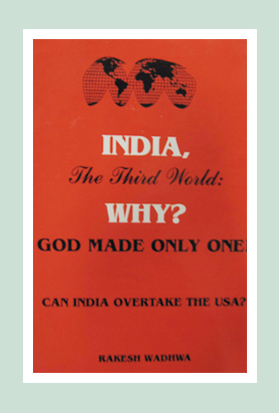
What the readers are saying…