








The Military Industrial Complex
The US deployment of troops in Afghanistan has raised much ironic press against Nobel Peace Prize winner, Barack Obama. It has also brought back speculation with regards to the US defense budget, specifically money allocated to private production of defense equipment and the supply of this
Communism
“The demise of communism has led to the realization that it never was, is no longer and will never be a viable economic system.”
Kasab and Tackling Crime & Terrorism
An overwhelming majority of people supported the death sentence for Kasab. More importantly an overwhelming majority of those who were his victims (obviously relatives of those he killed) wanted him executed.
Kasab and Tackling Crime & Terrorism
An overwhelming majority of people supported the death sentence for Kasab. More importantly an overwhelming majority of those who were his victims (obviously relatives of those he killed) wanted him executed.
Open The Borders
We have our freedom to move & settle, according to our choice. Then what is it, that chains our feet?
Government and Education
Is education really an essential element of government colleges and universities? They all are parts and parcels of the functioning of political parties.
Government: Less is More
Why do governments fail? Why are governments everywhere the butt of jokes? In the US, comedians regularly make fun of the president and the gargantuan federal government he heads.
Free the Banks
Whenever I make a presentation on how economic freedom would make Nepal prosper, I am confronted with the objection that Nepal is landlocked, different and what applies to other countries is not applicable here. Nepal is different and landlocked, but, to say that economic
Liquor and Cigarettes – Reduce taxes
Governments around the world are strapped for cash. Finance ministers, find liquor and tobacco the easiest ‘sins’ to tax. Who can object? Cigarette and liquor companies should be glad they are allowed to exist and be happy that they are merely taxed. Right?
 Rakesh Wadhwa. Ever since, I was a school boy, I knew India was on the wrong path. Socialism was just not what we needed to get ahead. Government controlled our travel; government controlled our ability to buy and sell; and government controlled our freedom to move our money. My life has focused on the inherent rights people have. When I was in college, I never understood, what the governments meant by their "socialistic attitude". If people are free to buy, sell and move their capital themselves without any restrictions by state, then the welfare of people is inevitable & hence the countries they live in will become wealthy.
 The Bastiat Award is a journalism award, given annually by the International Policy Network, London. Bastiat Prize entries are judged on intellectual content, the persuasiveness of the language used and the type of publication in which they appear. Rakesh Wadhwa won the 3rd prize (a cash award of $1,000 and a candlestick), in 2006.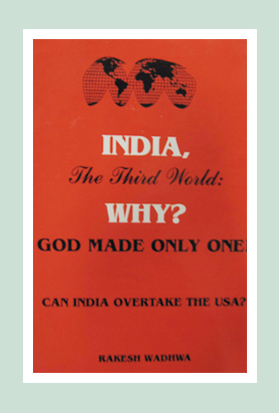
What the readers are saying…