Prof. B.R. Shenoy: India’s Free Market Visionary
The birth of a nation represents sheer potential. Potential in terms of an unwritten future, that could go in any direction. The blank pages of history wait to be filled… with overlying goals, structure and the freedom to decide how to achieve the goals. When India became independent, it was faced with three economic models.
These models where the outcomes of the visionaries that stood behind them. The Gandhian model focused on village economies and ‘trusteeship,’ the Bombay plan advocated total government regulation, especially in capital goods and manufacturing, and the Nehruvian model based on pure socialism minus private enterprise.

No prizes for guessing which model India ultimately chose. It took India 40 years to get over its blind faith in a mixed economy of a government controlled private sector. When government permission is needed for everything, you can be pretty sure of corruption creeping in. The License Raj in India, as it was called, ensured that competition was killed before it started and public choice was totally ignored. Moreover, reservations, quantitative export ceilings, restrictions on import and export and even prohibition straggled whatever dreams people had of creating value in the economy. All these factors corroborated to a financial crisis that could only be ironed out by integrating with a global economy.
Which brings us to the lone voice of dissent in the midst of all the rose-tinted projections into an economic future based on the Russian Gosplan committee’s five-year plans. By the time India’s second five-year plan rolled out, Prof. B.R. Shenoy was the only Indian economist on the Panel of Economists given the task to evaluate the plan, to point out that “the only hope of eradication of corruption on the current scale is a complete U-turn in our policies”.
Voicing Free Markets: The Early Years
Bellikoth Ragunath Shenoy took his first name from the village of Bellikoth in Karnataka, where he was born in 1905. After a stellar academic record, he did his masters in economics from Benares Hindu University in 1929, enrolled for an MSc and PhD in economics at the London School of Economics (1929–32). At LSE, he was influenced by Professor Friedrich A. Hayek’s writings on the price system, knowledge problems, and the irrelevance of centralized planning. Shenoy wrote his thesis, “Some Aspects of a Central Bank for India,” at LSE, along with two theoretical scholarly papers in the Quarterly Journal of Economics: “An Equation for the Price Level of New Investment Goods” and “Interdependence of Price Levels.” These papers refuted none other than renowned economist John Maynard Keynes’s fundamental premise in his book Treatise on Money (1930).
On his return to India, Prof. Shenoy taught economics at various Indian colleges and universities, such as Wadia College (Pune), the University of Ceylon, Gujarat University and even at the LSE. Professionally, he worked with the Ceylon Commission on Currency, Ceylon Department of Commerce, Reserve Bank of India, International Monetary Fund and the World Bank. No stranger to controversies and opposition, Prof. Shenoy advocated the ideas of classical liberalism all through his life. He became a member of the famous international forum for liberalism, the Mont Pelerin Society. After retiring, he founded the Economic Research Centre in Delhi.
Final Accolade for a Free Thinker
Throughout his life, Prof. Shenoy continued to push for economic reforms and wrote prolifically on the subject. So forthright were his views that even the famous economist Milton Friedman acknowledged him, “…there is only one prominent professional economist, Professor B.R. Shenoy of Gujarat University, who is openly and publicly and at all effectively opposed to present policies and in favor of greater reliance on a free market. He is a remarkable and courageous man.”
Prof. Shenoy passed away in 1978, 13 years before India’s economic crisis in 1991, which finally ushered in economic reform. The blind faith in centralized planning, government control and a restricted private sector finally acknowledged that he was right all along. As a footnote, Milton Friedman said, “…If one reads Shenoy’s report now, it sounds like a retrospective description of what happened rather than a forecast. But needless to say, though most economists display a deep respect for Shenoy’s courage and personal qualities, he remains a prophet without honor in his own country.”It is rightly said that what Indian economists are out to do today was first suggested by Prof. B.R. Shenoy decades ago. If only the decision makers had paid heed to his warnings then.
 Rakesh Wadhwa. Ever since, I was a school boy, I knew India was on the wrong path. Socialism was just not what we needed to get ahead. Government controlled our travel; government controlled our ability to buy and sell; and government controlled our freedom to move our money. My life has focused on the inherent rights people have. When I was in college, I never understood, what the governments meant by their "socialistic attitude". If people are free to buy, sell and move their capital themselves without any restrictions by state, then the welfare of people is inevitable & hence the countries they live in will become wealthy. The government has no right whatsoever, to point a finger at me or my business. I am not a revolutionary. I just want to light up my cigarette and not get nagged about it. I believe in non-interfering attitude to attain more.
 The Bastiat Award is a journalism award, given annually by the International Policy Network, London. Bastiat Prize entries are judged on intellectual content, the persuasiveness of the language used and the type of publication in which they appear. Rakesh Wadhwa won the 3rd prize (a cash award of $1,000 and a candlestick), in 2006.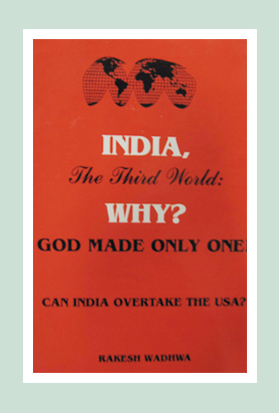
1 Comment
A prophet of free economy | EmpoweringIndia
November 10, 2013[…] Read more at http://wadhwarakesh.com/prof-b-r-shenoy-indias-free-market-visionary/ […]