Global Casino Industry Grapples with Geo-Political Pressures

A combination of global developments is proving costly for the casino industry. Coronavirus or Covid-19, a deadly virus has taken global centre stage, disrupting trade, supply-chains, tourism, business activities and even cultural events. The number of infected people has surpassed 126,000 worldwide, spreading from China to countries like Italy, Iran, the United States and UK. The death toll has crossed 4,000. Under such unprecedented circumstances of panic and fear, travel and tourism has taken a hit. Naturally, many casinos worldwide are suffering the consequence, particularly the Macau province in China.
On the other hand, changes in immigration laws, after Brexit, is also poised to hurt the large casino industry in the UK after 2020.
The Coronavirus Impact on Casinos Worldwide
Casinos were shut down for two weeks earlier in January 2020, when news of the viral outbreak started to emerge. Travel bans led to a decline in tourism revenues, including that of casinos. Revenue figures for the Macau region, the only region in China where casinos are regulated, was worse than expected. At $386.74 million, the revenues showed an 87.8% decline, on a year-on-year basis in the month of February 2020.
Macau generates 80% of its revenues from casinos, but low tourist footfall will continue to impact the region for several more months. Health restrictions and strict entry regulations on tourists will impact the 41 casinos in the region, as well as businesses dependent on them.
Casinos like Wynn Resorts lost $2.6 million a day during the closure. Casino stocks have been plunging and analysts predict that forecasts will be revised down 70% in March 2020, and 35% for Q2 2020.
In other parts of the world, casinos have been closing due to reports of infection. For instance, The Wildhorse Resort and Casino in the US state of Oregon was closed due to a casino worker testing positive for Coronavirus. While US-based brands like Wynn and MGM are suffering in Macau, the Las Vegas casino industry is also bracing itself for the impact of low Chinese footfall in the region.
In 2018, Chinese visitors to Las Vegas constituted 4% of the foreign travellers to the city. Companies like Google are cancelling events in the city. Cancellations due to the spread of Covid-19 will impact hotels and casinos in the city in 2020.
UK Immigration Policy Will Hurt Casinos
While the UK’s new “points system” immigration policy will appease pro-Brexit voters, by keeping the so-called “low-skilled” non-English speakers out of the country, entire sectors, from healthcare to casinos, will be severely affected.
The UK Betting and Gaming Council (BGC) has called upon the government to exempt casino workers from these rules. According to the BGC, foreign workers constitute 70% of the casino staff in the UK. Under the new points system, they will need to meet various criteria, including English-speaking ability, skills and qualifications to get a visa. This with a score of 70 and above will be granted a work visa for the UK. However, many casino workers will not be able to meet these new standards.
Ironically, croupiers, the people in charge of gaming tables at casinos will not qualify as well. The UK’s casino industry is a huge source of income from wealthy tourists around the world. To maintain their competitive edge, these casinos need croupiers with strong mathematical skills.
It is a bleak time indeed for the global casino sector. Government restrictions have always been problematic for the industry. While restrictions due to the Coronavirus epidemic might be justified, the British immigration laws appear downright unnecessary.
 Rakesh Wadhwa. Ever since, I was a school boy, I knew India was on the wrong path. Socialism was just not what we needed to get ahead. Government controlled our travel; government controlled our ability to buy and sell; and government controlled our freedom to move our money. My life has focused on the inherent rights people have. When I was in college, I never understood, what the governments meant by their "socialistic attitude". If people are free to buy, sell and move their capital themselves without any restrictions by state, then the welfare of people is inevitable & hence the countries they live in will become wealthy. The government has no right whatsoever, to point a finger at me or my business. I am not a revolutionary. I just want to light up my cigarette and not get nagged about it. I believe in non-interfering attitude to attain more.
 The Bastiat Award is a journalism award, given annually by the International Policy Network, London. Bastiat Prize entries are judged on intellectual content, the persuasiveness of the language used and the type of publication in which they appear. Rakesh Wadhwa won the 3rd prize (a cash award of $1,000 and a candlestick), in 2006.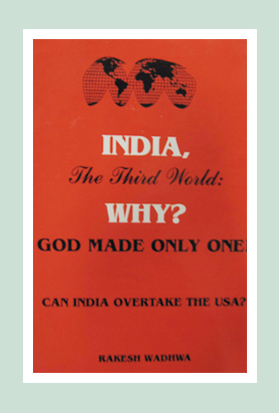
What the readers are saying…