
Why India and Nepal Rank Low in Economic Freedom Index
On the face of it, economic freedom is a simple concept. However, it encompasses every aspect of an individual’s life. Economic freedom defines the standard of living and has a significant influence on the quality of life.
Equal Income Distribution – Characteristic of Free Economies?
The wealthiest countries are those that have free economies. There is a popular belief that the more capitalist economies in Europe, North America and even Asia (like Japan) have greater financial inequalities. But the true picture reflects a different scenario altogether. Such countries are better off than the socialist economies when it comes to distribution of wealth.
Free the People, Control the Government: A Lesson from Hong Kong
It is often believed that countries that are small are easy to govern. It is also believed that high population impedes economic development. There is one nation that shattered these popular beliefs… Hong Kong!
When Government Inaction Cripples Economic Activity
It is a known fact that demand and supply decide the direction of a free market economy. However, it is the government that creates an atmosphere where market forces can operate without any fear for their investment.
Zero Tolerance for Corruption
The number 1 topic of discussion these days is corruption. Will putting people in jail solve the problem? Is it even the right thing to do? NO.
Is a Free Economy a Fair Economy?
The United States of America has emerged an economic superpower during the last couple of decades primarily because of its liberal trade policies. The world’s biggest ‘free trade’ zone was created with the removal of restrictions on
Shutting Down Sweat Shops isn’t Going to Help!!
One of the oldest and perhaps the most misguided myths about capitalism is the notion that businesses and factories exploit the poor. Among the various anti-capitalist propagandas being touted by the Marxists, one of the most striking is the sad image of
In the Name of Capitalism: All’s Not Well!!
Sarah Palin’s speech earlier this month in Indianola, Iowa tore apart Washington’s political fraternity. While it may have left her presidential aspirations in a dicey situation, her speech attacked government officials and politicos who are getting wealthy
David and Goliath
What is common to Estonia and China? Estonia is in Europe, China is in Asia. Estonia is just a dot on the map, in China you could fit 212 Estonias. Estonia’s population of 1.5 million is 6.5% of Nepal’s. China has 1.3 billion people, 56 times that of Nepal. Estonia is a
13% – Russia’s tax on income
America is a haven for capitalists while Russia is a workers paradise. US glorifies profits, Russia vilifies it. This was the conventional wisdom. It has been turned on its head. Bush fought a bruising battle in the US Congress to marginally reduce taxes. Vladimir Putin, the Russian President, did it with ease.
Jan 1, 2001 was the beginning of a new era in Russia. Russians woke up to a flat 13 percent income tax. It was a watershed event. That’s right; it is Russia that we are talking about, not Hong Kong or Singapore. The USSR was founded on the principle that all businessmen were evil and profits were passe – a bourgeois concept.
Now, businessmen can retain 87 percent of what they earn in the land of Lenin! This is something which I would not have dreamed of 10 years ago. Truth is stranger than fiction.
What is surprising is that Russia had just three tax rates of 12, 20 and 30 percent prior to this reduction. The rates were high but comparable with what most countries charge, and, yet, Putin chopped them.
What has been the result of this relatively low tax rate? It has been an unprecedented success for Russia. It has contributed to Russia’s stability which was so lacking in the aftermath of the collapse of communism. The benefits to the Russian economy grow by the day.
Capital flight has stopped and foreign investors have started returning to Russia. This, inspite of the huge losses incurred by the dollar investors resulting from a complete collapse of the ruble in the 1990’s.
Hoover Institution scholar Alvin Rabushka observed in a February 21, 2002 analysis for www.russiaeconomy.org, “the 13 percent flat tax has exceeded the expectations of the government in terms of revenue. For the vast majority of taxpayers, its implementation is simple, and no forms need to be filed.” Adjusting for currency fluctuations, Rabushka adds, “real ruble revenues increased about 28 percent.”
This novel experiment is paying huge dividends for the Russian government by inculcating the habit of paying taxes in people who were used to a culture of evasion. This changed attitude was to be expected; after all, evasion too comes at a cost – black money is difficult to reinvest in business and peace of mind is lost. People, therefore, do pay up when rates are not extortionate.
Russian tax revenue which barely equaled nine percent of its Gross Domestic Product (GDP) has grown to 16 percent. Russia also grew by 5% in 2001. A win-win situation for all concerned. Taxpayers are smiling, Putin has become a hero of the ‘Union of World’s Taxpayers’, and Russia’s government is busy collecting a windfall.
The US meanwhile has six tax rates from 10 to a high of 38.6 percent. Its 46,900-page Tax Code provides elephant size loopholes to the wealthy while the middle classes pay up. Russians file a simple one page form.
It is estimated that tax accountants will gobble up over 150 billion dollars for the paperwork which accompanies the tax payment in the US. This burden is one of the reasons why the US economy will not average even half the growth rate accomplished by Putin’s Russia.
It is ironic that Russia has a 13 percent flat tax while the bastion of world’s capitalism cannot even bring in a flat 17 percent tax. This is what Steve Forbes, a republican contender for the US presidency, had wanted but could not achieve.
Clearly, Russia has more to do if it wants to prosper. Rule of law, freedom of speech and, especially, far stronger property rights are surely needed. The 13 percent income tax is however a very powerful step in the right direction.
Nepal, to make an impact, must abolish the income tax. To do so would signal to the world’s business community, ‘invest here; Russia may have larger markets but in Nepal you need no tax experts and pay no income tax.’
With the abolition of the income tax, foreign and domestic investment would boom and trade would virtually explode. Any loss in revenue would be more than made up by higher VAT realizations by the government.
The Boss
 Rakesh Wadhwa. Ever since, I was a school boy, I knew India was on the wrong path. Socialism was just not what we needed to get ahead. Government controlled our travel; government controlled our ability to buy and sell; and government controlled our freedom to move our money. My life has focused on the inherent rights people have. When I was in college, I never understood, what the governments meant by their "socialistic attitude". If people are free to buy, sell and move their capital themselves without any restrictions by state, then the welfare of people is inevitable & hence the countries they live in will become wealthy. The government has no right whatsoever, to point a finger at me or my business. I am not a revolutionary. I just want to light up my cigarette and not get nagged about it. I believe in non-interfering attitude to attain more.
 The Bastiat Award is a journalism award, given annually by the International Policy Network, London. Bastiat Prize entries are judged on intellectual content, the persuasiveness of the language used and the type of publication in which they appear. Rakesh Wadhwa won the 3rd prize (a cash award of $1,000 and a candlestick), in 2006.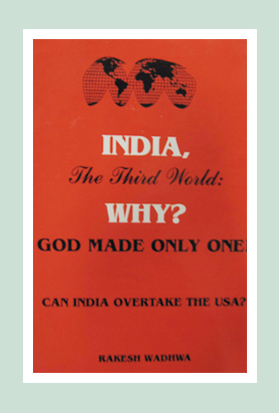

What the readers are saying…