Freedom and education
I went to St Columbus’s school in New Delhi in the 1970’s, and enjoyed it. The Irish missionaries who taught there were dedicated and made learning fun.
And yet as good as my school was, I remained uncomfortable with certain aspects of it. I studied science, maths and english by choice. Why was I forced to learn Hindi, Sanskrit and painting?
The government dictated to the school that I learn to write in Hindi, I have never done that again after I left school. I regarded Sanskrit as a waste of time; I have never written, spoken or heard it since I left school. Inspite of a great drawing teacher, I never passed that exam or had any inclination to be an artist.
My school’s attempt to make me a linguist and an artist failed. I wondered if there was a better option. A school where you could study and do as you liked. A school where you were not forced by control minded governments and school authorities to learn and do things you had no interest in.
Count Leo Tolstoy spoke about it in 1862.
“What is meant by non-interference of the school in learning? — It means granting students the full freedom to avail themselves of teaching that answers their needs, and that they want, only to the extent that they need and want it; and it means not forcing them to learn what they do not need or want.”
“I doubt, whether the kind of school I am discussing, will become common for another century. It is not likely that schools based on students’ freedom of choice will be established even a hundred years from now.”
Tolstoy was right. It was only a 106 years later, in 1968 that such a school was founded in Framingham, in Massachusetts, USA.
The by-laws of “The Sudbury Valley School’ say, “the purpose for which this corporation is formed is to establish and maintain a school for the education of members of the community that is founded upon the principle that learning is best fostered by self-motivation, self-regulation, and self-criticism.”
The school starts from Aristotle’s premise stated over 2000 years ago, “human beings are naturally curious”. It allows its students to do what they like. If you have no interest in science and would rather fish the whole day, you are allowed to do just that. In fact you may fish for a whole year if you like.
Before you write-off that experiment as unworkable, please understand that the school’s existence after 35 years of its founding is a testimonial to its success. It does not get or ask for any financial or other support from the government and competes exceptionally well with ‘free’ schools run by the government.
The students, teachers and parents are all fiercely loyal to the school and swear by it. The school has been written about extensively and is admired by freedom loving people worldwide. Those who pass out are admitted to the best US universities with ease.
It is beyond the scope of this article to explain how the school works. Suffice it to say that it is among the most disciplined in the country. Everyone’s rights are respected.
Yes, you may fish the whole day, but if you decide to attend classes you must honour your commitment. If, for example, you fix time with the maths teacher to help you understand a theorem, you must attend and fulfill your promise.
The experience has been that when students want to learn, they do so in double quick time. There are boys and girls completely uninterested in maths until they are 12 years old and then suddenly get the urge to learn. When that happens, they learn in one year what students in other schools learn in 12 years of schooling.
This country would do well not to straightjacket education under the deadening weight of rules and regulations of a know-it-all bureaucracy. The need of the hour is to let private investment, including foreign, come into education unhindered. Who knows, perhaps then ‘Sudbury’ might be persuaded to open a school in Nepal.
The Himalyan Times
Regulate Less, Save Lives
It is a fundamental principle of economics that demand for a product increases with a reduction in its price. As regulations are ‘free’, and people who advocate them bear negligible costs, it is virtually guaranteed that demand for government regulations will continue to grow indefinitely.
However, do government regulations really cost us nothing? Is the cost always borne by big corporations and evil businessmen? Businesses may initially bear the costs, but rest assured that they will, as soon as they can, pass on these costs to you and I. How? By an increase in the price of goods that we buy. We as consumers ultimately pay for all government regulations.
Each individual regulation added onto by the government means little to us, and the cost of each may be so infinitesimal, that it is only rational for us to ignore it and concentrate our attention on more pressing matters. The problem is that when the cost of all the regulations imposed on us is added up, it is no longer a small matter.
The only country where an attempt has been made to identify the cost of regulations is the US. The cost borne by its people was estimated at $660 billion in the year 2000. The projected annual cost now for a household of four exceeds $10,000.
Clearly, this level of regulation if imposed on the people of Nepal, would immediately shatter the economy. Imagine if the US regulations, designed to protect buildings against earthquakes in Los Angeles, were made applicable in Kathmandu. All, except the wealthy few, would find themselves gazing at the stars at night instead of a roof.
Even though a rich country can better tolerate regulations, yet it is this regulatory burden – exceeding half of the US federal government’s tax receipts – which has made annual growth rates in America average an anemic two percent.
No one doubts the good intentions of our lawmakers. Regulations are often drafted with thoughts of making our buildings safer, food healthier, water hygienic, air pollution free, aircrafts less likely to have accidents, and labour happy.
The problem is that this plethora of regulations increases the cost of everything we buy and, hence, makes life difficult for the most vulnerable in our society: the poor. They just cannot afford the costly goods.
Theoretically, it is possible to eliminate aircraft crashes by zealous government oversight and regulation. However, the cost of such burdensome regulations would make air-travel so expensive that many more people would die because of the use of road transport, which is far less safe than travel by air.
In Nepal, the best way for government to make domestic air travel safer would, ironically, be by deregulation. Let the government abrogate the monopoly of domestic airlines and permit foreign airlines to compete on domestic routes. This would increase foreign investment, bring in international airlines – with a worldwide reputation to protect – and make flights safer.
Big companies often capture the government agency in charge of regulating by intensive lobbying. They then use regulations as a weapon against their smaller competitors.
In the UK, for example, large businesses wanted an onerous licensing burden to be applied to all food premises. These big companies knew that they would have an easy time complying with these regulations, but their smaller competitors would be forced to close shop.
In the same manner, asking roadside restaurants in Nepal to adhere to standards which are met by Hyatt or Holiday Inn would result in their closure. Commonsense tells us that this is not a desirable outcome.
Likewise, minimum wage laws and other labour legislation cause problems for small businesses. The big companies can pay their staff more than what is required by law and would be happy to see that the small enterprises are forced to do the same. Strict enforcement of wage & labour laws as exist today would lead to the closure of most of the small businesses with unemployment even more widespread than it is now.
We should learn from the example of the developed countries and try to rid ourselves of regulations if we are to banish poverty faster. Deregulating by creating wealth, would save lives. Rich people live longer by about 20 years – that is the difference in life expectancy between those living in the rich and those in poor countries.
The Himalyan Times
 Rakesh Wadhwa. Ever since, I was a school boy, I knew India was on the wrong path. Socialism was just not what we needed to get ahead. Government controlled our travel; government controlled our ability to buy and sell; and government controlled our freedom to move our money. My life has focused on the inherent rights people have. When I was in college, I never understood, what the governments meant by their "socialistic attitude". If people are free to buy, sell and move their capital themselves without any restrictions by state, then the welfare of people is inevitable & hence the countries they live in will become wealthy. The government has no right whatsoever, to point a finger at me or my business. I am not a revolutionary. I just want to light up my cigarette and not get nagged about it. I believe in non-interfering attitude to attain more.
 The Bastiat Award is a journalism award, given annually by the International Policy Network, London. Bastiat Prize entries are judged on intellectual content, the persuasiveness of the language used and the type of publication in which they appear. Rakesh Wadhwa won the 3rd prize (a cash award of $1,000 and a candlestick), in 2006.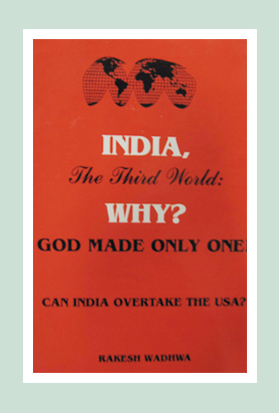
What the readers are saying…