Equal Income Distribution – Characteristic of Free Economies?
The wealthiest countries are those that have free economies. There is a popular belief that the more capitalist economies in Europe, North America and even Asia (like Japan) have greater financial inequalities. But the true picture reflects a different scenario altogether. Such countries are better off than the socialist economies when it comes to distribution of wealth.
Free the People, Control the Government: A Lesson from Hong Kong
It is often believed that countries that are small are easy to govern. It is also believed that high population impedes economic development. There is one nation that shattered these popular beliefs… Hong Kong!
Sweden Holds Lessons for Indian Economy
It was not long ago when a small country in northern Europe – Sweden – exemplified a perfect example of Keynesian economics. The country stuck to the context of welfare state and had no plans to move towards free market economy. However, the country woke up just in time to realise the importance of free markets.
Divestment Is Essential To Good Governance
Published in 1776, Adam Smith’s The Wealth of Nations defines the basic premise of business – profit. Smith argues that a voluntary exchange between two parties will take place if and only if both believe that they stand to benefit. In this context, how fair is a system that limits individuals from exercising their choices? Can a system that limits individuals from expanding their businesses, in the name of public good, be considered fair to the society itself? Consider this: It is the government that lays down the rules for business, or in other words, acts as a regulator and constructs the framework within which businesses must operate. How can, then, the government run its own businesses without being unfair to individuals who raise capital through markets?
When Government Inaction Cripples Economic Activity
It is a known fact that demand and supply decide the direction of a free market economy. However, it is the government that creates an atmosphere where market forces can operate without any fear for their investment.
Democracy after Capitalism or Capitalism after Democracy?
Democracy after Capitalism or Capitalism after Democracy? Does the order really matter? This is a question I have always wondered about. Democracy and capitalism have always been thought in the same light. Irrespective of the order, the very coexistence
What Happens Today Under the Pretext of Free Market
Free markets caused the 2008-2009 global meltdown. I hear people say this a lot. How can “freedom” make people work against themselves? President Obama said in a speech that the recession resulted from the fact that “everybody was left to fend for themselves
Will a Laissez-Faire System Boost Economic Growth?
Which kind of economy would you vote for – a laissez-faire market or a planned economy? My vote is for free markets.
3 Most Common Myths About Capitalism
If we take a look at the economic history worldwide, private businesses have been instrumental in improving the standard of living. Business houses have created job opportunities, invented products, made profits, helped impoverished people and
Myths About Free Markets Debunked!
The AT&T deregulation in the 1980s offered competitive phone rates to the market. The US airlines deregulation in 1979 facilitated lower airfares and more choices to consumers. Despite these historic successes of a free market system, those
 Rakesh Wadhwa. Ever since, I was a school boy, I knew India was on the wrong path. Socialism was just not what we needed to get ahead. Government controlled our travel; government controlled our ability to buy and sell; and government controlled our freedom to move our money. My life has focused on the inherent rights people have. When I was in college, I never understood, what the governments meant by their "socialistic attitude". If people are free to buy, sell and move their capital themselves without any restrictions by state, then the welfare of people is inevitable & hence the countries they live in will become wealthy. The government has no right whatsoever, to point a finger at me or my business. I am not a revolutionary. I just want to light up my cigarette and not get nagged about it. I believe in non-interfering attitude to attain more.
 The Bastiat Award is a journalism award, given annually by the International Policy Network, London. Bastiat Prize entries are judged on intellectual content, the persuasiveness of the language used and the type of publication in which they appear. Rakesh Wadhwa won the 3rd prize (a cash award of $1,000 and a candlestick), in 2006.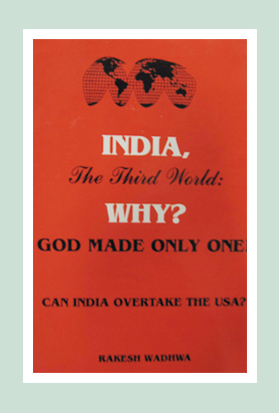
What the readers are saying…