Can Free Markets Battle Corruption?
When Alexander the Great visited the philosopher Diogenes and asked whether he could do anything for him, Diogenes is said to have replied: ‘Yes, stand a little less between me and the sun.’ It is what every citizen is entitled to ask of his government.
Are Indians Inherently Corrupt?
CWG scam… NRHM scam… Adarsh Housing Society scam… Kargil Coffin scam… Bofors scandal… and the list continues!!
Will Free Markets Ruin Society?
I am a staunch believer in free markets. But that isn’t reason enough for you to be convinced. Let’s instead consider a recent study in this field. Let us consider what some experts have to say regarding whether free markets will ruin society:
Zero Tolerance for Corruption
The number 1 topic of discussion these days is corruption. Will putting people in jail solve the problem? Is it even the right thing to do? NO.
Is a Free Economy a Fair Economy?
The United States of America has emerged an economic superpower during the last couple of decades primarily because of its liberal trade policies. The world’s biggest ‘free trade’ zone was created with the removal of restrictions on
Shutting Down Sweat Shops isn’t Going to Help!!
One of the oldest and perhaps the most misguided myths about capitalism is the notion that businesses and factories exploit the poor. Among the various anti-capitalist propagandas being touted by the Marxists, one of the most striking is the sad image of
In the Name of Capitalism: All’s Not Well!!
Sarah Palin’s speech earlier this month in Indianola, Iowa tore apart Washington’s political fraternity. While it may have left her presidential aspirations in a dicey situation, her speech attacked government officials and politicos who are getting wealthy
The Military Industrial Complex
The US deployment of troops in Afghanistan has raised much ironic press against Nobel Peace Prize winner, Barack Obama. It has also brought back speculation with regards to the US defense budget, specifically money allocated to private production of defense equipment and the supply of this
Open The Borders
We have our freedom to move & settle, according to our choice. Then what is it, that chains our feet?
Free the Banks
Whenever I make a presentation on how economic freedom would make Nepal prosper, I am confronted with the objection that Nepal is landlocked, different and what applies to other countries is not applicable here. Nepal is different and landlocked, but, to say that economic
 Rakesh Wadhwa. Ever since, I was a school boy, I knew India was on the wrong path. Socialism was just not what we needed to get ahead. Government controlled our travel; government controlled our ability to buy and sell; and government controlled our freedom to move our money. My life has focused on the inherent rights people have. When I was in college, I never understood, what the governments meant by their "socialistic attitude". If people are free to buy, sell and move their capital themselves without any restrictions by state, then the welfare of people is inevitable & hence the countries they live in will become wealthy. The government has no right whatsoever, to point a finger at me or my business. I am not a revolutionary. I just want to light up my cigarette and not get nagged about it. I believe in non-interfering attitude to attain more.
 The Bastiat Award is a journalism award, given annually by the International Policy Network, London. Bastiat Prize entries are judged on intellectual content, the persuasiveness of the language used and the type of publication in which they appear. Rakesh Wadhwa won the 3rd prize (a cash award of $1,000 and a candlestick), in 2006.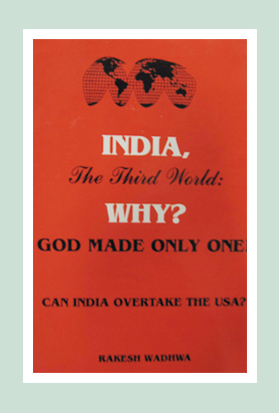
What the readers are saying…