Liquor and Cigarettes – Reduce taxes
Governments around the world are strapped for cash. Finance ministers, find liquor and tobacco the easiest ‘sins’ to tax. Who can object? Cigarette and liquor companies should be glad they are allowed to exist and be happy that they are merely taxed. Right?
David and Goliath
What is common to Estonia and China? Estonia is in Europe, China is in Asia. Estonia is just a dot on the map, in China you could fit 212 Estonias. Estonia’s population of 1.5 million is 6.5% of Nepal’s. China has 1.3 billion people, 56 times that of Nepal. Estonia is a
13% – Russia’s tax on income
America is a haven for capitalists while Russia is a workers paradise. US glorifies profits, Russia vilifies it. This was the conventional wisdom. It has been turned on its head. Bush fought a bruising battle in the US Congress to marginally reduce taxes. Vladimir Putin, the Russian President, did it with ease.
Jan 1, 2001 was the beginning of a new era in Russia. Russians woke up to a flat 13 percent income tax. It was a watershed event. That’s right; it is Russia that we are talking about, not Hong Kong or Singapore. The USSR was founded on the principle that all businessmen were evil and profits were passe – a bourgeois concept.
Now, businessmen can retain 87 percent of what they earn in the land of Lenin! This is something which I would not have dreamed of 10 years ago. Truth is stranger than fiction.
What is surprising is that Russia had just three tax rates of 12, 20 and 30 percent prior to this reduction. The rates were high but comparable with what most countries charge, and, yet, Putin chopped them.
What has been the result of this relatively low tax rate? It has been an unprecedented success for Russia. It has contributed to Russia’s stability which was so lacking in the aftermath of the collapse of communism. The benefits to the Russian economy grow by the day.
Capital flight has stopped and foreign investors have started returning to Russia. This, inspite of the huge losses incurred by the dollar investors resulting from a complete collapse of the ruble in the 1990’s.
Hoover Institution scholar Alvin Rabushka observed in a February 21, 2002 analysis for www.russiaeconomy.org, “the 13 percent flat tax has exceeded the expectations of the government in terms of revenue. For the vast majority of taxpayers, its implementation is simple, and no forms need to be filed.” Adjusting for currency fluctuations, Rabushka adds, “real ruble revenues increased about 28 percent.”
This novel experiment is paying huge dividends for the Russian government by inculcating the habit of paying taxes in people who were used to a culture of evasion. This changed attitude was to be expected; after all, evasion too comes at a cost – black money is difficult to reinvest in business and peace of mind is lost. People, therefore, do pay up when rates are not extortionate.
Russian tax revenue which barely equaled nine percent of its Gross Domestic Product (GDP) has grown to 16 percent. Russia also grew by 5% in 2001. A win-win situation for all concerned. Taxpayers are smiling, Putin has become a hero of the ‘Union of World’s Taxpayers’, and Russia’s government is busy collecting a windfall.
The US meanwhile has six tax rates from 10 to a high of 38.6 percent. Its 46,900-page Tax Code provides elephant size loopholes to the wealthy while the middle classes pay up. Russians file a simple one page form.
It is estimated that tax accountants will gobble up over 150 billion dollars for the paperwork which accompanies the tax payment in the US. This burden is one of the reasons why the US economy will not average even half the growth rate accomplished by Putin’s Russia.
It is ironic that Russia has a 13 percent flat tax while the bastion of world’s capitalism cannot even bring in a flat 17 percent tax. This is what Steve Forbes, a republican contender for the US presidency, had wanted but could not achieve.
Clearly, Russia has more to do if it wants to prosper. Rule of law, freedom of speech and, especially, far stronger property rights are surely needed. The 13 percent income tax is however a very powerful step in the right direction.
Nepal, to make an impact, must abolish the income tax. To do so would signal to the world’s business community, ‘invest here; Russia may have larger markets but in Nepal you need no tax experts and pay no income tax.’
With the abolition of the income tax, foreign and domestic investment would boom and trade would virtually explode. Any loss in revenue would be more than made up by higher VAT realizations by the government.
The Boss
Freedom and education
I went to St Columbus’s school in New Delhi in the 1970’s, and enjoyed it. The Irish missionaries who taught there were dedicated and made learning fun.
And yet as good as my school was, I remained uncomfortable with certain aspects of it. I studied science, maths and english by choice. Why was I forced to learn Hindi, Sanskrit and painting?
The government dictated to the school that I learn to write in Hindi, I have never done that again after I left school. I regarded Sanskrit as a waste of time; I have never written, spoken or heard it since I left school. Inspite of a great drawing teacher, I never passed that exam or had any inclination to be an artist.
My school’s attempt to make me a linguist and an artist failed. I wondered if there was a better option. A school where you could study and do as you liked. A school where you were not forced by control minded governments and school authorities to learn and do things you had no interest in.
Count Leo Tolstoy spoke about it in 1862.
“What is meant by non-interference of the school in learning? — It means granting students the full freedom to avail themselves of teaching that answers their needs, and that they want, only to the extent that they need and want it; and it means not forcing them to learn what they do not need or want.”
“I doubt, whether the kind of school I am discussing, will become common for another century. It is not likely that schools based on students’ freedom of choice will be established even a hundred years from now.”
Tolstoy was right. It was only a 106 years later, in 1968 that such a school was founded in Framingham, in Massachusetts, USA.
The by-laws of “The Sudbury Valley School’ say, “the purpose for which this corporation is formed is to establish and maintain a school for the education of members of the community that is founded upon the principle that learning is best fostered by self-motivation, self-regulation, and self-criticism.”
The school starts from Aristotle’s premise stated over 2000 years ago, “human beings are naturally curious”. It allows its students to do what they like. If you have no interest in science and would rather fish the whole day, you are allowed to do just that. In fact you may fish for a whole year if you like.
Before you write-off that experiment as unworkable, please understand that the school’s existence after 35 years of its founding is a testimonial to its success. It does not get or ask for any financial or other support from the government and competes exceptionally well with ‘free’ schools run by the government.
The students, teachers and parents are all fiercely loyal to the school and swear by it. The school has been written about extensively and is admired by freedom loving people worldwide. Those who pass out are admitted to the best US universities with ease.
It is beyond the scope of this article to explain how the school works. Suffice it to say that it is among the most disciplined in the country. Everyone’s rights are respected.
Yes, you may fish the whole day, but if you decide to attend classes you must honour your commitment. If, for example, you fix time with the maths teacher to help you understand a theorem, you must attend and fulfill your promise.
The experience has been that when students want to learn, they do so in double quick time. There are boys and girls completely uninterested in maths until they are 12 years old and then suddenly get the urge to learn. When that happens, they learn in one year what students in other schools learn in 12 years of schooling.
This country would do well not to straightjacket education under the deadening weight of rules and regulations of a know-it-all bureaucracy. The need of the hour is to let private investment, including foreign, come into education unhindered. Who knows, perhaps then ‘Sudbury’ might be persuaded to open a school in Nepal.
The Himalyan Times
Trade will make us rich
Countries which trade are rich. Countries which don’t are poor.
If I were to pick up one indicator of the wealth of a nation, that would be its exports and imports. Consider India: its share of world trade which was 2.5% at the time of its Independence, had plummeted to 0.45% by the late 80s.
It was a pathetic performance. India, with 16% of the world’s population, would have had to increase its imports and exports by 32 times to just reach the world’s ‘average’. India remained poor – its people had to survive on less than a dollar a day.
Compare this with a ‘dot’ on the globe: Singapore. With a population of just 4.2 million, its imports and exports are double that of India’s. This translates to each Singaporean trading, on average, 500 times more than an Indian. No wonder an average Singaporean lives comfortably, enjoying an annual income of over US$ 25,000.
Some say that the comparison with Singapore is not apt. Let us compare China with India. ‘Anti-capitalist’ China’s trade with the world has burgeoned to a trillion dollars, five times that of India’s while China’s population exceeds India’s by just 28%. Chinese now enjoy an annual income which is more than twice that of the Indians while just three decades ago the Chinese were poorer.
Contrast Nepal with Switzerland. Both countries are landlocked, but, the similarity ends there. Again trade provides an indication of why Nepal lags behind. Nepal’s imports and exports don’t add upto even three billion dollars. Switzerland’s figure is 326 billion dollars.
On a per person basis, the comparison is even more stark. Each person in Switzerland trades 400 times more than a Nepali. Switzerland’s per capita annual income at US$ 35,000 is one of the world’s highest.
Trade is not the only reason for Switzerland’s wealth. Their banking laws which guarantee anonymity to the depositor also have a lot to do with the Swiss being rich. However, trade plays a significant role.
Why are Singaporeans and the Swiss such good traders, achieving a prodigious percentage of the world’s trade, while the Indians and Nepalese are bit players and do not count? High taxes and stifling controls pursued by Nepal and India compared to the free market, low tax policies (average import duty is below one percent) of Singapore and Switzerland is the reason.
India, upto 1990, was ‘protected’ by the world’s highest tariff rates, import bans on all consumer products, and an inefficient and corrupt bureaucracy bent upon controlling trade.
The results of this ‘protection’ were obvious. Indians who would buy from a Scot and sell to Jew and still make a profit had no opportunity to do so in the world markets.
Post 1990, India began to see sense, but only after its policies had brought the economy to a shuddering halt. It had no foreign currency left and had to pawn its gold reserves. India liberalized and very soon its trade took off and dollar reserves started accumulating.
Within 15 years India achieved what it could not do in the earlier five decades. Its share of world trade has increased to 0.8% and foreign exchange reserves have crossed the 140 billion dollar mark starting from almost nothing.
If this was achieved with only a modest reduction of controls and import duties, consider what can be attained by the abolition of all controls and taxes on trade.
The good news for Nepal is that it can rewrite its laws tomorrow. There is nothing stopping this country from emulating Singapore and eliminating its trade barriers.
The government has to do just this and then watch the people of this country take to trade as a child takes to candy. Nepal will have shopping malls no less full of merchandise than Singapore. Goods will be cheaper too as both labour and real estate are priced lower.
Further Nepal will get as many tourists as it can handle. Why should people from India, Bangladesh and Pakistan go to Singapore, Hong Kong or Dubai when they can come to Nepal with its warm, hospitable people, majestic mountains, and, yes, cheaper perfumes too.
The Himalyan Times
Regulate Less, Save Lives
It is a fundamental principle of economics that demand for a product increases with a reduction in its price. As regulations are ‘free’, and people who advocate them bear negligible costs, it is virtually guaranteed that demand for government regulations will continue to grow indefinitely.
However, do government regulations really cost us nothing? Is the cost always borne by big corporations and evil businessmen? Businesses may initially bear the costs, but rest assured that they will, as soon as they can, pass on these costs to you and I. How? By an increase in the price of goods that we buy. We as consumers ultimately pay for all government regulations.
Each individual regulation added onto by the government means little to us, and the cost of each may be so infinitesimal, that it is only rational for us to ignore it and concentrate our attention on more pressing matters. The problem is that when the cost of all the regulations imposed on us is added up, it is no longer a small matter.
The only country where an attempt has been made to identify the cost of regulations is the US. The cost borne by its people was estimated at $660 billion in the year 2000. The projected annual cost now for a household of four exceeds $10,000.
Clearly, this level of regulation if imposed on the people of Nepal, would immediately shatter the economy. Imagine if the US regulations, designed to protect buildings against earthquakes in Los Angeles, were made applicable in Kathmandu. All, except the wealthy few, would find themselves gazing at the stars at night instead of a roof.
Even though a rich country can better tolerate regulations, yet it is this regulatory burden – exceeding half of the US federal government’s tax receipts – which has made annual growth rates in America average an anemic two percent.
No one doubts the good intentions of our lawmakers. Regulations are often drafted with thoughts of making our buildings safer, food healthier, water hygienic, air pollution free, aircrafts less likely to have accidents, and labour happy.
The problem is that this plethora of regulations increases the cost of everything we buy and, hence, makes life difficult for the most vulnerable in our society: the poor. They just cannot afford the costly goods.
Theoretically, it is possible to eliminate aircraft crashes by zealous government oversight and regulation. However, the cost of such burdensome regulations would make air-travel so expensive that many more people would die because of the use of road transport, which is far less safe than travel by air.
In Nepal, the best way for government to make domestic air travel safer would, ironically, be by deregulation. Let the government abrogate the monopoly of domestic airlines and permit foreign airlines to compete on domestic routes. This would increase foreign investment, bring in international airlines – with a worldwide reputation to protect – and make flights safer.
Big companies often capture the government agency in charge of regulating by intensive lobbying. They then use regulations as a weapon against their smaller competitors.
In the UK, for example, large businesses wanted an onerous licensing burden to be applied to all food premises. These big companies knew that they would have an easy time complying with these regulations, but their smaller competitors would be forced to close shop.
In the same manner, asking roadside restaurants in Nepal to adhere to standards which are met by Hyatt or Holiday Inn would result in their closure. Commonsense tells us that this is not a desirable outcome.
Likewise, minimum wage laws and other labour legislation cause problems for small businesses. The big companies can pay their staff more than what is required by law and would be happy to see that the small enterprises are forced to do the same. Strict enforcement of wage & labour laws as exist today would lead to the closure of most of the small businesses with unemployment even more widespread than it is now.
We should learn from the example of the developed countries and try to rid ourselves of regulations if we are to banish poverty faster. Deregulating by creating wealth, would save lives. Rich people live longer by about 20 years – that is the difference in life expectancy between those living in the rich and those in poor countries.
The Himalyan Times
Airlines and Regulations
The world including Nepal has realized the disservice caused to all of us by the state running businesses. Worldwide privatization of government assets has taken place on a grand scale.
However, most people still maintain that regulation by state is essential. Poor service by private organizations is the reason why many of us want government oversight.
In an article on domestic private airlines in the 19-25 November issue of Nepali Times by ‘Artha Beed’, the service – or rather the lack of it – was given by him as a reason for wanting the government to step in. He said that free markets need government regulators to be successful.
Not so. Let us find out what went wrong. When private airlines first took off, the staff was enthusiastic and well groomed, service was warm, and flights were on time. Let us agree with Artha that service and courtesy has since vanished.
Let us, however, compare the situation now with what was prevailing at the time when RNAC was the only airline. Perhaps Artha is too young to remember. People used to queue up overnight to get tickets, service was non-existent, and the staff attitude said, ‘put up with us or walk to your destination’. However, bad the situation now is, it is infinitely better than at the time of RNAC’s monopoly.
Apart from the impossibility of government regulators forcing the airline’s staff to smile (Artha’s desire), regulations boost costs, empower corrupt bureaucracies, and achieve little.
Does it mean that Artha will remain permanently frustrated? Is there no way to make private airlines come upto his expectations? Fortunately, there are ways to improve efficiency and service without the heavy hand of the government.
Ending RNAC’s monopoly was good. What wasn’t good was prohibiting foreign airlines from flying on domestic routes. If you want world class service, then you must let world class companies compete in your markets.
This is not only true of airline business but of all businesses. India was no better. Under the anti-foreign-investment raj of Indira Gandhi, protected businesses produced shoddy goods and customers got lousy service. Now, foreign investment where permitted is changing that.
India which produced the ugly ‘ambassador’, even for which there was a waiting period, now offers its consumers an unlimited array of world-class cars. Its autos and their components are exported to many countries. Would this have happened under the protective regime of the Neheru-Indira era? Never.
Nepal does not need more government regulations but opening up of its market including the domestic airline market to free and unfettered competition. Then it will be companies which best serve the interests of the Nepali consumer which will thrive.
A word of caution here is necessary. Open and free competition does not mean that private businesses, be they airline or any other, will always meet all of the customers expectations. It only means that customers will have a choice and most will be satisfied most of the time. All customers cannot always be satisfied. Airlines, for example, can only provide the level of service which the public is prepared to pay for.
While travelling within the US, I find that airlines do not serve much more than a packet of peanuts and a soft drink. This is because the US airlines have found that people travel on basis of cheap fares. The preference of people is not for fancy service and gourmet food but low ticket prices. Customers want rock bottom fares and that is what they get. They can always pick up-food of their choice at the airport’s fast-food restaurants and are unwilling to pay extra for food and service inside the aircraft.
It is possible that even after the domestic airline market is opened to foreign competition Artha still does not get gourmet food served to him on his half hour flight to Pokhara. This would only be if most travelers value cheaper flights which do not factor in the cost of Artha’s choice of food and drinks.
But again if Artha has resources he should have options. He could buy a plane, hire his own pilot and airhostess, and have food of his choice served to him. Good luck Mr. Beed.
The Himalyan Times
Where is the Gas?
It is December 7, 2004 as I write this. America remembers it as ‘a day of infamy’. On this day, 63 years ago the Japanese attacked Pearl Harbour.
For me this is a day of infamy in Nepal. Petroleum products have yet again vanished. Throughout the day, queues of vehicles at gas stations lengthened. It is criminal at this day and age for Nepal’s policy makers to repeatedly subject its citizens to this torture.
It is ironic that even as prices at gas stations worldwide decline as a consequence of a drop of US$10 per barrel in price of oil, Nepali consumers cannot fill up their vehicle tanks. How many times does history have to repeat itself before something is done?
That ‘something’ is getting rid of Nepal Oil Corporation (NOC). And I do mean getting rid of it in double quick time. Government has had privatization plans on the anvil for far too long. It is time for action.
NOC must be sold in a fair and transparent manner. But that alone is not enough. Care must be taken to see that it no longer enjoys any monopoly privileges.
Open up the entire oil sector – imports, distribution, and sales – to competition. Allow any company from anywhere in the world to set up base in Nepal.
It is this competition that will end the shortages, bring quality products, enhance the service at gas stations and bring gas prices in Nepal at par with the international market after adjusting for local taxes.
A major benefit of allowing unfettered competition in Nepal would be to end adulteration of petroleum products. This practice wreaks havoc on the vehicles. When companies have to protect their reputation in the open market they see to it that their gas stations sell only quality products. It is only when you have a government protected monopoly that you couldn’t care less about your customers who don’t have a choice.
Why does the economy of this country have to be repeatedly wracked by government mismanagement? Why is no action taken?
Whereas other countries learn fast, Nepal shows a proclivity to take an unduly long time to absorb the lesson of past failures. It should have been clear to all that NOC can’t meet the expectations of the people. The citizens of this country deserve better than over and over becoming a prey of this government organization.
The US, which is the world’s largest consumer of gasoline, too has faced a situation similar to what Nepal faces today. However, that was during the time of one of America’s least economically savy President, Jimmy Carter. He believed in the ‘Whitehouse’ micro-managing everything from the distribution and pricing of oil to rescue of hostages in Iraq. He was a failure and lost the election to Ronald Reagan. Shortly after Reagan took office in January of 1981, he reversed Carter’s actions.
Reagan did this by removing price controls on oil and ending the practice of allocating oil by government fiat. The results confounded Carter and his supporters. They had said that eliminating the price ceiling on oil would result in an unacceptable increase in prices people would have to pay at the pumps.
Did this happen? The results were the reverse of what Carter expected. Deregulation freed the market, ended shortages, queues at gas stations vanished overnight, and best of all the price of oil dropped.
Though prices in the US go up and down in response to international fluctuations, no President since Reagan has ever instituted government ownership or control over oil flows. And the American people have never had to queue up at pumps again.
Private companies in America are adept at fulfilling the needs of their customers. Gas stations are sparkling clean, display prices prominently and many have department stores on premises. And customers have a choice. If you don’t like the service of one you can go to another. Each oil company – Texaco, Chevron, Exxon and many more – have their own or franchised gas stations.
Should the Nepali consumer not be pampered with similar levels of service and have the same choice as his American counterpart?
The Himalyan Times
Tobacco, Alcohol, Gambling and Me
I smoke. I drink. I gamble. And there are plenty of people out there like me. In fact any person who has never smoked, drank or gambled would be rare to find and probably be disappointingly boring too.
What chance do government efforts have of stopping activities which, inspite of their purported harmful effects, are engaged in by an overwhelming majority at same point in their lives? None whatsoever.
I, for one, resent government intrusion into what essentially is my personal matter. Government and society has no role to play in deciding whether I light up a Marlboro, have my daily scotch, or I bet on cricket.
What is the effect of legislation which makes it mandatory for cigarette companies to place statutory health warning on all their packs and advertisements. I, like all other smokers I know, could not care less. The warnings elicit barely a thought.
And it has to be so. Anything which is as ubiquitous as warnings about tobacco gets a big yawn. It is part of the background which you see but hardly notice or pay attention to.
My doctor tells me to quit smoking, and so do my parents, wife and friends as well. I don’t need the government to do the same. This nagging, whether by friends and family or by the government, has no effect on me. At best I ignore the nags, at worst I find it so irritating that, in presence of those who object, I light up even more.
I will give up smoking whenever I’m ready to do so and not a day before. If I get cancer in the meantime so be it, I have the right to live my life as I wish and take as much risk as I desire. Perhaps my family, friends and well-wishers too will be affected by my decisions besides me, but, no one else will be. Therefore government and society doesn’t even come into the picture.
Leave my smoking, drinking and gambling habits for me to sort out with those who are near and dear to me. I value my freedom to be left alone far more then my health. I will therefore ask the do-gooders to desist from using the power of government to control my life, even if they think it will do me good. I am not a child and do not like my actions to be monitored or controlled by a nanny state, when I harm no one except myself.
And even if you wish me well, and are bent upon using government to do me good, good which I do not desire, you will never succeed. If you make alcohol and tobacco too expensive, you will, in fact do me more harm. I will not stop drinking or smoking, I will just move on to cheaper brands. I will smoke beedis if I have to but smoke I will. I will drink even illicit hooch if you make scotch too expensive, but drink I will.
What if you, acting in my interest, but against my wishes, forbid production, distribution and sale of cigarettes and whisky, and, make gambling illegal. You will be making a big mistake for you will achieve nothing. Don’t worry about me, whatever you do, I will get my smoke and my drink from illegal, underground sources if you make it impossible for legitimate businessmen to supply what I need. I will also find someone to accept my bets whatever you do.
Economics and history would both be on my side. Mahatma Gandhi tried to enforce prohibition in India. He failed. India’s efforts to ban gambling have resulted in every street in India having gamblers who will either be placing or accepting bets on cricket matches. Americans experimented with prohibition in the 30’s, the experiment was a miserable failure leading to the rise of gangsters like Al Capone who kept the Americans well supply with their daily drinks. America’s current efforts to control drugs have also failed and have in fact exacerbated the drug problem. The underworld keeps drugs within easy reach of all students in every campus in every US state.
My advice to government, society and do gooders, ‘Leave me alone, for it ain’t anybody’s business if I smoke, drink, or gamble.’
The Himalyan Times
 Rakesh Wadhwa. Ever since, I was a school boy, I knew India was on the wrong path. Socialism was just not what we needed to get ahead. Government controlled our travel; government controlled our ability to buy and sell; and government controlled our freedom to move our money. My life has focused on the inherent rights people have. When I was in college, I never understood, what the governments meant by their "socialistic attitude". If people are free to buy, sell and move their capital themselves without any restrictions by state, then the welfare of people is inevitable & hence the countries they live in will become wealthy. The government has no right whatsoever, to point a finger at me or my business. I am not a revolutionary. I just want to light up my cigarette and not get nagged about it. I believe in non-interfering attitude to attain more.
 The Bastiat Award is a journalism award, given annually by the International Policy Network, London. Bastiat Prize entries are judged on intellectual content, the persuasiveness of the language used and the type of publication in which they appear. Rakesh Wadhwa won the 3rd prize (a cash award of $1,000 and a candlestick), in 2006.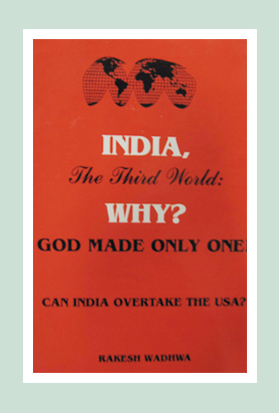
What the readers are saying…