







De-Regulate to Save Lives
It is a principle in economics that if prices of a product are reduced their demand increases. As regulations are ‘free’ and people who advocate or bring in regulations do not bear their costs, it is virtually certain that the demand for government
Smoking, Drinking, Gambling and the Government
There are plenty of people in this world who are involved in smoking, drinking or gambling or maybe all of them together. What chance does the government have of stopping activities which in spite of their harmful effects are being followed by an overwhelming
Education in Indian Government Institutions
Can students taking admission in government institutions receive education free from the influence of political parties? This is very difficult especially in a country like India.
Las Vegas: What Makes it Click With Businessmen?
Las Vegas has very quickly transformed itself from being called the ‘Sin City’ to one of the most sought after destination for family vacations and business conferences. What can stop it? Las Vegas has it all – accommodation with dozens of hotels having 5,000
Control versus Freedom: Comparing India and Hong Kong
Hong Kong spreads over 1,104.4 sq km and is home to 7.097 million people. Its GDP was $224.1 billion in 2010 at a GDP real growth rate of 6.8%.
Hong Kong is one of the leading capitalist economies of the world. It has been ranked as the freest economy for 17 consecutive years in the Wall Street Journal and Heritage Foundation’s Index of Economic Freedom. Hong Kong has proved that resources are used most efficiently if market forces decide its allocation. Hong Kong is one of the richest economies in the world.
Why Inflation is an Agent of Poverty?
India has had high inflation compared to most nations. The inflationary situation has been volatile since the financial year beginning 2010.The inflation in the Indian economy reached as high as 14.86% in April 2010.
What is the Reason for Nepal’s Poverty?
Nepal is among the world’s poorest countries. Poverty in this small nation is not only persistent, but is widespread. According to the 2010 Nepal Living Standards Survey, conducted by the Central Bureau of Statistics and the World Bank, 25.2% of the country’s population lives
Taxation or Robbery? Where to Draw the Line?
Taxation has been defined as “that part of the revenues of a state which is obtained by the compulsory dues and charges upon its subjects” by The Encyclopedia Britannica. In this definition, the word ‘compulsory’ definitely looms
How Much Will You Bet on the Indian Casino Industry?
Indians have been indulging in the casino scene abroad for a while. Macau, Singapore and Las Vegas are some of the favourite casino destinations of Indian gamblers. Moreover, it is estimated that as many as 70% of the visitors in Kathmandu casinos are Indians.
How Laborious are Labour Laws?
Although the Indian economy is thriving, the upsetting part is that the Indian labour is not partaking in the boom. The employment in the country is not expanding as fast as the increasing working-age population. The wages aren’t rising as fast as the per capita
 Rakesh Wadhwa. Ever since, I was a school boy, I knew India was on the wrong path. Socialism was just not what we needed to get ahead. Government controlled our travel; government controlled our ability to buy and sell; and government controlled our freedom to move our money. My life has focused on the inherent rights people have. When I was in college, I never understood, what the governments meant by their "socialistic attitude". If people are free to buy, sell and move their capital themselves without any restrictions by state, then the welfare of people is inevitable & hence the countries they live in will become wealthy.
 The Bastiat Award is a journalism award, given annually by the International Policy Network, London. Bastiat Prize entries are judged on intellectual content, the persuasiveness of the language used and the type of publication in which they appear. Rakesh Wadhwa won the 3rd prize (a cash award of $1,000 and a candlestick), in 2006.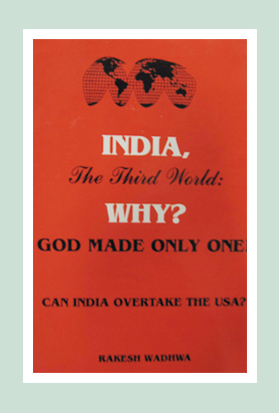
What the readers are saying…