How Far is India from a Free Market?
The year 1947 saw India in new light, and a free India was born. But this new India faced a serious challenge of stabilising its economy. The nation had just taken a beating from the Second World War

What does the Narendra Modi Government mean for the Indian Economy?
“India has won. Good times ahead.”
This is what Narendra Modi tweeted when his party achieved an irrefutable lead in the elections earlier this year. Now that Modi has formed his government at the centre, what does the new government have in store for the third largest economy in Asia?

Reaganomics: The Life and Economics of Ronald Reagan
“The American dream is not that every man must be level with every other man. The American dream is that every man must be free to become whatever God intends he should become.”
~ Ronald Reagan
Friedrich Hayek: Teacher, Philosopher, Author and More
During the Great Depression, John Maynard Keynes and Friedrich Hayek were building their economic models. After fighting out their fundamental differences at various debates, Keynes prevailed.
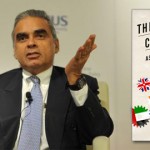
Kishore Mahbubani
From living with his parents and sisters in a one bedroom house to becoming the permanent representative of Singapore in the United Nations, Kishore Mahbubani has definitely come a long way.

What Does 2014 Have in Store for the Indian Economy?
While presenting the interim budget for fiscal 2014-15, Finance Minister P. Chidambaram said in the Lok Sabha, “I wonder how many have noted the fact that India’s economy, in terms of the size of its GDP, is the 11th largest in the world. There are great things in store.”

Dr. BR Ambedkar: A Free Market Economist at Heart
“Ambedkar is my Father in Economics. He is true celebrated champion of the underprivileged. He deserves more than what he has achieved today. However he was highly controversial figure in his home country, though it was not the reality.
Prof. B.R. Shenoy: India’s Free Market Visionary
The birth of a nation represents sheer potential. Potential in terms of an unwritten future, that could go in any direction. The blank pages of history wait to be filled… with overlying goals, structure and the freedom to decide how to achieve the goals. When India became independent, it was faced with three economic models.
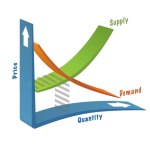
Factors Influencing Market Trends
Economic indicators tell us about the state of a market in the form of statistics. Analyzing economic indicators can help us predict future performance. Some common economic indicators include indices such as GDP, unemployment rate, industrial production, stock market and money supply. When a market follows a trend, this is most likely shown by certain associated economic indicators that shape the market.
 Rakesh Wadhwa. Ever since, I was a school boy, I knew India was on the wrong path. Socialism was just not what we needed to get ahead. Government controlled our travel; government controlled our ability to buy and sell; and government controlled our freedom to move our money. My life has focused on the inherent rights people have. When I was in college, I never understood, what the governments meant by their "socialistic attitude". If people are free to buy, sell and move their capital themselves without any restrictions by state, then the welfare of people is inevitable & hence the countries they live in will become wealthy. The government has no right whatsoever, to point a finger at me or my business. I am not a revolutionary. I just want to light up my cigarette and not get nagged about it. I believe in non-interfering attitude to attain more.
 The Bastiat Award is a journalism award, given annually by the International Policy Network, London. Bastiat Prize entries are judged on intellectual content, the persuasiveness of the language used and the type of publication in which they appear. Rakesh Wadhwa won the 3rd prize (a cash award of $1,000 and a candlestick), in 2006.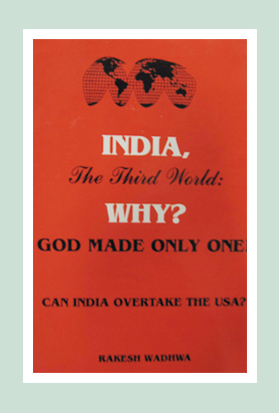
What the readers are saying…