







The Chinese Transformation
China today offers us the amazing scenario of a country marching towards economic freedom while remaining politically unfree. Even as the communist rulers of China liberalize their country for business and welcome foreign capital, they maintain their stranglehold on political power.
The result of the loosening of the State’s grip over the economy has been stunning: since 1980, the Chinese per capital income has more than tripled, over 200 million of its people have moved from poverty into middle class, foreign investment has soared to almost US$50 billion exceeding what is invested in India by foreigners by a factor of 20, and it has become one of the world’s principal exporters with its US$350 billion in export of services and goods – beating India’s export by over four times.
Government in China has been slowly but surely reducing its role in the economy. State owned enterprises which accounted for over 80% of the Chinese industrial output prior to 1980 now account for half that figure. This while exports from privately owned companies have skyrocketed. Shenzen, one of China’s dynamic coastal provinces has seen its exports rise from US$17 million in 1980 to US$6 billion in 1991 and today its exports exceed US$35 billion.
This transformation has occurred even as China remains undemocratic; dissent is virtually nonexistent after the Tiananmen square massacre. What this tells us is that however desirable democracy may be for other reasons, it is not indispensable for a country in achieving prosperity and wealth.
Singapore became wealthy under the iron-fisted rule of Lee Kuan Yew. Singapore did not offer parliamentary, electoral, and press freedom to its people as India did. Singapore, however, unlike India and Nepal, gave its people economic freedom soon after the end of World War II. The result: Singapore today is one of the world’s wealthiest economies: its people earn an annual average income of US$27,000.
China’s transformation too is taking place under the iron-hand of its communist rulers. In the first decade of its economic reforms, though China saw mounting political dissent, it was mercilessly quashed: tanks, troops, and bullets were employed in the 1989 attack by the government on demonstrators at Tiananmen.
Economic reforms however continued. Controls on foreign exchange were loosened in the 1990’s leading to the present boom in investments from the US and the rest of the world. Today the world invests more in China than in the US. Stock markets – the prime symbol of capitalism – were set up in Shanghai and Shenzen in the early 90s.
In 1992, the supreme leader of China, Deng Xiaoping, acting more like the free-market Lee Kuan Yew of Singapore than a Maoist, spoke out in favour of the free market policies being followed by the coastal regions of Guangzhou and Shenzen. What happened? All dissent to open market policies was effectively shut up. Who was going to dare speak up against the supreme leader himself? These coastal regions largely freed from bureaucratic red tape and over-bearing controls grew at a sizzling 15% annual rate.
From then onwards there has been no looking back for China. Chinese people, who were at one time called no-good-opium-eaters by their colonial masters, shook the world with their ability to flood every market with goods. The efficiency of Chinese firms makes its competitors quake with fear.
This is not to say that things can’t go wrong in China. The government still exercises controls over vast areas of its economy and that’s where the danger lies. China’s controls over its currency and its inefficient and outmoded State enterprises can lower its growth. Other than that things are good and getting better.
Lessons for Nepal: all it needs is one strong leader who can give the people economic freedom, nothing else is going to make Nepal rich. Democracy and political freedom, important as they may be, are not going to result in Nepal’s progress. That is what we understand from what has happened in China and Singapore over the last few decades.
The Himalyan Times
>Outrage in Iraq
>
We can only salute their bravery.
They knew it was risky. They knew that they were going to a dangerous place, and that there was always a chance that they might not come back to their loved ones. Still they went. It is the courage of people like these twelve that sustains Nepal in these extraordinarily difficult times.
Let us remember that the economy is surviving because of remittances. The US$ 100 million which the 8,00,000 Nepalese working in 19 countries send to Nepal allows us to buy our necessities – fuel for our vehicles; liquefied cooking gas for our homes; medicines for those who are sick; and cars, buses & trucks to provide us with transportation.
Take away this inflow of money and the economy would be pushed into the stone age. We should take this opportunity to express our gratitude for these heroic men and women who go to foreign lands. In trying to improve their and their families’ lives, they improve the lives of all of us who stay on in Nepal.
The nation rightfully mourns the tragedy at Baghdad. Our hearts and prayers go out to the families who have lost their loved ones. No one can forget the horror evoked by the images on the internet, TV, and newspapers.
Who can but not grieve with Ramesh Khadka’s mother who fainted when she heard of her son’s death in Iraq, or, cry with Prakash Adhikari the father of one of the twelve hostages who collapsed on hearing the news of his son’s murder. However, this grief must translate into something more.
It is indeed time to be with and comfort the families of those who paid the ultimate price. It is time to assure them that their worldly needs will be taken care of by a grateful nation. But more than that it is time to unitedly assure the families in shock that their sacrifice will not be in vain.
How can we do that?
It won’t be by destroying the property of manpower agencies. They merely fulfill the yearning of Nepal’s young striving for a better life for themselves and their families.
It won’t be by burning and destroying property of muslim businessmen in Kathmandu. They are as much a part of Nepal as anyone else is, and, they are as much outraged by the atrocity in Iraq as the most patriotic of us are.
It won’t be by venting anger against foreign companies, of whatever nationality they might be, for most of the world is united in its condemnation of what has happened.
We can honour those who have fallen by forging a new economic agenda for Nepal. This must be an agenda which takes Nepal on the path to prosperity. An agenda which guarantees an opportunity for every Nepali to progress, to earn a decent living, so that when citizens of this great nation go abroad they do so by choice and not because of necessity.
How long can we have the best, the brightest, the most hardworking, the ones with the most initiative, the bravest and the most daring amongst us leave this country and work for the betterment of other nations. Let us give them the opportunity right over here; in Nepal. Our young deserve nothing less.
The path to growth, wealth and prosperity lies in embracing economic freedom. It is only free market policies which can take Nepal away from the brink of being labeled a failed state to a one where every Nepali is proud of his country’s economic might. For this we need to clear the obstacles created by the heavy hand of a visionless bureaucracy.
Let the people be free of extortionate taxation, controls on movement of foreign exchange, tyranny of import licensing and of petty customs officials who block free movement of goods, and corrupt government officials. Then and only then will the young of this land not have to seek opportunity elsewhere. They will find it right over here in their own land.
>Outrage in Iraq
>
We can only salute their bravery.
They knew it was risky. They knew that they were going to a dangerous place, and that there was always a chance that they might not come back to their loved ones. Still they went. It is the courage of people like these twelve that sustains Nepal in these extraordinarily difficult times.
Let us remember that the economy is surviving because of remittances. The US$ 100 million which the 8,00,000 Nepalese working in 19 countries send to Nepal allows us to buy our necessities – fuel for our vehicles; liquefied cooking gas for our homes; medicines for those who are sick; and cars, buses & trucks to provide us with transportation.
Take away this inflow of money and the economy would be pushed into the stone age. We should take this opportunity to express our gratitude for these heroic men and women who go to foreign lands. In trying to improve their and their families’ lives, they improve the lives of all of us who stay on in Nepal.
The nation rightfully mourns the tragedy at Baghdad. Our hearts and prayers go out to the families who have lost their loved ones. No one can forget the horror evoked by the images on the internet, TV, and newspapers.
Who can but not grieve with Ramesh Khadka’s mother who fainted when she heard of her son’s death in Iraq, or, cry with Prakash Adhikari the father of one of the twelve hostages who collapsed on hearing the news of his son’s murder. However, this grief must translate into something more.
It is indeed time to be with and comfort the families of those who paid the ultimate price. It is time to assure them that their worldly needs will be taken care of by a grateful nation. But more than that it is time to unitedly assure the families in shock that their sacrifice will not be in vain.
How can we do that?
It won’t be by destroying the property of manpower agencies. They merely fulfill the yearning of Nepal’s young striving for a better life for themselves and their families.
It won’t be by burning and destroying property of muslim businessmen in Kathmandu. They are as much a part of Nepal as anyone else is, and, they are as much outraged by the atrocity in Iraq as the most patriotic of us are.
It won’t be by venting anger against foreign companies, of whatever nationality they might be, for most of the world is united in its condemnation of what has happened.
We can honour those who have fallen by forging a new economic agenda for Nepal. This must be an agenda which takes Nepal on the path to prosperity. An agenda which guarantees an opportunity for every Nepali to progress, to earn a decent living, so that when citizens of this great nation go abroad they do so by choice and not because of necessity.
How long can we have the best, the brightest, the most hardworking, the ones with the most initiative, the bravest and the most daring amongst us leave this country and work for the betterment of other nations. Let us give them the opportunity right over here; in Nepal. Our young deserve nothing less.
The path to growth, wealth and prosperity lies in embracing economic freedom. It is only free market policies which can take Nepal away from the brink of being labeled a failed state to a one where every Nepali is proud of his country’s economic might. For this we need to clear the obstacles created by the heavy hand of a visionless bureaucracy.
Let the people be free of extortionate taxation, controls on movement of foreign exchange, tyranny of import licensing and of petty customs officials who block free movement of goods, and corrupt government officials. Then and only then will the young of this land not have to seek opportunity elsewhere. They will find it right over here in their own land.
Outrage in Iraq
The twelve Nepalese murdered in Iraq are our modern day heroes. They went to Baghdad to work and send money home to their families. It is this money that keeps the Nepalese economy afloat.
We can only salute their bravery.
They knew it was risky. They knew that they were going to a dangerous place, and that there was always a chance that they might not come back to their loved ones. Still they went. It is the courage of people like these twelve that sustains Nepal in these extraordinarily difficult times.
Let us remember that the economy is surviving because of remittances. The US$ 100 million which the 8,00,000 Nepalese working in 19 countries send to Nepal allows us to buy our necessities – fuel for our vehicles; liquefied cooking gas for our homes; medicines for those who are sick; and cars, buses & trucks to provide us with transportation.
Take away this inflow of money and the economy would be pushed into the stone age. We should take this opportunity to express our gratitude for these heroic men and women who go to foreign lands. In trying to improve their and their families’ lives, they improve the lives of all of us who stay on in Nepal.
The nation rightfully mourns the tragedy at Baghdad. Our hearts and prayers go out to the families who have lost their loved ones. No one can forget the horror evoked by the images on the internet, TV, and newspapers.
Who can but not grieve with Ramesh Khadka’s mother who fainted when she heard of her son’s death in Iraq, or, cry with Prakash Adhikari the father of one of the twelve hostages who collapsed on hearing the news of his son’s murder. However, this grief must translate into something more.
It is indeed time to be with and comfort the families of those who paid the ultimate price. It is time to assure them that their worldly needs will be taken care of by a grateful nation. But more than that it is time to unitedly assure the families in shock that their sacrifice will not be in vain.
How can we do that?
It won’t be by destroying the property of manpower agencies. They merely fulfill the yearning of Nepal’s young striving for a better life for themselves and their families.
It won’t be by burning and destroying property of muslim businessmen in Kathmandu. They are as much a part of Nepal as anyone else is, and, they are as much outraged by the atrocity in Iraq as the most patriotic of us are.
It won’t be by venting anger against foreign companies, of whatever nationality they might be, for most of the world is united in its condemnation of what has happened.
We can honour those who have fallen by forging a new economic agenda for Nepal. This must be an agenda which takes Nepal on the path to prosperity. An agenda which guarantees an opportunity for every Nepali to progress, to earn a decent living, so that when citizens of this great nation go abroad they do so by choice and not because of necessity.
How long can we have the best, the brightest, the most hardworking, the ones with the most initiative, the bravest and the most daring amongst us leave this country and work for the betterment of other nations. Let us give them the opportunity right over here; in Nepal. Our young deserve nothing less.
The path to growth, wealth and prosperity lies in embracing economic freedom. It is only free market policies which can take Nepal away from the brink of being labeled a failed state to a one where every Nepali is proud of his country’s economic might. For this we need to clear the obstacles created by the heavy hand of a visionless bureaucracy.
Let the people be free of extortionate taxation, controls on movement of foreign exchange, tyranny of import licensing and of petty customs officials who block free movement of goods, and corrupt government officials. Then and only then will the young of this land not have to seek opportunity elsewhere. They will find it right over here in their own land.
The Himalyan Times
Coffee, The Grand, and Government
Unbelievable as it may sound, Starbucks, specializing in serving a variety of coffees to its customers, has become a US$ 19 billion chain. Its shares are listed on the Nasdaq stock exchange in the US.
Starbuck’s founder Howard Schultz made a fortune serving coffee. How is it possible? Doesn’t every restaurant, hotel, supermarket chain, store, home, and office in the US serve coffee?
Yes, anyone who has ever been to the US knows that coffee is the national drink of the Americans. Coffee is available in every establishment. The coffee maker is ubiquitous and more a symbol of America than its flag.
The answer just lay under the eyes of everyone in the US, but only one man, Schultz, had the vision to see the possibilities offered by this simple stimulant. He recognized that though everyone drank and served coffee, no one specialized in doing it. He said let me serve the finest and largest variety of coffees to my customers and they will pay me three times more than they pay other coffee vendors. Starbucks did just that and the rest as they say is history.
That is the power of specialization. A legendary Japanese industrialist once said, ‘it doesn’t matter if I just make and sell noodles in a village, I will merely make sure that I sell the very best’. This example may resonate well with us in Nepal where noodle-makers have done such a tremendous job that Nepal with barely 2.5% of India’s population consumes as much as 50% of the noodles consumed in India.
Recently, while in Delhi, I had idlis and dosas, both at ‘The Grand’ hotel and at the lowly ‘Madras Cafe’, a small, largely unknown South Indian restaurant which specializes in these southern dishes. The idlis and dosas at ‘The Grand’ were just what they are in a 5 star establishment: dosas rather tasteless and idlis just a little too hard; ‘Madras Cafe’, served them near perfect.
Was there anything wrong with ‘The Grand’ management? Why can’t they serve idlis and dosas like Madras Cafe, and coffee like Starbucks? They cannot and in their defense I might add that no other 5 star establishment can either. Why not? Because, dosas, coffees and idlis is not the core product which these hotels sell. Their competence lies in providing accommodation, ambience, and style to their customers and that they do.
Starbucks would not survive with bad coffee – that is its core product. Madras Cafe would not survive if it sold the kind of dosas and idlis which are routinely offered at five star hotels.
This shows that irrespective of money and resources, one can’t be best in other than a very few services or products. Therefore, the need for specialization is obvious. And this has profound lesson for how governments; it shows how they ought to be run.
It is impossible for governments too to be all things to all people. Governments must understand that trying to run airlines, airports, hospitals, sugar companies, cement companies, banks, finance companies, newspapers, TV stations, hotels, … and simultaneously trying to mange its core task of providing law and order, a justice system, and a national defense is a sure recipe for disaster.
Accept that it is impossible to do so many things, accept that people and businessmen can handle airlines and the like better, accept that governments responsibility is to fulfil its core functions, and, we will see the birth of a new nation which will prosper in no time at all.
Some people will dispute what I say. To them I say, ‘lets do a poll and find out if people are satisfied with the functioning of the law courts and the police force. If and when 75% of the people say, ‘We are satisfied’, then and only then should the government venture out to do more. Until such time let our government concentrate on what it is supposed to do and leave the rest to us.
The Himalyan Times
My Golden Standard
My friends frequently ask me as to how come I am never at a loss to voice my opinion about government policies. How can I talk of import controls, income tax, rules and regulations, prostitution, drug laws, and the like without specialization in any of these fields.
My secret is that I use what I call my very own gold standard for judging public policy. The question I ask myself is whether the policy in question will promote our freedom or diminish it. If it decreases our freedom to act as we wish when we are not harming others, I will be against it. If the effect of a new policy, law, or rule is to enhance our freedom to act as we please, I will be all for it.
Reduction in taxes enables us to keep more of our money ourselves rather than give it to a corrupt government. This enhances our freedom. We are free to spend it, give it away in charity, or leave it for our heirs. Our money in our hands maximizes our satisfaction. Our money in government hands maximizes the satisfaction of politicians and bureaucrats. That is why I am for a government, which exercises efficiency and economy in its affairs, and minimizes our taxes.
When it comes to property rights, I am all for a government which provides constitutional guarantees against expropriation and confiscation. Without property rights our other freedoms are irrelevant. If your house can be taken away from you, your company can be nationalized, your bank balance can be seized, and you can be subjected to extortionate taxation, then you will not find whatever freedom remains as very meaningful.
Shifting from economic to social policy, I again use the same gold standard. If the activity is voluntary, and harms no one other than those engaging in it, I advocate that it remain legitimate even though I may personally hate it. This is why I feel that the government has no role to play in dictating to people what they drink, eat, or inhale.
I don’t like people – even friends – when they are drunk. They make fools out of themselves. And yet I do not support government restrictions on drinking (driving while drunk is a crime and should remain so for its potential to cause injury to others), for if I do, it is just one step away from advocating controls over the amount of fat we eat and the sugar we ingest. These products too are harmful for they cause heart attacks and diabetes.
Over time I have realized that though economic and social freedoms need no further justification (freedom is its own justification and our birthright), support for freedom is justified on other grounds too. It goes hand in hand with progress and prosperity.
Countries with repressive governments have remained poor. Countries which are free have achieved prosperity. This benefit of freedom should make even those who do not value it for its own sake support it. Reduce taxes, enhance property rights, have a minimalist government which doesn’t restrict voluntary trade and commerce, and Nepal will soon join the league of rich nations.
Sometimes you and I may be tempted to disregard the golden rule and want to give the government the power to do good. We may want the government to tax us and give the money to the poor, we may want the government to restrict obscenity on TV, or we may want that the government ban gambling and prostitution for public good.
At this time let us remember what Jim Babka, President of the American Liberty Foundation, has to say, ‘the power you give your fovourite politician today to do something you like is the power that will be used in ways you never would have imagined or approved of tomorrow by a politician you hate’.
Give the government taxes for helping the poor and the money will end up serving the interests of the politicians and bureaucrats. Let the government restrict obscenity and it will use its power over the media for its own propaganda. Let the government ban gambling and prostitution, and you give a powerful tool to the law enforcement agencies to collect their ‘hafta’ while prostitution and gambling go on regardless.
The Himalyan Times
Tobacco, Alcohol, Gambling and Me
I smoke. I drink. I gamble. And there are plenty of people out there like me. In fact any person who has never smoked, drank or gambled would be rare to find and probably be disappointingly boring too.
What chance do government efforts have of stopping activities which, inspite of their purported harmful effects, are engaged in by an overwhelming majority at same point in their lives? None whatsoever.
I, for one, resent government intrusion into what essentially is my personal matter. Government and society has no role to play in deciding whether I light up a Marlboro, have my daily scotch, or I bet on cricket.
What is the effect of legislation which makes it mandatory for cigarette companies to place statutory health warning on all their packs and advertisements. I, like all other smokers I know, could not care less. The warnings elicit barely a thought.
And it has to be so. Anything which is as ubiquitous as warnings about tobacco gets a big yawn. It is part of the background which you see but hardly notice or pay attention to.
My doctor tells me to quit smoking, and so do my parents, wife and friends as well. I don’t need the government to do the same. This nagging, whether by friends and family or by the government, has no effect on me. At best I ignore the nags, at worst I find it so irritating that, in presence of those who object, I light up even more.
I will give up smoking whenever I’m ready to do so and not a day before. If I get cancer in the meantime so be it, I have the right to live my life as I wish and take as much risk as I desire. Perhaps my family, friends and well-wishers too will be affected by my decisions besides me, but, no one else will be. Therefore government and society doesn’t even come into the picture.
Leave my smoking, drinking and gambling habits for me to sort out with those who are near and dear to me. I value my freedom to be left alone far more then my health. I will therefore ask the do-gooders to desist from using the power of government to control my life, even if they think it will do me good. I am not a child and do not like my actions to be monitored or controlled by a nanny state, when I harm no one except myself.
And even if you wish me well, and are bent upon using government to do me good, good which I do not desire, you will never succeed. If you make alcohol and tobacco too expensive, you will, in fact do me more harm. I will not stop drinking or smoking, I will just move on to cheaper brands. I will smoke beedis if I have to but smoke I will. I will drink even illicit hooch if you make scotch too expensive, but drink I will.
What if you, acting in my interest, but against my wishes, forbid production, distribution and sale of cigarettes and whisky, and, make gambling illegal. You will be making a big mistake for you will achieve nothing. Don’t worry about me, whatever you do, I will get my smoke and my drink from illegal, underground sources if you make it impossible for legitimate businessmen to supply what I need. I will also find someone to accept my bets whatever you do.
Economics and history would both be on my side. Mahatma Gandhi tried to enforce prohibition in India. He failed. India’s efforts to ban gambling have resulted in every street in India having gamblers who will either be placing or accepting bets on cricket matches. Americans experimented with prohibition in the 30’s, the experiment was a miserable failure leading to the rise of gangsters like Al Capone who kept the Americans well supply with their daily drinks. America’s current efforts to control drugs have also failed and have in fact exacerbated the drug problem. The underworld keeps drugs within easy reach of all students in every campus in every US state.
My advice to government, society and do gooders, ‘Leave me alone, for it ain’t anybody’s business if I smoke, drink, or gamble.’
The Himalyan Times
Plan or Prosper
Most people believe that governments must plan. Communist and socialist regimes made planning the centerpiece of their development agenda. India had its five year plans, copied on the basis of central planning by its ally the Soviet Union. Nepal too has its planning commission.
Government it seemed – and still seems to most – is required to plan everything. Government has to plan the savings rate. Government has to plan the growth in population, and family size. Government has to channel investments according to its plan. Government has to plan the food grain output. Government has to plan, plan, and plan – for four decades after independence the government of India planned the production of cement, iron, scooters, cars, fertilizers, electricity, wheat…
Nothing in India could be produced without a license. The government decided that it alone must allocate scarce resources in a planned manner for its people’s benefit.
Government also intervened directly to mandate that no private investment would be permitted in TV, airlines, railways, telephones, power stations … and that government would exclusively run and plan the production of these goods and services.
The private sector and markets were subjugated. Indira Gandhi referred sarcastically to those who advocated free markets as ‘marketwallahs’. In interest of planning India’s progress she nationalized the insurance companies and banks.
How successful were these plans? Indian industry was chained and crippled by its planners. Shortages became endemic. People could – at least some people could – satisfy their urgent requirements by buying in the black market. Smugglers satisfied the requirement of goods demanded from abroad.
Government planned the use of foreign exchange. “Perish the thought of private importing”, the people were told, “we hardly have enough dollars to buy petrol”.
Government of India planned. The economy stagnated. The sub 2% growth rate achieved during that period was dubbed, “the Hindu rate”. There was a problem with Hindus, thought the people of India. Inspite of such extensive government planning, if we still can’t progress, the reason must lie in our nature and our religion that advocates a belief that life is pre-destined and beyond our control.
All this changed in the early 1990’s. Industrial licensing was abolished in one fell swoop by the Narasimha Rao government. What could not be achieved by bureaucrats in over four decades of planning was accomplished by businessmen in a few years when planning became their job.
Shortages of steel, cement, telephones, scooters, and cars vanished. Today, not only do these industries fund their own expansion, they pay huge taxes as well. Foreign exchange reserves have grown from zero to $110 billion and the problem now is how to effectively use all the dollars coming in.
Similar failures of planning became even more apparent in the former Soviet Bloc. Planning by the state doomed the ‘evil’ Russian Empire. It collapsed overnight. The Berlin wall came down and East Germany disappeared in its rubble.
What is required is not planning by the state, but a complete separation between government and the economy. The role of the government must be minimized, that of the market maximized.
It is not the job of bureaucrats to allocate resources, it is for the consumer guided market to do so. Bureaucrats have no incentive to take correct decisions. If they allocate too few resources for the manufacture of cement, so what, they can always shift the blame to greedy hoarders. If government buys wheat at a price leading to overflowing granaries that serve as food stores for rats, so what, the loss gets to be borne by the taxpayers.
If private companies make mistakes – and they often do – it is they who lose out, not the taxpayer. Businessmen, therefore, have all the incentive to rectify mistakes fast or risk bankruptcy. If they produce too little they leave room for a competitor to come in and bridge the gap. If they produce too much, they run into a loss. They will thus continually struggle to get things right. There is no taxpayer and no currency printing presses supporting their mistakes.
Government, if it is serious about economic progress must shut down its planning office, and leave planning and implementation where it belongs – in the hands of businessmen.
The Himalyan Times
Don, you are wrong about taxes
In response to my December 27, 2004 article advocating reduction in taxes, Don Michaels sent a letter, published in THT, making a case for an increase. Let us analyze each of his arguments.
Don’s first contention is that even if taxes are reduced businessmen will not reduce prices. Don is right that when taxes go down, the prices may not immediately go down, but, in general goods are available at a cheaper rate to consumers in a lower taxed nation than in a high one. Isn’t zero or very low taxes the reason that countries like Singapore and Hong Kong boast of the world’s highest per capita trading volumes as well as living standards which are the envy of those of us in the 3rd world?
Further, high prices due to high taxation reduce demand and thus lower economic activity in the country. If Don, you can afford to buy a Toyota RAV 4 for Rs.20 lakhs, you may not, perhaps, be willing to buy it when taxes result in it being priced at Rs.40 lakhs.
Does Don really believe that if duty rates are brought to zero from say 100% prices will stay the same? How can they? Competition amongst sellers ensures that the consumers get their reductions fast.
Second point made by Don is that, “governments use taxes to build infrastructures; without them nations cannot progress”. I do agree with the later part of the sentence. Nepal does need infrastructure, desperately so. However, if anyone thinks that government taxes result automatically in building infrastructure, that person is dreaming.
A committed socialist like Rajiv Gandhi stated that not more than 15% of what government collects is spent on what the collection is for. 85% or more just disappears in funding the government machinery and in corruption. Why not let the private sector do the job? Why not allow foreign and domestic investment to be utilized for building of roads, airports, communication networks, and power plants?
In India when government regarded telephones as infrastructure people had to wait for years to obtain a connection. And if you did manage to get one it was just that one model made by a government factory and had to be black. When a member of India’s Parliament complained about his instrument not working to the Minister, he was told that only the ‘lucky’ few got telephones as India was poor and there were no funds for ‘luxuries’. Now India’s private companies are not only supplying phone connections by the millions each month, but, are also contributing thousands of crores in taxes to the government.
Don your argument regarding infrastructure doesn’t hold water. Tax money is people’s money, if it is not collected by government it would be available for whatever people desire including infrastructure. To allocate resources is the work of capital markets not government bureaucrats and politicians.
Thirdly, Don says, “As for ‘taking’ money from the rich, who is it that creates the wealth of a nation? Is it a CEO in his plush office or the worker on a construction site, factory, mine or farm?” The implication here clearly is that the worker builds wealth, the businessmen contributes nothing.
This contention displays such ignorance of the wealth generating process that all other arguments of Don pale in comparison. How can anyone even think that a worker without capital, or managerial resources, can produce wealth? Far from it.
If workers could produce wealth on their own then Nepal would be as rich as the US. Does Thapa, a porter, in a remote mountain village at Lukla work harder, or, Smith, an elevator operator, in New York’s Waldorf Astoria Hotel? Thapa in Lukla barely survives, Smith in New York with 1% of the effort owns a car, an apartment, and flies for a holiday to Mexico each year. If Thapa in the Himalayas expended the same effort as does Smith, Thapa would surely starve.
Don, productivity and wealth are the result of capital and capital is destroyed by taxes. Businessmen are required, for they bring in this much needed capital; without them, there would be no site on which to construct, no factory, no mine, and no farm except for subsistence hand to mouth agriculture.
The Himalyan Times
 Rakesh Wadhwa. Ever since, I was a school boy, I knew India was on the wrong path. Socialism was just not what we needed to get ahead. Government controlled our travel; government controlled our ability to buy and sell; and government controlled our freedom to move our money. My life has focused on the inherent rights people have. When I was in college, I never understood, what the governments meant by their "socialistic attitude". If people are free to buy, sell and move their capital themselves without any restrictions by state, then the welfare of people is inevitable & hence the countries they live in will become wealthy.
 The Bastiat Award is a journalism award, given annually by the International Policy Network, London. Bastiat Prize entries are judged on intellectual content, the persuasiveness of the language used and the type of publication in which they appear. Rakesh Wadhwa won the 3rd prize (a cash award of $1,000 and a candlestick), in 2006.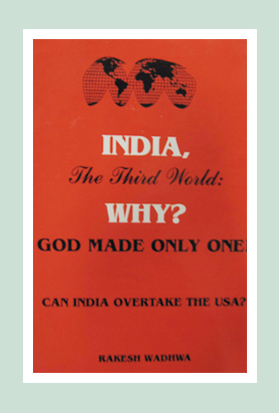
What the readers are saying…